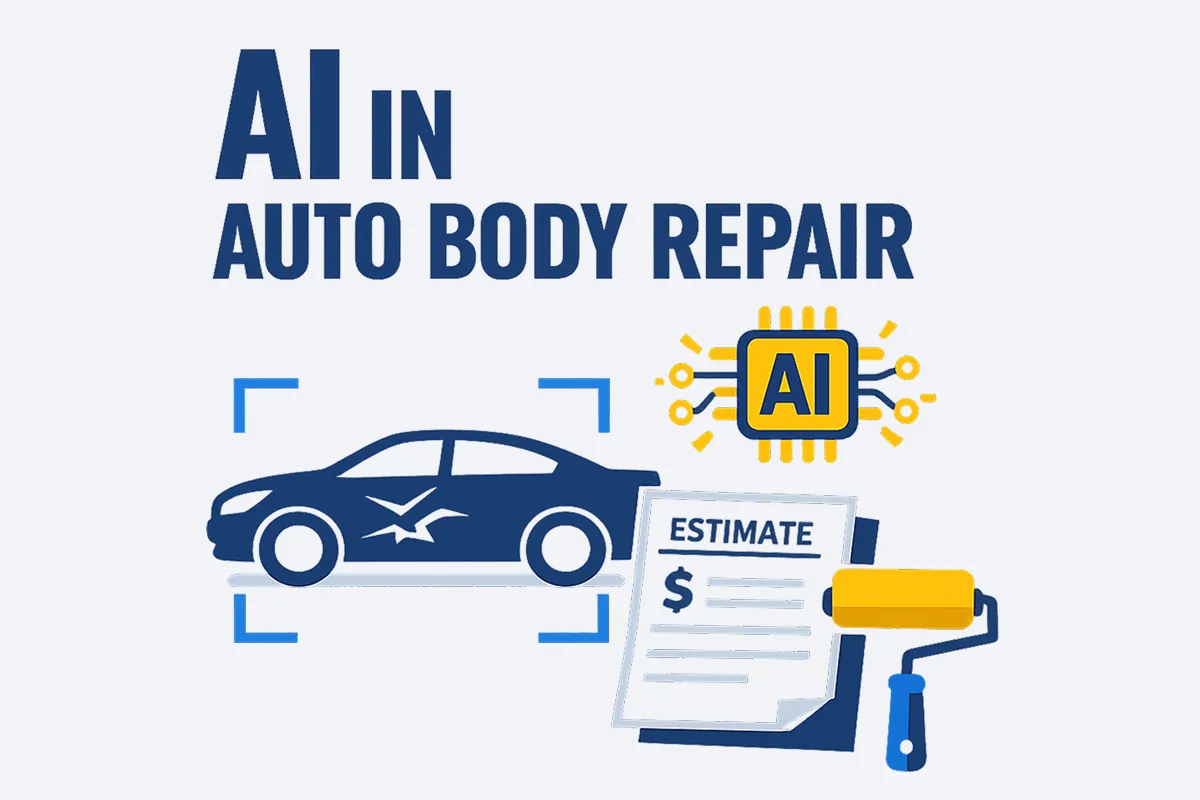

AI isn’t coming to auto body repair. It’s already here. From photo-based damage estimating that generates repair costs in under 90 seconds to financial reconciliation engines that catch missed vendor credits overnight, AI collision repair software is reshaping how body shops operate in 2026.
But here’s what most shop owners miss: the AI tools getting headlines (diagnostic scanners, ADAS calibration systems) are only half the story. The other half happens in your back office, where unchecked invoices, unbilled parts, and missed credits quietly drain your margins.
This guide covers the full landscape of AI applications in auto body shops, from the bay to the books, so you can make smart decisions about which tools actually move the needle for your collision repair business.
How AI Collision Repair Software Works
At its core, AI collision repair software uses three technologies working together:
- Computer vision interprets photos and video of vehicle damage, identifying scratches, dents, structural deformation, and broken components
- Machine learning improves accuracy over time by studying millions of repair images and outcomes; platforms like Tractable have trained on over 500 million damage images
- Predictive analytics estimates repair costs, parts requirements, and cycle times based on historical repair data
These systems don’t replace your estimators or technicians. They accelerate the repetitive work (initial assessments, line-item population, parts lookups) so your people can focus on the judgment calls that require experience.
The collision repair industry has been slower to adopt AI than other sectors, but that gap is closing fast. CCC Intelligent Solutions reported an 11% year-over-year revenue increase driven largely by AI-powered tools, and shops using AI-assisted estimating are seeing measurable reductions in cycle time and supplement rates.
AI-Powered Damage Assessment and Estimating
Photo-based damage assessment is the most visible AI application in collision repair today. Here’s how the leading platforms stack up:
CCC ONE Mobile Jumpstart allows customers and insurance adjusters to submit collision photos through a smartphone app. The AI analyzes the images and generates preliminary estimates that capture roughly 84% of final estimate value, in under 80 seconds. The platform can also predict whether a vehicle should be repaired or declared a total loss with 95-97% certainty.
Mitchell Intelligent Estimating pre-populates approximately 70% of estimate line items automatically, cutting the typical 30-minute estimate creation process significantly. Mitchell’s database includes OEM and aftermarket parts data compiled over nearly 75 years, giving the AI a massive foundation for accurate predictions.
Tractable AI specializes in damage assessment for both insurers and body shops, using computer vision trained on hundreds of millions of images. Their partnership with PartsTrader integrates real-time parts pricing directly into the review process, which is especially useful for subrogation claims where 13-15 parts per estimate need price verification.
For body shop estimating software with artificial intelligence, the key benefit isn’t replacing your estimators; it’s giving them a structured starting point. Instead of building estimates from scratch, they review and refine AI-generated drafts. That means faster throughput, fewer supplements, and more time for complex repairs that need human expertise.
How Does AI-Powered Scanning Benefit Repair Shops?
AI-powered scanning delivers three major advantages that directly impact a body shop’s bottom line:
Speed. Traditional diagnostic troubleshooting can consume 2-3 hours for comprehensive analysis. AI-powered scan tools complete equivalent assessments in minutes by cross-referencing fault codes against millions of known repair patterns, then generating ranked lists of probable causes with verified parts availability.
Accuracy. Visual recognition tools from companies like UVeye and Bosch use AI-powered cameras to perform 360-degree vehicle inspections in under 5 minutes, catching damage that might escape a quick visual check: brake wear, tire issues, body panel deformation, and hidden structural problems.
First-time fix rates. When your technicians start with an AI-generated diagnosis instead of sifting through pages of error codes, they move straight to confirmation and repair. Higher first-time fix rates mean jobs close faster, customers leave satisfied, and your bays turn over more work without adding staff.
For collision shops specifically, AI scanning also helps with ADAS calibration requirements. Modern vehicles have dozens of sensors and cameras that need recalibration after body work. AI tools flag which calibrations are required based on the specific vehicle, damage location, and repairs performed, reducing the risk of missed procedures that can create liability issues.
AI Applications in Auto Body Shops: The Full Picture
AI in auto body shops extends well beyond estimating and scanning. Here’s the complete landscape of how collision repair businesses are using artificial intelligence in 2026:
Damage Assessment and Triage
AI photo analysis sorts incoming vehicles into categories (cosmetic damage, structural damage, or total loss) before they reach an estimator. This pre-triage saves hours per week and prevents repairable cars from sitting behind total losses in your queue.
Parts Sourcing and Inventory
AI algorithms predict which parts you’ll need based on damage type, vehicle model, and repair history. Automated sourcing checks OEM, aftermarket, and recycled parts availability in real time, reducing downtime caused by missing components and helping shops maintain leaner inventory.
Customer Communication
AI-driven chatbots and SMS systems handle repair status updates, appointment scheduling, and common questions around the clock. Platforms like these report 30-40% review conversion rates through automated post-delivery requests, compared to roughly 4% when staff asks verbally. For body shops, where customers are often anxious about repair timelines, automated transparency builds trust and drives retention.
Workflow and Production Scheduling
AI production tools analyze technician skill sets, efficiency patterns, and current workloads to build optimized weekly schedules. When delays hit (a parts backorder, a supplement discovery), the AI reshuffles assignments to minimize downstream impact on cycle time.
Financial Reconciliation and Profit Protection
This is where most body shops have a massive blind spot. Your shop management system handles estimates, scheduling, and customer records. But who’s watching the money trail between your invoices, repair orders, vendor statements, and credits?
That’s the layer where WickedFile operates, and it’s often where the biggest profit leaks hide.
How Do AI Customer Interaction Systems Impact Repair Order Revenue?
AI customer interaction tools affect revenue in three measurable ways:
1. Fewer missed leads. Body shops miss 30-40% of incoming calls during peak hours, and 78% of collision customers work with the first shop that responds. AI receptionists and web chat tools book appointments and answer questions 24/7. Some platforms report appointment increases of 39%.
2. Higher review volume. Shops with 4.5+ stars and 75+ reviews see up to 40% higher new customer acquisition. AI reputation systems automate the entire review lifecycle: request, screen for satisfaction, route unhappy customers to private feedback, and generate professional responses. One collision shop grew from 59 to 720 Google reviews using automation.
3. Customer reactivation. Past collision customers are seven times more likely to return than cold leads, with 10x higher lifetime value when they receive regular follow-up. AI identifies inactive customers at 6-, 12-, and 18-month intervals and triggers personalized outreach referencing their prior repairs, for services like detailing, paint protection, ceramic coating, or ADAS recalibration.
The compound effect: more leads captured, better online reputation, and higher lifetime revenue per customer, all without adding front-office staff.
Are There AI-Driven Solutions That Help Auto Body Shops Catch Missed Revenue?
Yes, and this is the category most collision shops don’t know exists yet.
Every body shop loses money to invisible financial leaks. Not the obvious kind like physical theft, but the operational kind:
- A part gets ordered for a repair but never makes it onto the RO
- A vendor credit for a returned core sits unprocessed for weeks
- A duplicate invoice gets paid because statements don’t reconcile against repair orders
- An overcharge from a parts supplier goes unnoticed in a stack of monthly invoices
With industry margins averaging around 6.3%, these “small” leaks have an outsized impact on profitability. A shop doing $2M in annual revenue can easily lose $50,000-$100,000 per year to unreconciled invoices, missed credits, and billing gaps.
WickedFile is purpose-built to close these gaps. The platform sits between your existing systems, connecting your shop management system, vendor invoices, bank feeds, and QuickBooks, and uses AI-powered OCR and continuous reconciliation to cross-reference every transaction automatically.
WickedFile integrates with the shop management systems body shops actually use: Tekmetric, Shop-Ware, Mitchell 1, NAPA TRACS, Protractor, Fullbay, and RO Writer, plus QuickBooks and bank/credit card feeds.
When a part shows up on a vendor invoice but doesn’t match an RO, WickedFile flags it. When a credit isn’t applied, you know immediately, not at the end of the month during the frantic reconciliation sprint. When a duplicate charge slips through, the system catches it before it hits your bank account.
Think of it as AI working behind the scenes to protect every dollar that flows through your body shop’s back office.
AI for Multi-Location Collision Repair Operations
If you’re running multiple body shop locations, every AI application described above becomes exponentially more valuable, and more necessary.
More locations means more vendors, more invoices, more repair orders, and more opportunities for inconsistencies. Manual AP processes that barely work at one shop collapse completely at three or four. And the typical solution, hiring more back-office staff, just masks a broken process while increasing overhead.
AI-powered platforms give multi-shop operators what they actually need: centralized visibility without centralized headcount.
With WickedFile, for example, owners can monitor financial reconciliation across every location from a single dashboard. If one shop consistently shows unaccounted parts or a vendor at a specific location is slow to issue credits, the data surfaces it before it becomes a recurring pattern.
This is the difference between scaling by adding people and scaling by adding intelligence. The shops growing to 5, 10, 20 locations in 2026 aren’t doing it with bigger back-office teams. They’re doing it with AI that handles the volume their manual processes can’t.
For a deeper look at how this scales, see WickedFile: The Future of Auto Repair Shop Software in 2026.
A Practical AI Adoption Roadmap for Body Shops
You don’t need to overhaul everything at once. Here’s a disciplined order of adoption that starts where AI touches revenue and works outward:
Phase 1: Capture every lead. Deploy an AI receptionist or web chat tool to eliminate missed calls and after-hours inquiries. This is the fastest revenue impact with the lowest implementation effort.
Phase 2: Protect your profits. Implement AI-powered financial reconciliation (like WickedFile) to close the gap between what you’re owed and what you’re collecting. Most shops recover the cost of the tool within the first month through caught discrepancies.
Phase 3: Accelerate estimating. Adopt AI-assisted photo estimating where your insurer relationships support it. Start with CCC ONE, Mitchell, or Tractable depending on your current DRP partnerships.
Phase 4: Systematize reputation. Set up automated review requests and response management. Consistent review generation compounds over time, so start early.
Phase 5: Optimize production. Once your lead capture, financials, and estimating are solid, layer in AI scheduling and workflow tools to reduce cycle time and improve technician utilization.
Each phase builds on the previous one. Capturing leads doesn’t help if profit leaks eat the revenue. Faster estimates don’t matter if your back office can’t reconcile the invoices they generate.
The Future of AI in Collision Repair
The AI tools available today are just the beginning. Here’s what’s emerging:
Augmented reality repair guidance. AR systems that overlay step-by-step repair instructions directly onto damaged areas, helping technicians follow OEM procedures precisely, especially critical for ADAS-equipped vehicles where repair accuracy affects sensor calibration.
Vehicle telematics integration. AI that receives real-time crash data from the vehicle itself (impact severity, airbag deployment, damage vectors) so shops can prepare repair plans before the car even arrives on the lot.
Automated repair bays. Robotics paired with AI for routine bodywork tasks like panel alignment, sanding, and primer application. Still early-stage, but moving fast in high-volume fleet operations.
End-to-end AP automation. Platforms like WickedFile are building toward complete accounts payable workflows, from invoice receipt through reconciliation to direct vendor payment, eliminating the entire manual AP process for auto body shops.
As collision vehicles become more complex (more sensors, more electronics, higher-value components), the documentation and financial accuracy around each repair will only grow more critical. Shops that build AI into their operations now will be positioned to handle that complexity. Shops that wait will find the gap harder to close.
For more on keeping up with diagnostics, OEM updates, and scan tools in this rapidly evolving landscape, we’ve covered the technical side in a separate deep dive.
Take Control of Your Body Shop’s Back Office
AI is changing everything about collision repair, from how damage gets assessed to how invoices get reconciled. But while most shops focus on the tools in the bay, the smarter ones are protecting what happens behind the counter.
The shops winning in 2026 aren’t just fixing cars faster. They’re catching every missed credit, reconciling every vendor statement, and making sure every dollar flows where it should.
WickedFile gives you that financial clarity. See how AI-powered AP reconciliation catches the profit leaks your current process misses, without replacing your shop management system or disrupting your workflow.
Book a demo and see WickedFile in action, or explore the best accounting and bookkeeping software for auto repair shops to understand where WickedFile fits in your tech stack.