
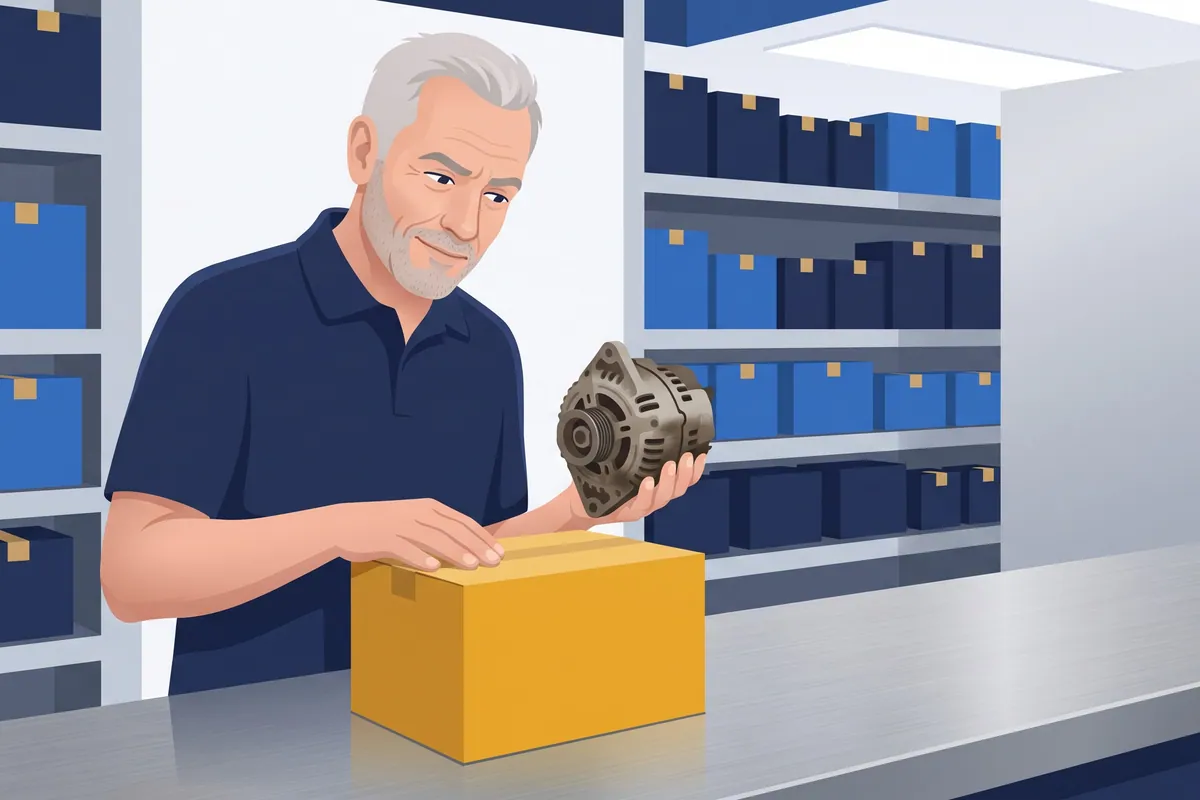

A car parts return policy is the fine print on the back of a receipt. In most shops, that’s also where somebody wrote the next customer’s phone number. (Guilty. I’ve written more VINs on return policies than I have ever read.)
So I read them for you. Here’s the short answer for the big four counters: O’Reilly lists 90 days, Advance lists 45, AutoZone lists 90, and NAPA depends on the store, because most NAPA Auto Parts stores are independently owned. The online sellers (Parts Geek, CarParts.com, and RockAuto) run 30 days, with RMAs, return shipping, and in one case a 20% restocking fee.
Here’s the catch. That’s the retail policy. It’s written for the guy buying wiper blades on a Saturday.
If you run a shop, most of your parts arrive on a commercial account. A driver drops them off, the vendor bills them on a statement, and the return runs on a different set of terms. None of the chains publish those.
This post is for the owner or parts person who sends parts back every week. It covers the published policies store by store, the six things to get in writing from your commercial rep, what uncredited returns cost, and the workflow that makes sure a return actually turns into money.
Full disclosure: I run WickedFile, which flags parts that were returned but never credited, uncredited cores, and credits missing from the vendor statement. Everything below works with a pen and a folder. The comparison comes first.
Car parts return policy comparison: four counters, three websites
Policies checked November 2026. They change, so confirm at the counter.
A quick word on sources, because this is the part most return-policy pages skip. The official pages for NAPAonline, CarParts.com, and RockAuto loaded for us, and the table reflects what they say. O’Reilly, AutoZone, and Parts Geek block automated readers, and Advance’s site was down for maintenance every time we tried it. For those four, the details come from the text of their own policy pages as indexed by search, not from a coupon blog.
Where we couldn’t confirm something, the table says “check with the store.” Guessing about somebody else’s policy is how you end up arguing with a counter guy who has the real one printed out.
| Seller | Return window | Receipt / proof | Condition | Exclusions we confirmed | Restocking fee | Cores |
|---|---|---|---|---|---|---|
| O’Reilly Auto Parts | 90 days from the purchase date on the receipt | Original receipt required; also required for warranty | Original packaging with everything that came in it | Clearance, custom-made, or modified parts | Not stated. Check with the store | Online orders: core refund 3-5 business days after the core arrives. In store: check with the store |
| Advance Auto Parts | 45 days to return as new | No receipt: merchandise gift card at the lowest price in the last 45 days | New, unused, original packaging | Electrical and special-order: check with the store | Not stated. Check with the store | Check with the store |
| AutoZone | 90 days | Receipt; customer support may be able to look up a lost one | Original condition and packaging; used or installed parts may be refused | Customized items are final sale | Not stated. Check with the store | Drained, with receipt. A core that fails inspection isn’t reimbursed |
| NAPA (NAPAonline orders) | 30 days from receiving the order | Receipt or order confirmation for in-store returns | New, original packaging and condition; damaged or defective items accepted | Clearance and final-sale items | Not addressed | 30 days with a receipt showing the core charge (45 for lead-acid battery cores in California) |
| NAPA (bought at a store) | Set by the store | Check with the store | Check with the store | Check with the store | Check with the store | Check with the store |
| Parts Geek | 30 days (its pages differ on purchase date vs delivery date) | RMA number required. No RMA, no return | Unused, original packaging; installed or altered parts not eligible | Installed or altered parts | 20% on “no longer needed,” “bought by mistake,” “found better price,” refused shipments, no RMA, missing tracking, or damaged packaging | Check with Parts Geek |
| CarParts.com | 30 days (60 for CarParts+ Gold members) | Start through its online return form | Every item and component from the original package | Opened or unsealed electric parts, special-order or custom-made, painted, modified, consumables, semi-universal catalytic converters | Not mentioned on the policy page | 30 days from receiving the replacement, with the original receipt, in the replacement’s box |
| RockAuto | 30 days, refund of the part price | Arranged through its Order Status & Returns page | Complete, in original unmarked manufacturer’s packaging; no installed or modified parts | Opened liquids, gift certificates | Not mentioned on the help page | Six months from purchase, in the new part’s box. No credit if it’s smashed or rusted solid |
Store by store: what the fine print actually says
The table is the summary. Here’s the detail that matters to a shop, plus a link to each seller’s own page so you can check it yourself.
O’Reilly Auto Parts return policy
O’Reilly’s policy text allows a refund within 90 days of the purchase date printed on the receipt. The original receipt has to be presented. Clearance items and custom-made or modified parts aren’t eligible. For online orders, refunds go back to the card or account you paid with, not store credit, and a core refund lands 3-5 business days after O’Reilly receives the core.
The line a shop should underline: warranty service requires the original sales receipt. In a shop, the “receipt” is the invoice sitting in your AP pile. If your invoices live in a shoebox, so do your warranty claims.
Plenty of sites claim O’Reilly runs a shorter window on electrical parts or special orders. We couldn’t find that on O’Reilly’s own page, and the sites making the claim don’t agree with each other. Ask the store. O’Reilly’s returns page is the authority.
Advance Auto Parts return policy
Advance’s returns page allows 45 days to return a product as new, unused and in its original packaging. That’s half the window O’Reilly and AutoZone list, which is a bold choice for a company called Advance.
No proof of purchase gets you a merchandise gift card at the item’s lowest selling price in the last 45 days. Not cash. For a shop, that’s a gift card sitting in somebody’s desk drawer instead of a credit on your account.
Two more details from Advance’s warranty page:
- The standard parts warranty runs 90 days from purchase, or longer if a longer period is printed on the original receipt.
- Parts installed on commercial-use vehicles get 90 days from purchase, regardless of what the receipt says. If you do fleet work, that one matters. The lifetime warranty on the receipt may not apply to the delivery van you put it on.
One conflict we couldn’t resolve: Advance’s warranty page said defective-part refunds need the part and the original receipt within 45 days, while some of its help-desk articles said 90. Ask your store which one they follow. (If you searched “advance auto return policy,” this is the same policy. Same company, shorter name.) The authority is Advance’s returns page.
AutoZone return policy
AutoZone’s terms allow returns within 90 days with the receipt, in original condition and packaging. Refunds may be denied if the part has been used or installed, customized items are final sale, and AutoZone reserves the right to limit returns even with a receipt.
Lost the receipt? AutoZone’s terms point you to customer support, which may be able to pull up the transaction.
Cores have their own rules. They have to be drained and returned with the receipt, and a core that fails inspection isn’t reimbursed. It comes back to you instead, which is a heavy way to say no. The search-indexed copy of the terms we saw was dated mid-2025, so check the live AutoZone terms and conditions before you rely on it.
NAPA return policy
NAPA has two answers, and it’s worth knowing which one you’re dealing with.
NAPAonline orders follow a published policy. You get 30 days from receiving the items. New items need to be in original packaging and condition, and items that arrived damaged or defective are returnable too. In-store returns need a valid receipt or order confirmation. Ship-to-home orders go back free by UPS once you get a Return Goods Authorization number, and the refund comes within 15 business days of NAPA receiving the return. Batteries have to go back to a participating store, and clearance or final-sale items can’t be returned. That’s all on NAPA’s returns page.
NAPA cores get 30 days from buying the replacement, with a receipt that shows the core charge. Lead-acid battery cores in California get 45.
Parts bought at a NAPA Auto Parts store are a different conversation. NAPA’s own FAQ says most of its stores are independently owned and operated. We couldn’t find a published in-store policy, so the honest answer to “does NAPA take returns without a receipt” is: ask your store. If you’re a shop, your NAPA store probably knows your techs by first name. That’s the conversation to have.
Parts Geek, CarParts.com, and RockAuto
Online sellers have the same 30-day window but a sneakier cost: you usually pay to ship it back. If a return label on a $60 sensor costs $14 (illustrative), you got back 77% of what you paid. Nobody calls that a restocking fee. It works exactly like one.
- Parts Geek requires an RMA number before anything goes back, and returns without one aren’t accepted. Its 20% restocking fee covers the reasons shops actually return things: no longer needed, bought by mistake, found a better price. Unused and original packaging only. See Parts Geek’s return policy.
- CarParts.com gives 30 days, or 60 for CarParts+ Gold members. It won’t take opened or unsealed electric parts, which is awkward, since opening the box is often how you find out the sensor is wrong. Return shipping is only reimbursed if CarParts.com made a shipping error or the part was defective, and its policy disclaims any labor reimbursement. See CarParts.com’s return policy.
- RockAuto refunds the part price within 30 days, as long as the part is complete and in its original unmarked packaging. Shipping isn’t refunded unless RockAuto made the mistake. The standout is cores: six months from purchase, the longest core window on this list. See RockAuto’s help page on existing orders.
Your commercial account has its own car parts return policy
Everything above is the retail policy. It’s what a walk-in customer gets.
A shop buying on account lives under a different document: the account agreement. Return windows, restocking fees, and how credits post are set there, and they can vary by account, by region, and by how much you buy. None of the four chains publish them. I’m not going to guess at them either.
What I can tell you is what to ask. Get your rep to put these six things in writing, in an email you can find again:
- The return window for stock parts vs special-order parts. And whether special-order parts are returnable at all.
- The restocking fee. When it applies, how much it is, and whether it’s waived when they delivered the wrong part or their catalog was wrong.
- How and when credit memos post. Does the driver’s pickup slip turn into a credit memo the same day? Who sends it, and where?
- Core credit timing. How long after pickup the core credit shows up, and what happens to a core they reject.
- Defective vs warranty returns. Is a part that fails out of the box a return (credit) or a warranty claim (replacement part)? Does anyone ever cover labor?
- Credit on the statement vs refund. Does the credit apply against your open balance automatically, or sit as an unapplied credit you have to ask about? Does it expire?
Why in writing? Because a handshake with a rep who changes territories next spring isn’t a policy.
If you run more than one location, ask for the same answers on every location’s account. Each store can have its own account number, its own rep, and its own understanding of the rules. Our vendor management guide has a scorecard for holding parts vendors to what they agreed to.
What uncredited returns cost a shop
The 2026 Ratchet+Wrench Industry Survey found 47% of shops use five or more regular parts vendors each month. Five vendors means five return policies, five ways credits post, and five statements to check.
Here’s an illustrative single-location shop:
- 8 returns a week × 52 weeks = 416 returns a year
- Average part cost: $85, so about $35,360 of parts sent back
- 5% never credited, or credited short (illustrative)
- 416 × $85 × 5% = $1,768 a year
Now the core version:
- 25 core-charged parts a month × $60 average core = $1,500 a month, or $18,000 a year in deposits
- 10% never credited (illustrative): rejected, lost, or credited to the wrong account
- $1,800 a year
That’s $3,568 a year for one shop. Across a four-location group, it’s $14,272.
To put it in sales terms: accounting firm Paar Melis’s 2025 benchmark report puts average parts gross profit at about 46.1%. Replacing just the $1,768 of lost return credits takes roughly $3,835 in extra parts sales. That’s real selling, all to earn back money for parts you already handed to the driver.
None of this shows up as an expense line. The return slip sits in a folder, the credit never arrives, and the statement gets paid in full. Cores have their own set of failure points if you want the deeper version.
A return slip is a receipt for a box, not for money
Here’s where shops get comfortable too early. The part went back on the truck. The driver signed the slip. Everyone moves on.
That slip proves the box left your building. It doesn’t prove anyone gave you money for it. To borrow from Seinfeld’s rental car counter: the parts house knows how to take the return. Holding the credit is a separate department.
Here’s the shop-side workflow. The long version, with the “pending credit” folder, is in our return-and-forget loophole playbook. The short version:
- Tag and hold. The moment a part becomes a return, tag it with the RO number, the original invoice number, the vendor, the reason, and the date. It goes on one shelf, sorted by vendor. Not on the bench, and not in the nearest empty box from a different vendor.
- Get the slip or RMA, and file it as open. It goes into a pending-credit folder by vendor. It does not go in the “done” pile.
- Match the credit memo to the original invoice. Same part number, same amount, core and part credited separately. A credit that’s $15 short looks exactly like a credit that’s right unless you compare it. Our credit memo guide covers what to check on each one.
- Check it on the statement before you pay. Every open slip should have a matching credit on the statement. If it doesn’t, call before you cut the check, not after.
- Age the open returns every week. Anything with no credit after two weeks gets a phone call. Anything older than the vendor’s window gets escalated.
Somebody has to own steps 1 through 5, and “everybody” isn’t a name. Our post on the parts manager role covers who should own returns and what that job looks like. If you want to test whether past return credits ever arrived, the accounts payable audit walks through pulling the slips and matching them against twelve months of statements.
Where WickedFile fits, and where it doesn’t
The workflow above works. It also depends on someone matching every slip to every credit memo, across every vendor and every location, every month. That’s the job that slides first when the shop gets busy, and it’s the gap WickedFile was built for.
Here’s what it actually does on returns:
- Reads the documents. Parts invoices, credit memos, and vendor statements, scanned or uploaded, plus repair orders from your shop management system.
- Keeps returns open until the money shows up. A part marked returned and awaiting credit stays flagged until a matching credit memo arrives. Same for core charges with no core credit.
- Checks the statement. Credits missing from the statement, and statement lines with no supporting document, get flagged before you pay.
- Connects the money side. It links to QuickBooks Online and to bank and card feeds through Plaid, so counter purchases on the shop card get checked too.
The best use of the free trial (500 scanned pages, no credit card) here: take the last three statements from the vendor you return the most to, plus every invoice and credit memo behind them, and upload them. If returns went back without credits, you’ll see them on your own paperwork.
What it doesn’t do, honestly:
- It isn’t primarily a return-tracking system. It doesn’t replace the tag, the shelf, or the person who boxes the part. It checks whether the credit came back.
- It doesn’t process the return or talk to the store. It won’t request an RMA, call your rep, or argue a rejected core. Somebody in your shop still does that.
- It isn’t a payment processor. It tells you what to question before the payment run. You still pay vendors the way you do now.
- It isn’t QuickBooks, and it isn’t your shop management system. Your bookkeeper keeps the books and your advisors keep ordering parts where they do now.
After the trial, the Grow plan is $299 a month, flat. If you run one location, buy from two vendors, and your pending-credit folder comes back empty every month, you probably don’t need it. A folder and a Friday habit will do the job.
Book a demo or start the free trial →
The short version
The published car parts return policy at O’Reilly and AutoZone is 90 days with a receipt. Advance is 45 days. NAPA online is 30 days, and NAPA stores set their own. Parts Geek, CarParts.com, and RockAuto run 30 days, with RMAs, return shipping, and some hard exclusions on electrical parts. RockAuto gives cores six months.
Your commercial account runs on its own terms, so get the six answers in writing. Then treat every return slip as an open item until the credit shows up on the statement.
My daughter is seven months old and returns every bottle she didn’t ask for in about two seconds. No receipt, no RMA, no restocking fee, full credit every time. Your parts house doesn’t have to match that. But it should get a lot closer than it does.