
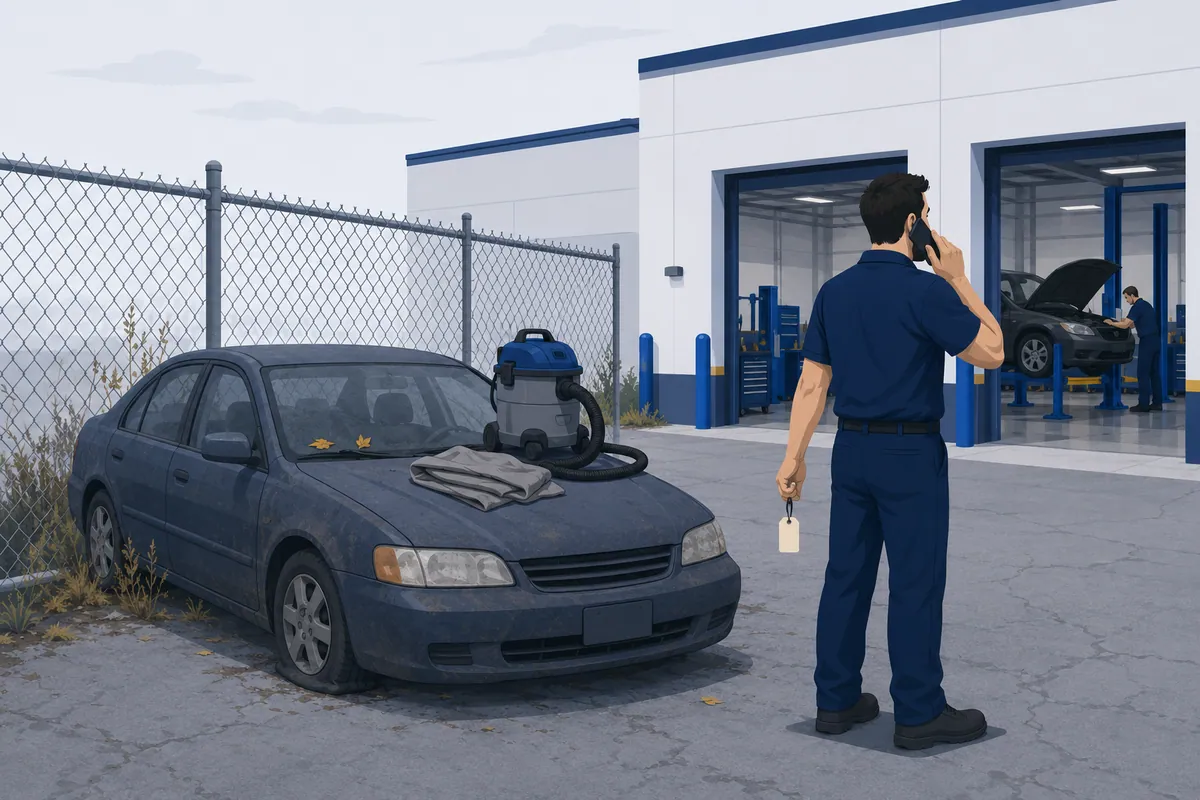

You call. It rings six times and goes to voicemail. The voicemail is full. So you pull the intake form, find the emergency contact line, and the emergency contact is the customer’s own cell number. Congratulations. You now own a car.
A mechanic lien on a car is the legal tool for that exact moment, and this post is written for the owner or multi-shop operator holding the keys, not for the person who left them. One thing first, and I mean it: this is operator experience, not legal advice. Lien procedure is state law, the deadlines are unforgiving, and every answer below ends at your state agency and a local attorney, not at my desk.
Here is the sentence that changes what you do today. Your lien lives in your possession. Hand the car over on a promise and you did not keep a lien. You traded it for a receivable.
What a Mechanic Lien on a Car Actually Is
Cornell’s Legal Information Institute defines a mechanic’s lien as “a security interest that may be acquired in property by someone who spends material or labor working on that property,” and it uses your business as the example: “an automobile mechanic may be able to hold a car until its owner pays for repairs.”
You will see the same idea under four different names, which is half the confusion. Cornell lists artisan’s lien, supplier’s lien, and garageman’s lien among the alternates, and its separate entry for a garageman’s lien calls it “a type of lien that gives a security interest in an automobile to someone who performs work on it. Essentially, a mechanic’s lien by another name.”
So a mechanics lien on a vehicle, a garageman’s lien, and a possessory lien on a car are the same animal wearing different collars. Use whichever term your state statute uses, because that is the one the clerk will recognize.
The Construction Lien Trap, and Why Your Search Results Are Wrong
This is the most useful paragraph in the post, so I am putting it early.
When you search “mechanics lien,” most of what comes back is about construction. Preliminary notices. Ninety-day windows. Notices of commencement. Filing with the county recorder against real property. Those pages are professionally written, they rank well, and they are describing a completely different body of law.
Construction liens attach to land and buildings. Your lien attaches to a car sitting in your third bay. The statutes are different, the filing offices are different, and the deadlines are different. Do not follow a construction lien deadline on a vehicle. Read a comfortable 90-day window on a contractor’s site, plan around it in a state where the vehicle clock runs 30, and the clock is already out by the time you start.
If the page you are reading mentions a general contractor, close it. You want your state’s vehicle code or titling agency, not a construction resource.
Possession Is the Whole Ballgame
Here is the part that outranks the bank, and almost nobody in the trade knows it.
Article 9 of the Uniform Commercial Code defines a possessory lien as an interest that secures payment for “services or materials furnished with respect to goods by a person in the ordinary course of business,” created by statute or rule of law, and “whose effectiveness depends on the person’s possession of the goods.” Then UCC 9-333 delivers the punchline: “A possessory lien on goods has priority over a security interest in the goods unless the lien is created by a statute that expressly provides otherwise.”
Read that twice. While the car is on your lot, your claim can outrank the lender’s.
Now read the other half. Its effectiveness depends on your possession of the goods. Not on your invoice. Not on your intentions. Not on the very sincere text message the customer sent at 4:52 on a Friday.
Which makes “let them take it and we’ll bill them” the most expensive decision in this entire article. Nine times out of ten it is made by a service advisor at 5:15 who just wants the lobby empty and genuinely believes the guy will Venmo it over the weekend. Nobody is being dishonest. Somebody is being optimistic, and optimism is not a lien.
If your advisors do not know that releasing a car releases the claim, that is a training conversation, not a character flaw. Getting authorization and payment terms handled at the counter is an advisor skill like any other.
One sentence on the other risk, because it deserves exactly one: a customer’s car parked on your property for 90 days is a garagekeepers exposure the whole time it sits there, and what your garage policy actually covers is worth knowing before you find out.
How to Put a Mechanic Lien on a Car: The Shape Is the Same Everywhere. The Deadlines Are Not.
I am not publishing a 50-state table. Anybody who does either verified 50 statutes or copied a table from someone who did not, and if you rely on the wrong row you lose the lien. What I can give you honestly is the shape, and then four real states to prove how much the shape moves.
The shape, in seven steps:
- Confirm you have a signed authorization and a real invoice. No signature, no charges you can defend, no lien worth pursuing. What belongs on the paper is its own subject, and the invoice and authorization trail covers it properly.
- Fix the amount owed and stop it growing quietly. Every day you add unposted storage is a day your number becomes harder to defend.
- Find out who else has an interest in the car. Run the title through your state titling agency (DMV, MVA, BMV, or Department of Revenue, depending on where you are). There is frequently a lender you have never heard of.
- Send written notice to the registered owner, the legal owner, and every recorded lienholder. In writing. With proof of mailing.
- Wait out your state’s clock. Not a clock you read on a blog.
- Apply to your state titling agency for authority to sell, or file a court action if your state requires that route instead.
- Conduct the sale exactly the way your state prescribes, account for the proceeds, and keep every scrap of paper.
Every one of those seven steps has a state-specific number, form, and fee attached to it, and I am not going to invent one for you. Below are four states I read myself. Treat them as illustrations of variance, not as a template.
California: your lien has a 30-day fuse
California Civil Code 3068 is the single most useful statute to read even if you do not operate there, because it shows you what a real deadline looks like.
The lien covers repairs, labor, supplies and materials, and also “the storage, repair, or safekeeping of” a registered vehicle. It “shall be deemed to arise at the time a written statement of charges for completed work or services is presented to the registered owner or 15 days after the work or services are completed, whichever occurs first.”
Then the trapdoor. That lien “shall be extinguished and no lien sale shall be conducted” unless the lienholder applies for authorization to conduct a lien sale within 30 days after the lien arose, or an action in court is filed within that same 30 days.
Thirty days. Which, if you are counting, is roughly the interval between “he’ll come get it” and “has anybody heard from that guy?”
The same section will also extinguish your lien for behaving badly during the process. Refuse the legal owner or lessor a vehicle inspection inside the window the statute sets after a written demand, or fail to hand over a copy of the work order within 10 days of a written demand for it, and the lien goes away. Your paperwork is not a formality here. It is the lien.
Virginia: a $4,200 engine job can be a $1,000 lien
Virginia Code 46.2-644.02, titled “Lien of mechanic for repairs,” gives a mechanic a lien for just and reasonable charges and says the mechanic “may retain possession of such property until such charges are paid.”
Then it adds three things California does not.
First, an affirmative homework assignment: the mechanic must check with the Department “within seven business days after the due date of an invoice” to find out whether the title shows an existing lien. Not eventually. Seven business days.
Second, the number that ought to change how you take deposits in Virginia: “No lien under this section shall exceed $1,000 for any vehicle for which the title shows an existing lien.” You may claim what is left of the proceeds after the prior liens are satisfied, which on a financed car with negative equity is frequently nothing at all.
Third, an exit for the customer: the statute lets an owner go to court, post a bond covering the claimed amount plus costs, and drive off pending judgment.
So in Virginia, a $4,200 engine replacement on a financed truck may be a $1,000 lien with a hopeful footnote. Enforcement runs after the invoice goes unpaid for 10 days past due. Read the section yourself before you count on the outcome.
Florida: you are not even allowed to mail your own notices
This one surprises people. FLHSMV states that it “requires that repair shops and tow companies use approved third-party service vendors to send notice of lien and notice of sale documents to owners, insurance companies and lienholders, in accordance with 713.78 and 713.785, Florida Statutes.”
The state names the approved vendors on that page: Auto Data Direct and Beacon Software. So in Florida, a perfectly drafted certified letter, mailed by you, from your counter, is not the procedure. That is not a technicality you can talk your way out of after the fact.
Maryland: the state’s own page will not tell you the deadline
The Maryland MVA publishes a mechanic’s lien page for businesses: “If you repaired, rebuilt, towed, or stored a vehicle and were not paid, you may file a Mechanic’s Lien under Maryland law.”
It tells you what the written notice needs (your business name and contact information, the vehicle’s year, make, model and VIN, the total amount owed, the reason for the charges) and what to submit (a completed application, proof that proper notice was sent, an itemized invoice or billing record, vehicle information, and the required filing fee).
What it does not tell you is when. On timing it says only that notice must be sent “within the timeframe required by law,” and points you at the Transportation Article to go find it.
I am leaving that blank, on purpose. When a state’s own business-facing page declines to print the day count, that is your signal to call the agency and talk to an attorney licensed there, not to accept a number from a website. Including this one.
Storage Fees, and the Cost Nobody Counts
Every shop has the car. Out back by the fence, or third bay from the door, sitting long enough that the tires have gone flat and somebody has started using the hood as a shelf for the shop vac. Nobody remembers the customer’s name. Everybody remembers the car.
Here is the arithmetic on it, and it is illustrative, but it is the arithmetic I see over and over.
A $1,400 repair. Ninety days on the lot. Storage at $25 a day is $2,250, which is now larger than the repair. Total claim: $3,650, on a car worth about $3,000. Sale costs come out of the proceeds before you see a dollar. You have spent three months building a lien sale that nets less than the original invoice.
And that is the version where everything works.
Now the number nobody puts on the whiteboard: the real cost is the bay, not the invoice.
According to accounting firm Paar Melis’s 2025 benchmark report, built from client shops’ actual 2024 financials, the average repair order runs about $702 at an overall gross margin of 52.3%. Say that bay could have turned 20 repair orders across those 90 days. Deliberately conservative, and still: 20 ROs at $702 is $14,040 of sales, and at 52.3% that is roughly $7,340 of gross profit you did not make.
The abandoned car is not a $1,400 problem. It is a $7,340 problem wearing a $1,400 costume.
That works out to about $80 a day of gross profit that bay is not producing while it babysits a Buick. Keep that number in your pocket. It is going to decide the last section of this post.
Six Controls That Keep the Car From Becoming Yours
Almost every abandoned vehicle at a repair shop was preventable at the counter, on day one, for free. Process beats memory, and it definitely beats a lien sale.
- A signed written authorization before a wrench moves. Including for the guy you have known since high school. Especially for him.
- Documented approval for every supplement. The job that gets abandoned is almost never the job that was quoted. It is the one that grew, verbally, twice.
- A deposit that covers parts above a threshold you set. A non-returnable special order for an unfamiliar customer is a loan you did not know you made, and your parts cost is the piece you cannot get back if the car walks.
- A logged call the day the car is finished. Logged, meaning it is in the file with a date and a time, not in somebody’s head. The gap between “finished Tuesday” and “we called him at some point” is where every one of these starts.
- A written and posted storage rate, on the authorization the customer signs. A storage charge invented on day 60 is an argument. A rate the customer signed on day zero is a term.
- A 3, 7, 14, and 30-day escalation ladder with one named owner. Day 3 is a call. Day 7 is a call and a text. Day 14 is a letter. Day 30 is a decision made by a human being, not by inertia. This belongs in your written shop process documentation with a name beside it, and the notes belong on the repair order itself where the next person can see them.
None of that requires software. It requires somebody owning day 3.
When a Mechanic Lien on a Car Is the Wrong Move
Now the unpopular part, and it is the whole reason I wanted to write this.
Most abandoned cars are not worth the lien. Nobody ever billed their way out of an empty bay.
You are going to hit a fork with these, usually somewhere around week three, and it looks like this: the customer surfaces, cannot pay the $1,400, and offers you $600 to get the car back. Every instinct says no. You did the work. The number is the number. Refusing feels like principle.
Run it anyway. Take the $600, release the car, write off the $800, and put the bay back to work. At roughly $80 a day of gross profit, that bay earns back the $800 you wrote off in about ten days. Then it keeps earning for the other eighty.
Compare that to the alternative: three more months of storage nobody will ever collect, a notice process with fees, an application, possibly a lawyer, an auction, and a car worth $3,000 that you now have to explain to your accountant. All to chase $800 you already decided you were not getting in cash.
The lien is the right tool in two situations. When the vehicle is genuinely worth materially more than the total claim, and when the customer is not negotiating in any form, at which point you need the procedure because you need clean title to move the car off your lot. Outside those two, the honest move is usually to stop the clock, take what is offered, and get the bay back.
One policy line before you ever run a sale: nobody who works for you bids in it. The person running the auction should never be the person buying at it, and you want that in writing before the situation arrives, not after.
What To Do This Week
Walk the lot. For every car nobody is working on today, answer three questions in writing: when did we last document contact, what do we have signed, and what is this bay worth per day?
Then call your state titling agency, ask for the vehicle lien procedure for repair shops, and put the real deadlines on a laminated card by the key board. Not a blog post. Not a construction site. The agency.
Because the car by the fence is not free storage, it is not a customer, and it is definitely not a shelf for the shop vac. It is a bay with a Buick on it, quietly billing you $80 a day for the privilege.