
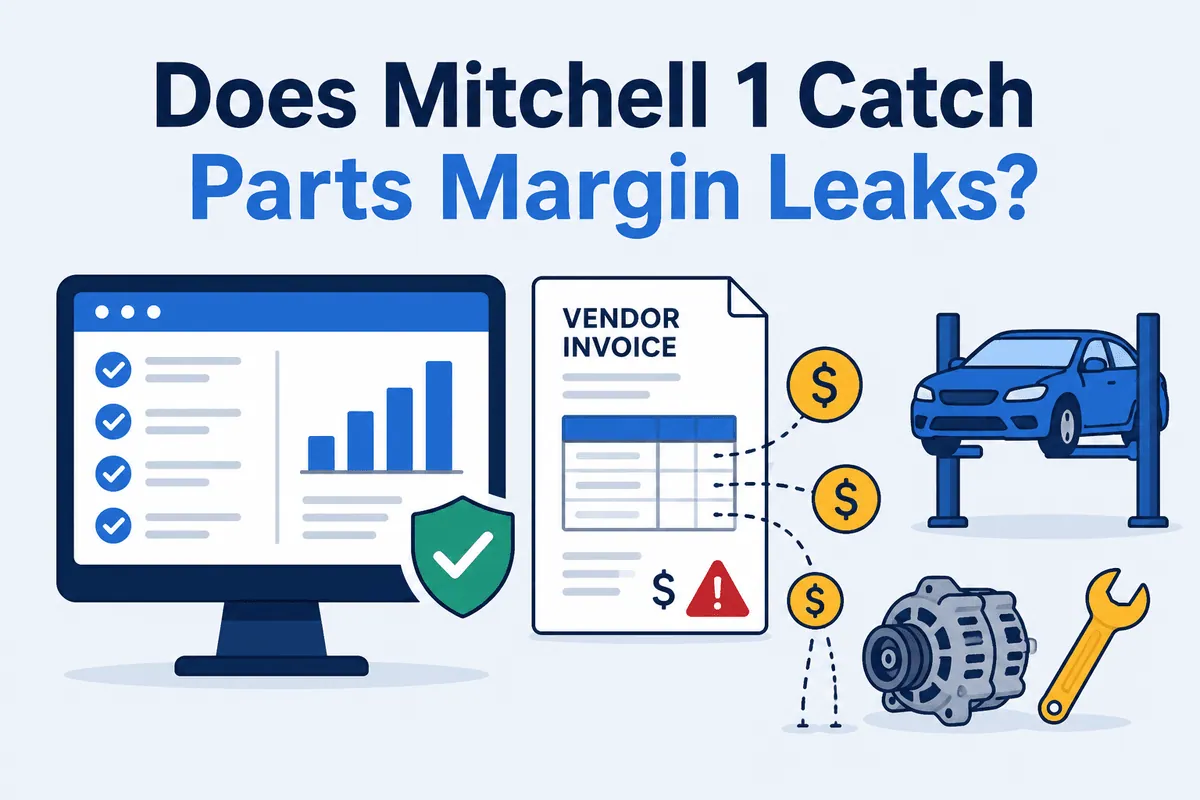

Your parts margin has a slow leak, and not the kind a plug kit fixes in the bay. If you run Mitchell 1 and you’ve never reconciled vendor invoices against your repair orders, there’s a strong chance somewhere between $8,000 and $40,000 a year is quietly hissing out of your parts margin. So does Mitchell 1 catch parts margin leaks? Only the ones that live on the ticket. The leaks that hide in the vendor invoice never enter Mitchell 1 at all, so its reports can’t see them. Mitchell 1 will tell you your parts margin to the decimal. It just can’t tell you the decimal is wrong.
That’s not a flaw in Mitchell 1. Manager SE — part of Mitchell 1, which sits under Snap-on — is one of the most trusted shop management systems in the trade for a reason, and on parts it does genuinely good work. This post is for the shop owner and the multi-location operator already running it. Not to talk you out of it. To draw a clean line around what the system of record can and can’t see, and to show where a reconciliation layer recovers three to eight margin points on top of it.
Read it in six minutes. Audit it on your own Mitchell 1 data this week.
What Mitchell 1 Does Well With Parts Margin
Let’s be honest about the tool, because the whole argument depends on respecting what it’s genuinely good at.
Mitchell 1 Manager SE gives you per-repair profit visibility through Job View — you can see the gross profit on a single job, parts and labor broken out, before the customer ever signs. That’s real discipline. Most shops can’t tell you whether a specific ticket made money until close, and Mitchell 1 puts it on the screen at the counter.
Its parts matrix is solid: tiered markup by cost bracket, applied automatically, so your service writers aren’t pricing alternators off gut feel. And it lets you record core charges on the part line and track them on the RO, which is more structure than the clipboard-and-bin routine most shops actually run.
Put it together and Mitchell 1 reports your parts gross profit cleanly — by job, by advisor, by period. If you read the reports, a low-margin ticket shows up. The reporting is not the problem. The reporting is good. Give Mitchell 1 the credit it’s earned: as a system of record for what happens inside your shop, it does the job.
Where Mitchell 1’s View Of Margin Ends
Here’s the boundary, and it’s a clean one. Mitchell 1 reports on what you sold and what you keyed. The repair order is the universe it can see. The vendor invoice — the document that says what the parts house actually charged you — never enters Mitchell 1. So the moment a leak lives in that invoice instead of on the ticket, Mitchell 1 is blind to it by design, not by defect.
Let’s do the math, and label all of it as illustrative — these are “say this happens” figures, not your actuals.
The wrong-matrix ticket. Say a dealer-sourced water pump should be marked up on your dealer matrix but gets billed on the standard matrix instead. Cost is $260. Your dealer matrix would sell it at roughly 1.85x, or $481. The standard matrix marks it at about 1.06x for that bracket, or $276. That’s roughly $205 of margin left on one ticket, and Mitchell 1’s report shows a perfectly valid line. The markup math ran. It just ran on the wrong matrix. This one Mitchell 1 can help you catch if you read the gross-profit report, because both numbers are on the ticket.
The overbill that isn’t on the ticket. Now the harder one. A vendor quotes that water pump’s bracket-mate — say an $84 part — and your writer builds the RO on $84. Three days later the invoice arrives at $97. Nobody re-keys the cost. Mitchell 1 still shows $84, marks it up, and reports a healthy line. The real landed cost was $97. That $13 never touches a Mitchell 1 report, because the invoice that carries the truth never touches Mitchell 1. Multiply $13 across a few hundred parts lines a month and the “healthy” margin report is overstating your profit by real money.
This is where I’ll say the quiet part out loud: your accounting software doesn’t verify reality, and neither does your SMS. Both record what gets entered. Neither one knows the vendor billed you more than the quote. The same gap exists in every system of record — the same gap exists in Tekmetric, for the identical structural reason: the invoice is the truth, and the invoice isn’t in your SMS. The full pattern is laid out in vendor overbilling in auto repair.
Accounting Link Is Not Invoice Auditing
The word “reconciliation” means two different things, and Mitchell 1 does one of them.
Mitchell 1’s Accounting Link integration transfers your closed repair order data — sales income, parts and labor cost, taxes, payments, supply charges, discounts — from Manager SE into QuickBooks, in summary or detail. That’s a real, useful step. It keeps your books in agreement with your tickets, and it saves your bookkeeper hours of re-keying.
But notice the direction. Accounting Link flows outward: from Manager SE to QuickBooks. It exports the data Mitchell 1 already holds. It assumes that data is correct and makes the books match it. It makes the books agree with the tickets. It does not make the tickets agree with the parts house.
That distinction is the entire post. Accounting reconciliation answers “do my books agree with my system of record?” An accounts-payable audit answers a different question: “does my system of record agree with what the vendor actually charged me?” There is no three-way match here — no order-versus-packing-slip-versus-invoice comparison — because two of those three documents (the packing slip and the vendor invoice) never enter Mitchell 1. So Accounting Link can’t flag the wrong-matrix overbill from the section above, and it can’t flag a core charge that posted but was never credited. It faithfully exports both straight into QuickBooks as if they were correct. Generic AP software has the same blind spot for shops, for reasons we cover in why generic AP tools fail auto shops.
The Leaks Mitchell 1 Structurally Can’t Catch
Two of the most common parts leaks live entirely off the ticket — which is exactly why Mitchell 1 can’t close them.
Unreturned core charges. Mitchell 1 records that you paid a core. What it can’t see is whether the vendor ever issued the credit, because that refund lands on a vendor statement or a credit memo, not on the RO. So a core can sit on the ticket marked returned and still never come back as cash — past the return window, worth nothing. Cores aren’t homing pigeons; they don’t find their own way back as money.
Here’s the math, illustrative: say you do 60 core-eligible jobs a month, a 15% walkaway rate where the credit never gets reconciled, and a $75 average core. That’s 9 unrecovered cores a month at $75, or $675 a month — roughly $8,100 a year in deposits you paid and never got back. Mitchell 1’s report won’t show a dime of it red, because the missing half of each transaction lives at the parts house. Full breakdown in our core charges and profit leakage guide.
Service advisor discounting drift. An advisor knocks lines down to save a sale. Mitchell 1 does record the discount on the ticket, so at one shop you can audit it by reading the report — this is the leak the system of record handles best. The gap is at the group level: a 3% creep in advisor discounting across eleven stores never shows up as one alarming number, just a hundred small ones spread across a hundred separate reports nobody reads side by side. We dig into that in service advisor discounting and parts gross profit.
Both leaks share a trait. The proof you need to catch them either lives outside Mitchell 1 entirely (the core credit memo) or is scattered across instances no single Mitchell 1 report aggregates (group-wide discount drift).
How To Audit Your Mitchell 1 Parts Margin This Week
You don’t need software to find out whether this is real in your shop. You need an afternoon and your existing Mitchell 1 reports.
- [ ] Pull 90 days of vendor invoices from your top two or three parts houses plus your dealer counters — statements or the vendor portal.
- [ ] Pull the matching parts cost that posted to the RO in Mitchell 1 for that same window.
- [ ] Spot-check the part lines: does the invoice unit price match the cost on the RO? Flag anything over a $12 or 5% gap. Those gaps are the overbills Mitchell 1 can’t see.
- [ ] Pull every core charge from the period and check each against a vendor credit memo. No matching credit means an open core — total those.
- [ ] Skim the matrix gross-profit report for dealer parts sold on the standard matrix — this is the leak Mitchell 1 does show, so use it. (Dealer vs. standard vs. list matrix covers which part belongs on which.)
- [ ] Total the flagged dollars and multiply by four for an annualized number. At a group, run it at your two highest-volume stores and extrapolate.
If that number is small, your reconciliation is already tight, and Mitchell 1 plus discipline is doing the job. Good. If it’s four or five figures, you’ve just found the gap between what your system of record reports and what actually happened at the parts counter.
Where A Reconciliation Layer Fits
Here’s the clean division of labor: Mitchell 1 runs the shop. A reconciliation layer audits the money.
That’s where WickedFile fits — and only here, so I’ll be exact. WickedFile reads the documents Mitchell 1 never sees — the vendor invoices, the credit memos, the core refunds, the bank and card feeds — and reconciles them against the parts activity Mitchell 1 records and the entries that hit QuickBooks. When the invoice says $97 and your RO was built on $84, it flags the $13. When a core charge posted but no credit ever came back, it flags the open deposit. When a dealer part got sold on the standard matrix, it surfaces the slippage. It’s the three-way match — order, receipt, invoice — that no SMS runs on parts. For shops that have never reconciled, that’s where the three-to-eight points come from. CPA Hunt Demarest and WickedFile CEO Alex Saladna walk through this exact SMS-to-accounting gap on the parts-reconciliation gap that costs shops six figures.
Now the honest limits, because credibility is the whole game. WickedFile does not process payments. It does not issue corporate cards. It does not do accounts receivable or invoicing. It does not replace Mitchell 1, and it does not replace QuickBooks. It finds the money; a human still moves it — you or your AP person calls the rep, requests the credit, short-pays the disputed line, and confirms it posts. WickedFile is the reconciliation layer between your SMS, your vendors, and your books. Nothing more, and nothing Mitchell 1 already does.
For a multi-location group this is where it pays hardest. A $15 missed core is a rounding error at one shop and a budget line at eleven. Auto-repair net margins run thin — often in the single digits — so three to eight recovered points of parts margin moves the whole group’s number. Mitchell 1 gives you clean per-location reporting; a reconciliation layer gives you a group-wide audit of the vendor dollars flowing through every Mitchell 1 instance you run.
Mitchell 1 tells you your parts margin to the decimal. Make sure the decimal is true before your leak needs its own zip code — book a demo and run it against your own invoices.