
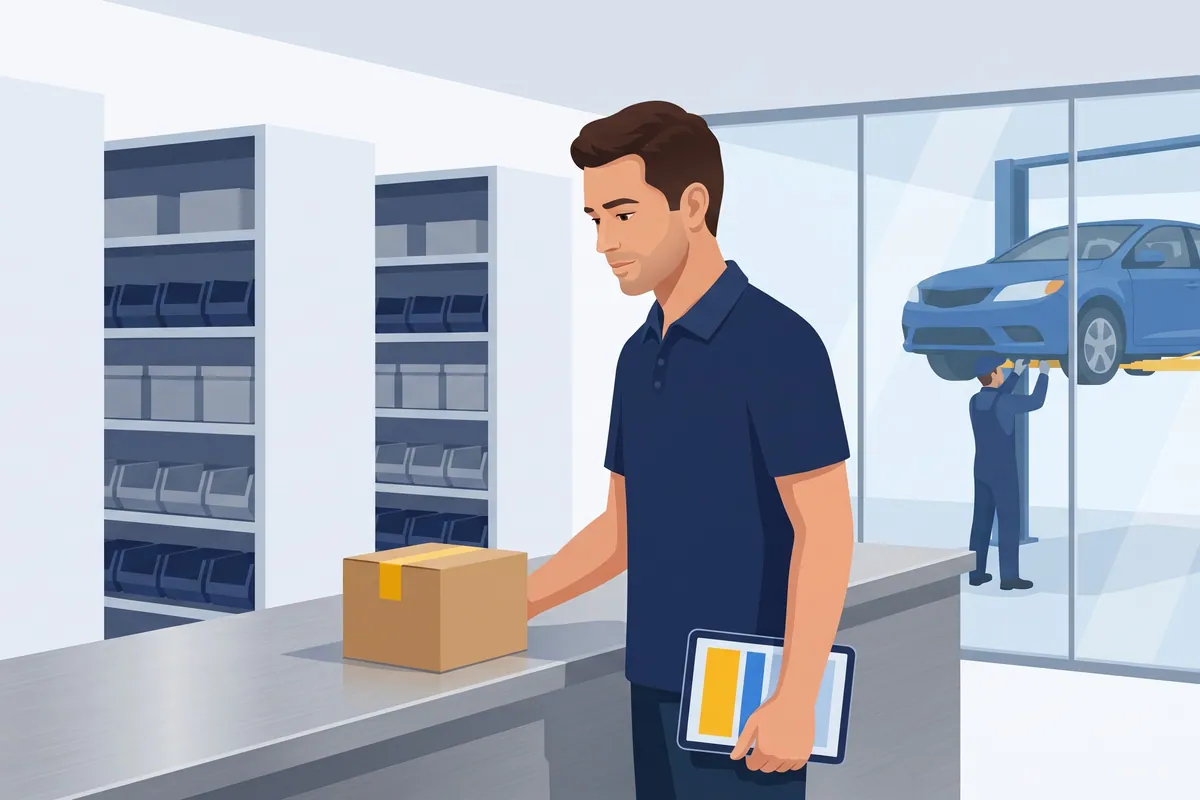

Fixed ops is the only department in a car dealership named after something it is not. The revenue is not fixed, the schedule is not fixed, and on a Monday morning with three comebacks and a tech out sick, nothing in the building feels fixed at all. (Yes, I know. Nobody asked us before they picked the name, and we are all stuck with it now.)
Fixed ops, short for fixed operations, is a dealership’s service, parts, and body shop. It is the side of the store that fixes cars, as opposed to the side that sells them, which the industry calls variable operations.
That is the definition most pages stop at. This one keeps going, because fixed ops is where a dealership’s most predictable money lives, and predictable money is exactly the kind that leaks quietly.
Why it is called fixed: predictable, not constant
Vehicle sales swing with inventory, interest rates, incentives, and the general mood of the country. Service work does not care. The cars already on the road keep needing brakes.
That is the whole meaning of “fixed.” It is a description of reliability, not a promise that the number never moves. NADA’s 2026 midyear report shows exactly that: “Revenue was up by 2.2% in the fixed operations department, despite a slight decline in repair order counts,” in a half where the average dealership’s total revenue fell 0.9%.
Sales had a soft half. Service and parts kept going. That is the department doing its job.
The size of the fixed ops department
From NADA Data’s 2025 annual financial profile, for franchised light-vehicle dealers:
- Dealerships “wrote more than 276 million repair orders, with service and parts sales exceeding $164 billion.”
- Service and parts were 13.3% of total dealership sales dollars.
- The average dealership had $9,687,942 in total service and parts sales and wrote 16,252 repair orders.
- Service and parts sales averaged $494 per customer-pay repair order and $551 per warranty repair order.
- The average customer mechanical labor rate was $186.
- The average dealership carried $572,382 in parts inventory.
Thirteen percent of sales sounds modest until you remember what the other 87% is. Selling a car moves a lot of dollars and keeps very few of them. Service keeps a much larger share of every dollar it touches, which is why fixed ops carries so much of the store’s overhead.
Fixed absorption is 60%. Total absorption is 100%.
This is the most misquoted ratio in the dealership world, so let me give you NADA’s own words from its 2026 formulas and guides:
Fixed Absorption: “Total fixed gross profit ÷ total dealer expense. Guide: 60%”
Total Absorption: “Total used-vehicle, service, parts and body shop gross profit ÷ total dealership expense.” Guide: 100%
The 100% target is real, but it includes used-vehicle gross. Fixed ops alone is expected to cover about 60% of the store’s expenses.
That distinction matters for one practical reason. If your fixed absorption is 64% and someone measures it against 100%, a healthy department looks like it is failing, and the next move is usually to squeeze it. Measure the ratio you actually mean.
Customer pay, warranty, internal: three customers, three sets of books
Every repair order in fixed ops has a pay type, and each one behaves like a different business.
- Customer pay. The vehicle owner pays. This is the retail work, and it carries your full labor rate and parts margin.
- Warranty. The manufacturer pays under its warranty. NADA’s guide sets warranty receivables at about 25% of current-month parts and labor sales, which tells you how much money is sitting out waiting on a factory at any moment.
- Internal. The dealership pays itself, mostly reconditioning used cars before they go on the lot.
The scale of internal surprises people. NADA’s 2025 profile puts internal service labor at $12.22 billion and internal parts at $8.55 billion across all franchised dealers. That is real labor and real parts, billed from one department of the store to another.
Internal work is where I would look first in any dealership I walked into. Not because anyone is doing something wrong. Because a repair order the customer never sees, paid by a department that wants the number low, is the one RO in the building that no outside party ever checks. The used-car manager wants recon cheap. Service wants it billed. The parts on it still came from a vendor, and that vendor’s invoice still has to match something.
Warranty at retail only works if your repair orders are right
Several states require manufacturers to reimburse warranty work at the dealer’s retail rate rather than a discounted one. California is a clear example. Vehicle Code section 3065 requires franchisors to compensate franchisees “for parts and labor at rates equal to the franchisee’s retail labor rate and retail parts rate.”
The part that matters is how that rate gets established. Under section 3065.2, the dealer submits the fewer of “Any 100 consecutive qualified repair orders” or “All repair orders completed in any 90-consecutive-day period,” and calculates the retail parts rate “by determining the total charges for parts from the qualified repair orders submitted, dividing that amount by the franchisee’s total cost of the purchase of those parts, subtracting one, and multiplying by 100.”
Read that formula again with an accountant’s eyes. The cost side comes from your own records. If the parts cost on those repair orders is wrong, because a vendor invoice was never matched, a price changed, or a credit never landed, the markup you submit is wrong too. The statute rewards a dealer with clean repair orders. It cannot help one without them.
A boundary I want to draw clearly: I build back-office software, I do not practice franchise law, and this varies a great deal from state to state. The California code is a useful example of how these rules work, not a guide to yours. Your state dealer association is the right first call.
Every purchased part deserves an ending
Here is the opinion I hold most strongly about any parts department, dealer or independent.
Every part you buy has a short list of acceptable endings:
- Sold on a customer-pay repair order.
- Claimed on a warranty repair order.
- Charged to an internal repair order.
- Sold over the counter or wholesale.
- Returned to the manufacturer or vendor, with the credit actually received.
- Still on the shelf, and moving.
Anything else is a part without an ending. And the shelf is where parts go to stop having one.
NADA’s guide defines parts obsolescence as “Parts inventory aged over 12 months with no demand” and sets the target at “Less than 5% of total inventory.” Its inventory profile expects about 85% of stock to move within six months.
Now the illustrative math, using NADA’s 2025 average parts inventory of $572,382. A store sitting at 12% obsolete instead of 5% has an extra 7% of its inventory with no demand:
$572,382 × 7% = about $40,000 sitting on shelves with no buyer.
That money already left the building. It does not show up as a loss on any one day, which is exactly why it gets to $40,000. Manufacturers offer return programs to clear some of it, and those return allowances only help if someone actually files the return and then checks that the credit arrived. A return slip is a plan. A credit memo is the ending.
If you want the benchmarks that sit around this one, parts KPIs and benchmarks covers turn, fill rate and gross on the independent side, and core charges covers the credits that most often fail to arrive.
Fixed ops is earning more and losing share
One more number, because it changes how both dealers and independents should read everything above.
Cox Automotive’s 2026 Fixed Operations and Ownership Study found that “Average dealer service and parts revenue reached ~$9.23M in 2025, up 33% in the last eight years, even as dealer share of service visits fell from 33% to 29%.” The same study estimates that “losing a service customer can represent more than $12,000 in potential lifetime service spend.”
Record revenue and shrinking share at the same time. Older cars need more work, so the pie is growing, and independents are taking a bigger slice of it. (Cox’s revenue figure and NADA’s differ because they are different datasets. Both point the same direction.)
If you run an independent shop, that is your opportunity in one sentence. If you run a dealer service department, it is the reason the back office matters more than ever: when you are fighting for every customer, you cannot afford to lose margin on the work you already won.
Where WickedFile fits in a dealership, and where it does not
To be straight about it: WickedFile is not dealership software. It does not replace your DMS, process warranty claims, touch your factory statement, or go anywhere near F&I or floor plan.
What it does is reconcile vendor invoices, credits, cores and statements against repair orders. Inside fixed ops, that is the non-factory side of the parts room: aftermarket and tire vendors, sublets, shop supplies, and the credits and cores those vendors owe you. It tells you which purchased parts landed on a repair order, which were returned and credited, and which have no ending yet. That is the same problem an independent shop has, inside a bigger building.
For the rest of the dealership’s books, car dealership accounting and what to look for in a dealership accountant cover the parts we do not touch. Warranty tooling is covered in automotive warranty software.
The monthly fixed ops check
Process beats memory. Six questions, once a month:
- Fixed absorption against 60%. Not against 100%.
- Parts aged over 12 months, as a share of inventory. Against NADA’s 5%.
- Returns filed versus credits received. Every return should end in a credit memo, not a slip.
- Internal RO gross. Is reconditioning billed consistently, or does it drift lower every month the used-car manager has a target?
- Warranty receivables. Are they near 25% of the month’s parts and labor sales, or growing?
- Parts cost on repair orders versus vendor invoices. If those two disagree, your retail parts rate, your margin, and your warranty submissions all inherit the error.
The labor side of the ledger has its own logic, and parts versus labor margin walks through it.
Fixed ops earned its name by being the steady part of the store. Keep it that way: count what is on the shelves, chase what you are owed, and make sure every part you bought got its ending. Otherwise the only fixed thing in the department will be the obsolete stock.
Sources: NADA Data 2025 Annual Financial Profile · NADA Data 2026 Midyear Report · NADA 2026 Formulas, Definitions, Guides · California Vehicle Code §3065 · California Vehicle Code §3065.2 · Cox Automotive 2026 Fixed Operations and Ownership Study