
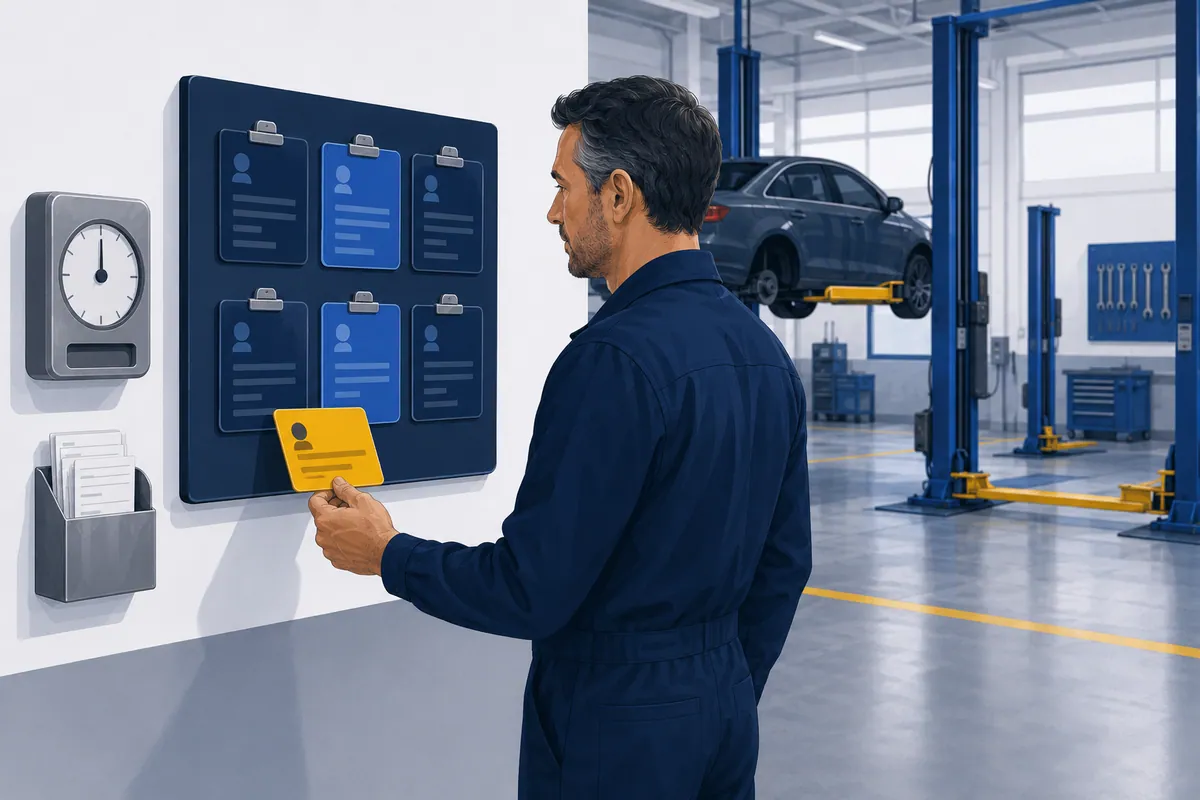

Ask a flat rate technician what time it is and he’ll tell you how many hours he’s turned. It’s ten past two. He says “I’m at six.” That isn’t a personality quirk. That’s your pay plan answering for him, and it will keep answering for him on every decision he makes today.
This is for the owner or multi-store operator choosing how to pay a crew. Not for the tech googling what flat rate means (though if that’s you: hello, and ask about the guarantee).
The whole argument in one sentence: a pay plan is not a payroll setting, it’s an incentive contract. Most owners have never once read their own plan as one. Read this in eight minutes, pull two reports Monday.
Flat rate pricing and flat rate technician pay are two different decisions
Start here. Everything below depends on it, and nearly every article on this topic mashes the two together.
Flat rate pricing is what you charge the customer. The job is quoted and billed at book time, long or short.
Flat rate pay is how you compensate the technician. The tech is paid for hours turned, not hours clocked.
Two separate dials, and you can set them independently:
- Bill book time, pay hourly. Common. The shop keeps the whole upside on a fast job; the tech’s check never moves.
- Bill book time, pay flat rate. The classic dealership model. The upside gets shared.
- Bill actual time, pay hourly. Some fleet, heavy-duty, and diag-heavy operations.
- Bill actual time, pay flat rate. Rare, and if you’re doing it by accident, that’s this week’s conversation.
What to charge per hour is the labor rate guide with rates by state. Where book hours come from is the labor time guide breakdown. This post takes guide hours as a given and asks the one question left: what happens when you staple a paycheck to them.
Carry this with you: changing what you charge and changing how you pay are different projects. The first annoys customers for a week. The second can cost you your best technician.
Your flat rate technician pay plan is an incentive contract you wrote by accident
Flat rate doesn’t just pay for work. It prices every decision a technician makes in a day. Watch what the plan decides for him:
- Which RO he grabs off the board. He knew which ticket was gravy and which one was a Saturday within four seconds of the board updating, and he’s already holding the keys to the good one. Nobody taught him that.
- Whether he writes up the leaking axle seal. Found work is unpaid inspection time until an advisor sells it. Unpaid inspection time asks a man on production pay to work for free and hope.
- Whether he walks the car to the alignment rack. Two minutes of walking, zero hours turned.
- Whether he touches the comeback. More on that below. It’s uglier than it looks.
None of that is a character defect. It’s arithmetic. You get the behavior you pay for, and what you forgot to pay for quietly stops happening.
Flat rate does real work when it fits. It rewards speed and skill and gives your fastest tech a reason to stay. Paar Melis’s top-performing client shops lean toward flat-rate and performance pay, and that’s no accident. But a plan is a contract. Read yours the way your tech reads it: line by line, looking for what pays.
There is no industry standard flat rate technician pay plan
If you came here for the number that says what everybody else does, the two best datasets in this industry disagree. Not slightly.
The 2026 Ratchet+Wrench Industry Survey of 430-plus owners and managers reports flat rate at 25% of shops, hourly plus commission at 23%, straight hourly at 16%, salary at 15%.
Paar Melis, the CPA firm, built its 2025 benchmark report from client shops’ actual 2024 financials. It reports salary or hourly at 44%, flat rate at 34%, commission at 23%.
Don’t blend them. One is self-reported survey bands, the other a tax firm reading its clients’ books. Flat rate is either a quarter of the market or a third of it, depending on whose shops you count.
Which is the point. There is no industry-standard pay plan waiting for you to adopt. This is a local decision: your car count, your dispatch discipline, and the specific humans in your bays.
One datapoint on that, labeled carefully. A July 2025 Fleet Maintenance piece on technician compensation plans cites WrenchWay’s Voice of Technician report finding 64% of diesel technicians prefer hourly or salaried pay and 5% prefer traditional flat rate. Diesel and heavy-duty techs, not general repair, so don’t quote it at your import crew. But the plan you love may be a recruiting obstacle you can’t see, and that’s the recruiting and retention conversation.
The guarantee is the line item nobody prices
Almost every real flat-rate plan in an independent shop has a guarantee bolted on, because that’s how you hire anybody right now. It’s also the part owners never price. Illustrative math, so recompute it with yours.
Four techs. A guarantee of 40 hours a week at an illustrative $32 flat rate. That’s a $1,280 weekly floor each.
A tech who turns 34 hours earned $1,088. You pay $1,280. The gap is six guaranteed-but-unearned hours:
- $192 per week
- ≈ $10,000 per year, one tech
- ≈ $40,000 per year across four techs
- ≈ $200,000 per year across five stores running four techs each
That last number makes this a group-level question, not a payroll question.
Now the part that matters more than the number. Were those six hours the tech’s fault, or the schedule’s? The payroll register charges you the same either way and will never tell you which. That’s the whole post.
You don’t have a pay plan problem, you have a scheduling problem
My one strong opinion here, and it’s why most pay-plan changes disappoint. Two numbers get used interchangeably at the counter, and they aren’t the same thing.
- Efficiency = billed hours ÷ hours the tech actually spent on jobs. Did he beat the book?
- Productivity = billed hours ÷ hours the tech was there and available. Was he on a job at all?
Flat rate pays for the first one. It has nothing to say about the second.
In the 2026 Ratchet+Wrench survey, the most common self-reported efficiency band was 80 to 99%, the most common productivity band 80 to 89%. Owner-reported, and rosy.
Paar Melis measures productivity against total available hours, a stricter denominator, and gets a different picture: 47.6% average across 2024, down from 57.0% in 2023, top 10% at 59.3%. Different denominators, so don’t lay those scales side by side. Pick one definition and keep it.
Put both together and you get the technician nobody admits they employ: 95% efficient and 45% productive. He beats the book on everything he touches. He touches a car about half the day. Flat rate can’t fix that, because it never pays for the empty hour and so never measures it.
What that empty hour is worth, illustrative, on benchmark inputs:
- 2,080 available hours a year per tech.
- At Paar Melis’s 47.6% average: 990 billed hours.
- At their top-decile 59.3%: 1,233 billed hours.
- The gap is 243 hours, about $40,100 of labor sales per tech per year at a ~$165 rate.
- At Paar Melis’s average labor gross profit of 59.3%, roughly $23,800 of gross profit per tech. (Yes, 59.3% appears twice. Coincidence. One is productivity, one is margin.)
Same report puts revenue per tech at $31,816 a month, top 10% at $36,292. Your average tech is a $380,000-a-year revenue center. Nobody manages a $380,000 asset by adjusting how it’s paid and hoping.
And the number that should end the argument: Paar Melis’s top 10% and bottom 10% post the same labor rate, around $163 to $164, and land at 26.2% versus 2.7% owner pay plus profit. The difference isn’t the rate. It isn’t the pay plan either.
So go find where the hours went before you touch the plan. Sold hours on the board. Parts on the shelf when the car hits the bay. Authorizations back in twenty minutes instead of a day and a half. A dispatcher who assigns work instead of letting the board get raided. Discounting counts too, since it shrinks the flat-rate tech’s check along with your margin, and effective labor rate takes that apart properly. Track the result beside your other parts and labor benchmarks.
Flat rate is the most popular answer to a productivity question it cannot answer.
Flat rate is not an overtime exemption
Quick and necessary: operator experience, not legal advice. Talk to an employment lawyer in your state before you set or change a plan. That said, the floor under flat rate sits lower than most shops think.
Minimum wage applies to hours worked, not hours turned. A tech who clocks 40 and turns 22 still has to clear minimum wage for all 40. Most common flat-rate mistake I see, and it’s why you need a real clocked-hours record on a production plan.
The famous “mechanic exemption” probably isn’t yours. The Fair Labor Standards Act exempts, at 29 U.S.C. 213(b)(10)(A), “any salesman, partsman, or mechanic primarily engaged in selling or servicing automobiles, trucks, or farm implements, if he is employed by a nonmanufacturing establishment primarily engaged in the business of selling such vehicles or implements to ultimate purchasers.”
Two things in it get skipped.
First, it’s written around the establishment, not the job title. The shop has to be primarily engaged in the business of selling vehicles. That’s a dealership. An independent repair shop generally isn’t, so its flat-rate techs typically aren’t covered and overtime still applies unless another exemption fits. That reading is about mechanics in the bay; the counter seat sits under a different clause of the same statute and does not follow from this, which is why the service writer post stops short of a conclusion there.
Second, look where it lives: subsection (b), headed “Maximum hour requirements.” Even where it applies it’s an overtime-only exemption. It never touched minimum wage.
The retail commission exemption has two locks, not one. The other provision shops reach for is 29 U.S.C. 207(i), which relieves a retail or service establishment of overtime for an employee only if “(1) the regular rate of pay of such employee is in excess of one and one-half times the minimum hourly rate applicable to him under section 206 of this title, and (2) more than half his compensation for a representative period (not less than one month) represents commissions on goods or services.”
Both conditions, every representative period. And whether flat-rate pay counts as “commissions” at all is a fact question you don’t want answered for the first time in a deposition.
State law can be stricter. California’s piece-rate and rest-break rules are the obvious example. Check your own state, not a blog post. (Including this one.)
The comeback is where the incentive quietly runs backwards
Straight talk about the evidence first. A pair of comeback-rate percentages circulates on the consultant blogs, credited to an industry association study, supposedly proving flat-rate shops produce twice the comebacks. I went looking for the primary source. There isn’t one. So I won’t reprint the numbers, and neither should the next person who repeats them.
I’ll argue the incentive instead, which you can check in your own building this afternoon.
A flat-rate tech redoing his own job earns nothing for those hours. So the rational moves are: argue about whose comeback it is, hand it off, or finish it fast. The most efficient technician in the building will spend eleven minutes explaining why he shouldn’t have to do the comeback, then do it in nine.
The honest other direction exists too. He pays for his own mistakes in the only currency he has, so flat rate also gives him a reason to get it right the first time. Both effects run at once, and your policy decides which wins:
- Are comeback hours paid, unpaid, or paid at a reduced rate? Write it down. Ambiguity resolves in favor of the argument.
- Who dispatches comebacks? If the answer is “whoever’s free,” you built a lottery your best tech stops entering.
- Do you measure comeback hours by technician, advisor, and op code? A comeback caused by a misdiagnosis at the counter isn’t a wrench problem.
Track comeback hours on their own line. Hours you paid for and billed to nobody.
Hybrid plans, and how to change one without a mutiny
Most well-run shops I talk to aren’t running pure anything. They run a hybrid, whether or not they call it that:
- Flat rate plus a guarantee. The default. See the math above, and know your number.
- Hourly plus an efficiency bonus. Predictable check, upside for beating the book. Easier to recruit into, and it forces you to measure efficiency.
- Flat rate with paid non-productive codes. Inspections, training, cleanup, lot moves, shuttle runs, paid at a set rate. Cheapest fix here, and the one most shops skip.
- Tiered flat rate by efficiency band. The rate steps up as sustained efficiency does.
That same Fleet Maintenance piece quotes one consultant, Peter Cooper of Ascend Consulting, putting tech wages near 17 to 20% of gross income and calling 70 to 75% efficiency the threshold where premium pay should kick in. Sanity check, not a rule.
Whatever shape you pick, change it like this:
- Model it before you mention it. Run six months of turned and clocked hours through the new plan, per tech.
- Nobody goes backwards in year one. If the model cuts somebody’s check, either the plan is wrong or that job description is.
- Publish the arithmetic. One page. If a tech can’t compute his own check from it, it isn’t a plan, it’s a mood.
- Run 90 days in parallel. Old plan pays, new plan reports. Then switch.
- Say what you’re paying for out loud. Inspections, training, comebacks, cleanup. In writing.
Advisor pay is a different animal, covered in the service advisor training playbook. Don’t copy your tech plan onto the front counter.
Your group cannot run five pay plans and one scoreboard
At one shop, an unclear pay plan is a morale problem. Across a group it’s a measurement failure, and that costs more than the payroll line.
Say store 1 pays flat rate with a 40-hour guarantee, store 3 pays hourly plus a bonus because the previous owner did, and store 5 pays hourly because the manager hates paperwork. Now:
- Labor cost per billed hour isn’t comparable store to store, so neither is labor gross profit. Your best location may just be your best-structured one.
- Productivity isn’t comparable either if stores use different denominators. Same trap as above, times five.
- Techs talk. They knew what store 4 pays before you closed the acquisition. Five plans means five recruiting pitches and one group text.
- You inherit guarantees. Buy store 6 and you buy its pay plans, including the handshake ones nobody wrote down. Ask in diligence, in writing, before close.
The fix is boring and it works: one structure, locally variable rates. The shape should be identical at every store. The dollar figure inside it can flex with the local market, the way the wider cost pressures on this industry do.
Read your own pay plan like a technician, this week
An hour with last quarter’s data. That’s the whole ask.
- Print the plan on one page. Hand it to a tech. Ask him to compute last week’s check. Watch what happens.
- Pull turned and clocked hours per tech for three months. Compute efficiency and productivity separately, and note which denominator you used.
- Total the guarantee top-up dollars you paid last quarter. That’s your invoice for unproductive hours, already cleared the bank.
- Take the worst week and name the cause: no work sold, parts not there, car not in the bay, authorization pending, or the tech. It’s almost never the tech five times running.
- List every task you require and don’t pay for. Inspections, training, cleanup, lot moves, shuttle runs.
- Compare plan structure across your stores. Rates can differ. Structure shouldn’t.
Then fix the schedule before you touch the plan. A pay plan decides how a technician spends an hour. It cannot invent the hour. If the board is empty at ten in the morning, no arrangement of dollars per turned hour will fill it, and your most efficient tech is simply efficiently unemployed until lunch.
He’ll tell you exactly what time that was, too. He’s at six.