
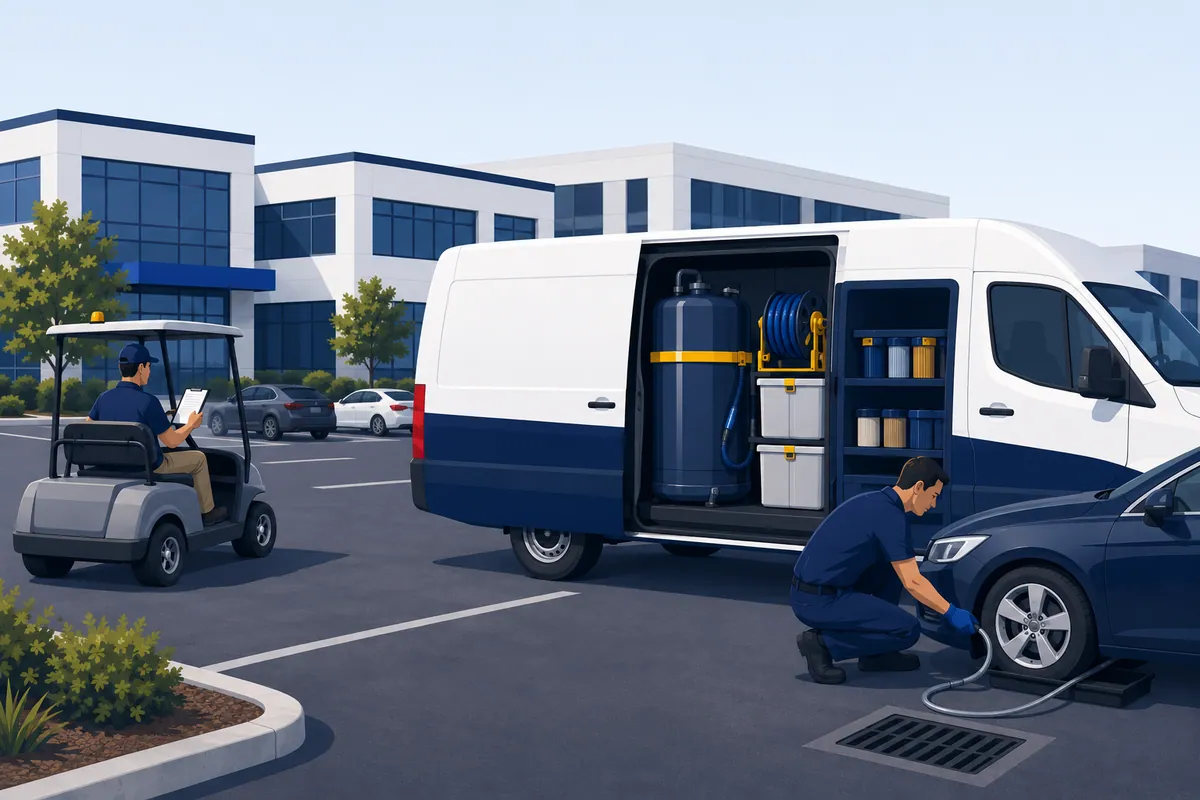

Nobody starts a mobile oil change business picturing the part where the maintenance guy in a golf cart arrives at minute four of a driveway oil change, having read the lease, and he is always right. Or the part where, eight days in, you are driving across town with fifty-five gallons of other people’s used oil sloshing behind your seat. There is a federal limit for how much of that you can have back there. You are standing on it.
That is the whole problem with the advice on this topic. The internet treats a van as a shop with wheels and a smaller rent bill. It is not. It is a different business with a different ceiling, and three of the things that decide whether it works never show up on a startup-cost calculator.
You cannot legally carry more than 55 gallons of used oil at a time. You do not control the parking lot you are standing in. And your ticket has no labor to sell.
This is for the person deciding whether to buy the van, and for the shop owner wondering whether a mobile unit is a second profit center or just a second phone to answer. The best part is the 55 gallons.
A van is not a small bay, and the ticket is why
A bay sells hours. A van sells drives.
That sounds like a slogan until you look inside the two tickets. Per accounting firm Paar Melis’s 2025 benchmark report, built from client shops’ actual 2024 financials, the average repair order at an independent shop runs about $702 at a 52.3% gross margin. Most of that is diagnostic and labor. Somebody sold time. (For the bay side of the comparison, see what an independent shop actually makes.)
An oil change has almost no time in it to sell. Oil, a filter, maybe a cabin filter, eighteen minutes. The customer already knows what it should cost, because there is a sign on the highway with the number on it.
So the usual shop moves are gone. You cannot raise a labor rate on a service with no labor in it. What you can change is how many stops you make between 8 and 4 and how few minutes you burn between them. Route density is the only variable that really moves, and everything else here is a constraint on it.
The category itself is healthy, for what it is worth. Valvoline Inc.’s fiscal 2025 results reported its “19th consecutive year of system-wide SSS growth,” with same-store sales up 6.1% across 2,180 stores, split 1,016 company-operated and 1,164 franchised, and system-wide store sales up 11% to about $3.45 billion against Valvoline’s own net revenue of about $1.71 billion. Do not divide $3.45 billion by 2,180 to invent a store average, no matter how many blog posts do, because that figure includes franchised stores whose sales Valvoline does not book. The category works. The question is whether your version of it does.
Is a mobile oil change business profitable? Run the honest day, not the good one
Yes, at a small scale, if the route cooperates. Here is the arithmetic everybody runs, and then the arithmetic that actually happens.
Start with gross profit per job, not price. Say you clear $60 per oil change after oil, filter, and disposal. Six jobs a day is $360. Twenty-two working days is $7,920 a month of gross profit. Out of that comes the van payment, fuel, commercial auto insurance, general liability, oil and filter inventory, disposal, your phone, your scheduling app, and your own pay. (Illustrative numbers, mine, not a survey.)
Now the honest day. Two customers were not where they said they would be. A third was, but the car was in a townhouse garage with a door you cannot stand up under and a drain pan that will not clear the exhaust. So you did four.
Four jobs a day is $240, or $5,280 a month. Same van, same fuel, same insurance, same you.
That gap is $2,640 a month, roughly $31,680 a year, and it is the entire business. Notice what it is not. Nobody refused to pay. It is not a pricing problem, it is a routing and confirmation problem, which is a much cheaper problem to fix and a much easier one to ignore.
One counterweight before you spend that number. The $60 is my illustration, not a survey, and the fastest way to find out whether it is anywhere near yours is to stop reading. Buy the oil, buy the filter, do one job, and subtract. If your real gross profit per job is $12 and not $60, every number above divides by five, and you would rather learn that from your own invoice than from a spreadsheet somebody built to sell you a template. Which is also why the difference between margin and markup stops being academic when the job is this small.
The 55-gallon rule is your real production ceiling
Here is the part nobody on this topic writes, and it is the one that changes how you plan your week.
Under 40 CFR 279.24, a used oil generator may haul its own used oil without an EPA identification number only under specific conditions. Self-transport is permitted where “the generator transports the used oil in a vehicle owned by the generator or owned by an employee,” where “the generator transports no more than 55 gallons of used oil at any time,” and where the destination is “a used oil collection center that is registered, licensed, permitted, or recognized by a state/county/municipal government.” A parallel provision covers hauling to an aggregation point “owned and/or operated by the same generator” under the same limits.
EPA is blunter about the alternative. Its used oil guidance for businesses states that “Transporters that haul used oil must have a valid EPA ID number,” and its definition of a generator is broad enough to include you: businesses that handle used oil “through commercial or industrial operations or from the maintenance of vehicles and equipment.”
Now put cars in it, because 55 gallons sounds like a lot until you do.
A five-quart oil change is 1.25 gallons. Fifty-five gallons is 44 cars. At six cars a day you reach the federal limit in just over seven working days. At four cars a day, eleven.
Serve fleets and it arrives faster. A half-ton pickup taking seven quarts is 1.75 gallons a unit, so 55 gallons is 31 trucks. Service twelve vans in one yard and you put 21 gallons in the back of your van before lunch. Add the filters, which hold oil of their own even after you drain them, and you are tighter than the arithmetic suggests.
So your disposal run is not an errand. It is a scheduled piece of your operation that eats a working half-day you cannot bill, and it comes around every week and a half at six cars a day, every other week at four. Put it on the calendar at 40 gallons, not on the Friday you find the tank full with three appointments booked.
Which brings up what you need before you buy the van. Your “shop” is a licensed collection point, and that is a relationship, not a search result. Call the registered collection centers near you first. Ask what they accept, what they charge or pay, their hours, whether they take filters, and whether they will service a tank at a yard. If the answer is “nobody takes small quantities,” you just learned something more important than your break-even.
Two more items from EPA’s guidance that cost nothing: “Label all containers and tanks as Used Oil,” and “Keep containers and tanks in good condition.” On filters, EPA notes the common practice is to puncture them, drain the oil into an appropriate container, and recycle the filters as scrap metal.
Then read all of it as a floor. 40 CFR 279 is the federal baseline. States run their own used oil programs, plenty are stricter, and EPA’s business FAQ does not address mobile or temporary service operations at all. Before you take a dollar, call your state environmental agency and ask about mobile used oil generation and transport specifically. I am not going to tell you which permit your state wants, because I do not know, and neither does anybody publishing a startup-cost calculator.
You do not own the parking lot, and the fix is a different customer
The guy in the golf cart is not an anecdote. He is the constraint, and every mobile operator meets him eventually.
Vehicle maintenance is prohibited in a lot of the places your customers park. Apartment complexes and HOAs ban it in the lease or the covenants. Office parks and retail centers have property management rules and a tenant who did not sign up for a drain pan by the front door.
The stakes are bigger than a lost slot. A quart on asphalt is a mess. A quart that finds a storm drain is a reportable environmental incident and a conversation with a property manager who will now ban the whole category from that address forever. So your liability question is not “what if I scratch a car.” It is “what if I spill on pavement I never had permission to work on.”
Here is the opinion, and it is the most expensive sentence in this article: if your plan is consumers in apartment complexes, your plan is a permission problem wearing a business plan. You can be a great tech with a spotless van and still lose the day to a document you never saw.
The fix is not better negotiating. It is a different customer, and the ones who work are the ones who own or control where the vehicles sit. Contractors with a yard. Plumbing and HVAC companies. Landscapers. Last-mile delivery depots. Municipal yards. Dealership and rental lots.
That customer solves three problems at once. They can grant permission, because they are the permission. They park multiple vehicles in one place, which is route density with no driving in it. And they buy on a schedule instead of a whim.
That schedule has a name, and if you want fleet work you should learn to speak it. A fleet preventive maintenance program is a written plan that services vehicles at fixed intervals in the fleet’s own units, mileage for vans and pickups, engine hours for equipment, instead of when something starts making noise. Build the unit list at the first visit (unit number, VIN, engine, oil capacity, filter part numbers) and keep the per-unit history after every one, because that list and that history are the asset. The van is not.
Two things the definition will not tell you. The PM program is why the fleet keeps you and also why they expect a discount, because you are trading price per unit for units per stop, and twelve vans in one yard at ten dollars less each still beats four driveways across town.
And sell the downtime, not the oil change. A fleet manager does not care about your ticket. He cares that his plumber is not sitting in a lobby at 9 a.m. on a Tuesday. Landing these accounts looks nothing like consumer advertising, and judging channels on gross profit per job is what keeps you from buying coupon customers.
Mobile oil change business equipment, and the startup total I am not going to print
The list is short. The sequence matters more than the brands.
- The van, chosen by payload rather than looks. Fresh oil runs about 7.5 pounds a gallon, so a 55-gallon drum is over 400 pounds before the drum. A full waste tank is about the same again. Add filters, canopy, tools, and yourself, then read the door sticker before you fall in love.
- An extraction pump and hose reel, plus a drain setup that clears low exhaust and low clearance.
- A waste oil tank, secured, labeled Used Oil, in good condition, mounted so a hard stop does not turn your van into a spill report.
- Fresh oil supply. Totes or drums with a pump and a meter, in the two or three viscosities your route actually uses.
- Filter inventory for the makes on your route. This is where fleets pay you back. Eleven identical Transits means eleven of one filter instead of eleven guesses.
- Spill kit, absorbent, drip mats, gloves. Buy more absorbent than you think you need.
- Scheduling and invoicing on your phone. One cheap tool that confirms appointments and takes a card at the curb. I am not relitigating that shortlist here, because mobile mechanic software already covers what works in a van.
Now the total. I am not printing one.
The published startup ranges for this business run from under $2,000 to $66,000 with a 21-month break-even, all from sites that show no methodology whatsoever. That is not a range. That is four websites guessing, and one of them guessed thirty-three times higher than another.
Do this instead. Take your four biggest lines, the van, the pump and reel package, the waste tank with its mounting, and opening oil and filter inventory, and get three real quotes on each in your own market this week. That number is worth something because you can defend it, which is the only test a lender applies. The mechanic shop business plan guide covers the document those numbers live in.
Licensing, and the insurance line that gets claims denied
The paperwork stack is short. A business license or registration where you operate. Sales tax registration, because you sell parts. And whatever your state environmental agency requires for used oil generation and transport, which is the phone call from earlier and the only item here you cannot hand to a filing service.
Then insurance, where mobile operators share one specific gap.
Commercial auto, not personal auto. Your van is a business vehicle carrying business property to a business appointment, and a personal policy is the one that gets denied at the worst possible moment. General liability for damage to the customer’s vehicle and property. Workers’ comp the day a second driver starts, not the day after. And the coverage nobody quotes unless you ask: pollution or environmental liability. You transport a regulated substance for a living. Ask for it by name.
That is one paragraph on a subject that deserves a chapter, so go read the auto repair shop insurance coverage gaps breakdown.
The gap between six jobs and four is a checklist, not a price increase
You do not need to buy anything to fix this. You need a habit and about fifteen minutes a night.
- Confirm the day before, by text, with a reply required. “Reply Y to confirm” is not rude. An unconfirmed stop is not an appointment.
- Ask three questions at booking. Where exactly will the vehicle be parked, who controls that pavement, and what is the year, make and engine. That is your permission filter, your garage-door filter and your oil-capacity filter in one breath.
- Sequence tomorrow tonight. Book by geography, not by who called first. One cluster of zip codes per half-day.
Confirmations that hold are worth more than a price increase, and they cost nothing but the fifteen minutes.
”Oil change business for sale” usually means a route with a person attached
Buying an existing operation is a legitimate way in, because you skip the cold start. What you are buying is not the van. Vans are for sale everywhere. You are buying a route and a customer list, and here the list is worth more than every piece of equipment bolted into that van.
So ask one question before the others, and listen closely. How many of the fleet accounts sit on a written agreement, and how many are a handshake with you personally?
Handshakes do not transfer. They re-decide. A route with eight fleet accounts on paper and a service history per unit is an asset. A route with eight accounts that all love Dave is Dave.
Then ask for the disposal relationship in writing, the per-unit histories, and twelve months of jobs by customer, so you can see whether that route is dense or heroic. Valuation, seller’s discretionary earnings, and the diligence list live in the build or buy guide.
One van is a job. Three vans is a business.
One van is a job you own, and there is nothing wrong with that as long as you call it what it is. Your income is capped by your own daylight, and every day you are sick the revenue is zero.
Three vans is a different animal. Now somebody routes three drivers, confirms three days of appointments, keeps three waste tanks under 55 gallons with three separate disposal runs, and stocks three inventories. That somebody is a dispatcher, and for a good while that somebody is you at 6 a.m. and again at 8 p.m.
And here is what every mobile operator eventually runs into. The fleet customer who loves you for oil changes will ask you to do brakes in their yard. Then a starter. Then “hey, can you look at this no-start.” That request is a compliment and a fork in the road, because brakes on gravel in February is not the business you priced. A bay is.
That is the day you find out whether you wanted a van or a shop. Both are real answers. Just pick one on purpose, and pick it before the fifty-five gallons behind your seat picks for you.