
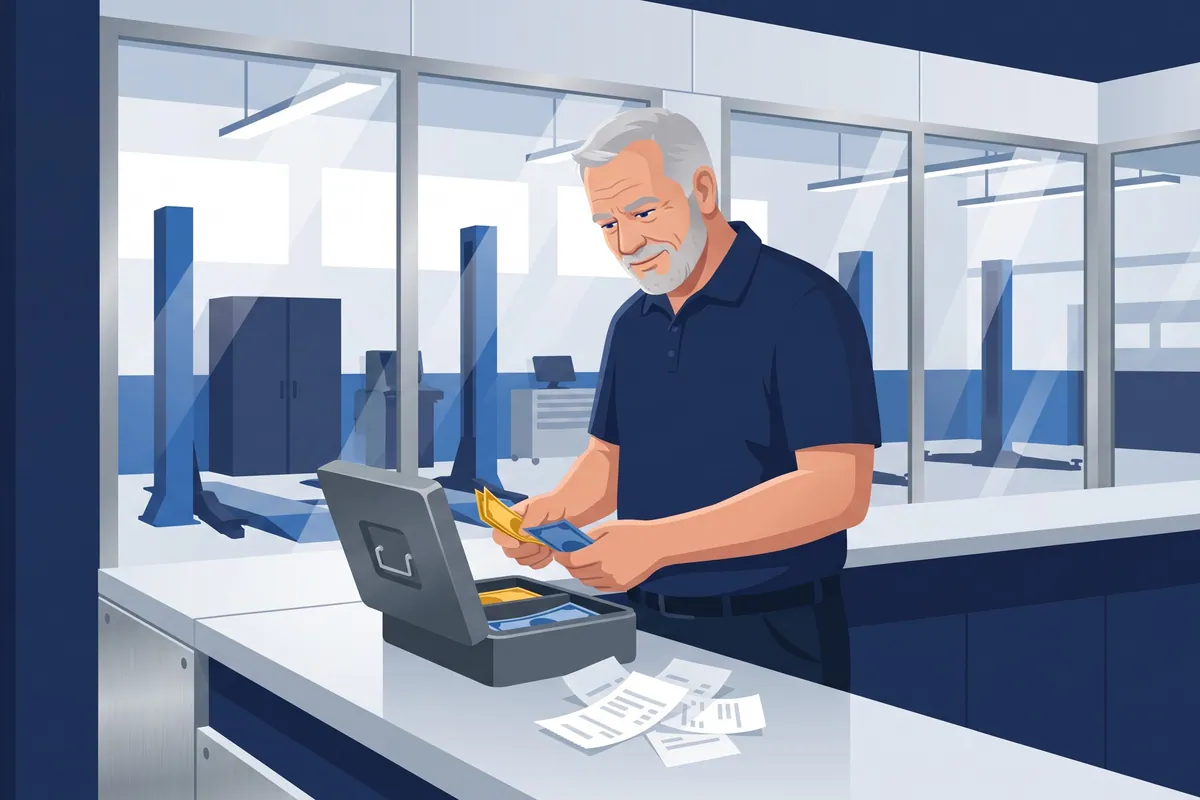

Petty cash is a small amount of cash a business keeps on hand to pay for minor expenses without a check or a card. In a repair shop, petty cash is the bank bag in the service desk drawer, and it always holds less money than everyone remembers, plus one receipt that just says “parts” in pencil.
That’s the definition in plain words. It’s also the name of the account in your books that tracks that money. AccountingCoach calls it a general ledger current asset account, which is a fancy way of saying it’s still your money, even when it’s in a bag.
(Full disclosure: I run WickedFile. It reads parts invoices and receipts, matches them to your repair orders, and flags parts the shop paid for but never billed. It doesn’t count your cash box. That part is on you and a pencil, and I’ll walk you through it first.)
What petty cash is, and what an imprest fund means
Most guides describe petty cash as the money for birthday cakes and postage. In an office, sure. In a repair shop, it buys parts.
The standard way to run it is the imprest system. You set the fund at a fixed number and it never moves in the books. AccountingCoach explains it with a $100 fund: the Petty Cash account “will always report a debit balance of $100.” The custodian should at all times hold cash plus receipts equal to that number.
Here’s how the money flows:
- Set it up. Write a check for $300 (or whatever you pick) and cash it. The entry is a debit to Petty Cash and a credit to your checking account. That’s the last time Petty Cash changes unless you resize the fund.
- Spend it. Every payment out of the bag gets a receipt and a line in the log.
- Refill it. When cash runs low, write a check for the total of the receipts. That check debits the expense accounts on the receipts (parts, supplies, postage) and credits checking.
The expenses hit your books when you refill, not when you spend. That’s why a fund nobody refills is also a fund nobody reviews.
Most petty cash in a repair shop buys parts
Here’s what actually comes out of the bag at most shops:
- COD parts runs. The tech needs a thermostat housing in 20 minutes and the store down the road doesn’t have you on account.
- Counter parts with no invoice. A bulb, a clip, a fuse, paid in cash, with a register receipt instead of a vendor invoice.
- Shop supplies. Zip ties, washer fluid, the good shop towels.
- Small stuff. Postage, a key copy, Saturday lunch.
The first two are the ones that matter. A part bought with cash is still a part. It should end up in one of four places: sold on a repair order, put into stock, returned for credit, or used in the shop. The IRS says the same thing in tax language: for purchases and expenses, your supporting documents should show the payee, the amount, proof of payment, the date, and a description of what you bought. A receipt that says “parts” is one-fifth of that list.
A petty cash log template you can print today
A petty cash log is the running list of every dollar in and out. Tape it inside the lid of the cash box, or keep it on a clipboard next to it. Here’s the one I’d use in a shop:
| Date | Paid to | What it was for | RO # | Amount | Receipt? | Initials |
|---|---|---|---|---|---|---|
| Oct 2 | Parts store (COD) | Brake pads | 48211 | $64.18 | Yes | JM |
| Oct 6 | Hardware store | Washer fluid, zip ties | Shop supplies | $23.47 | Yes | JM |
| Oct 9 | Post office | Certified letter | n/a | $9.85 | Yes | KT |
| Oct 14 | Parts store (COD) | Thermostat housing | 48302 | $41.60 | Yes | DR |
| Oct 20 | Deli | Saturday crew lunch | n/a | $52.00 | Yes | KT |
| Oct 27 | Parts store (COD) | “Parts” | blank | $12.99 | Yes | ? |
(Illustrative numbers. The blank RO and the question mark in the last row are, sadly, very realistic.)
The column most templates leave out is RO #. In a repair shop, that’s the column that matters most. Make it mandatory for anything that goes into a car.
Where petty cash leaks in a repair shop
Everybody says “we don’t lose petty cash.” Then somebody counts it. The leaks are almost never one big theft. They’re small and boring:
- Parts bought with cash that never hit the RO. The housing went on the car. Nobody added it to the ticket. The customer drove off with a free part.
- Receipts with no purpose. $12.99 of “parts” with no RO and no initials. Was it a bulb for a customer, for stock, or for somebody’s truck?
- IOUs. A sticky note that says “Mike, $20, Friday.” Which Friday?
- Customer cash mixed in. Somebody pays cash for an oil change and it goes in the petty cash bag “for now.” Now neither one balances.
Here’s the math on the first one. Paar Melis, a CPA firm that works with repair shops, put the average parts gross profit at 46.1% in its 2025 benchmark report. Using that margin, a $41.60 part should have sold for about $77. Miss two of those a month and you’ve given away roughly $1,850 a year in parts sales, from a cash bag that only ever holds $300. (Illustrative math. Your matrix will differ.)
The worst version I know of didn’t even involve cash. One of Bob’s service advisors bought a customer’s car himself, which employees weren’t allowed to do, then ordered the parts through the shop and never paid for them. The lesson wasn’t about the car. It was that every part the shop pays for needs a legitimate business reason attached, and the RO number is that reason. A cash parts run is the easiest place for that link to disappear.
How to do a petty cash reconciliation every month (with numbers)
A petty cash reconciliation proves that the cash plus the receipts equals the fund. Do it at month end, and any time you refill. Here’s October from the log above, on a $300 imprest fund.
Step 1: Add up the receipts. $64.18 + $23.47 + $9.85 + $41.60 + $52.00 + $12.99 = $204.09.
Step 2: Work out what should be in the bag. $300.00 minus $204.09 = $95.91.
Step 3: Count the cash. The bag holds $89.91. You’re $6.00 short.
Step 4: Record the difference. Small differences go to a cash over and short account. AccountingTools notes that a shortage is a debit to that account, which is an expense, and calls the account “an excellent tool for tracking down fraud situations” when you track it separately for each petty cash box. Six dollars once is change on the floor. Six dollars every month is a pattern.
Step 5: Write the refill check. Receipts plus the shortage: $204.09 + $6.00 = $210.09. That puts the bag back to $300.
Step 6: Post the entry.
| Account | Debit | Credit |
|---|---|---|
| Parts cost (64.18 + 41.60 + 12.99) | $118.77 | |
| Shop supplies | $23.47 | |
| Postage | $9.85 | |
| Meals | $52.00 | |
| Cash over and short | $6.00 | |
| Checking | $210.09 |
Step 7: The shop step nobody else tells you. Pull ROs 48211 and 48302. Are the brake pads and the thermostat housing on them, at the right price? Then find out what the $12.99 was. In my illustrative October, the housing isn’t on RO 48302. That’s the $77 sale from earlier, and it’s still fixable if you catch it this month.
A simple petty cash reconciliation form is just those seven steps on one page: fund amount, receipts total, expected cash, counted cash, over or short, refill amount, two signatures. Staple the receipts behind it.
(I’ll admit my own household would fail this test. I have a seven-month-old daughter, and at our house twenty-dollar bills turn into diapers with no receipt and no initials. Do as I say, not as I do at 2 a.m.)
Petty cash management rules that take five minutes
Petty cash management in a shop comes down to a few habits:
- One custodian. One person holds the bag and the log. Everyone else asks them.
- No receipt, no reimbursement. No exceptions for the owner. Especially not for the owner.
- RO number on every parts receipt, written on the receipt itself at the counter.
- Keep customer cash out of it. Register cash and petty cash live in different places.
- Count it by surprise once a month, with someone other than the custodian watching.
- Size the fund to about a month. If you’re refilling weekly, too much is running through cash.
- Move parts runs to an account or a company card when you can. AccountingTools makes the same point: because of theft risk and paperwork, many businesses now prefer company credit cards or expense reimbursement over petty cash. Card spend still needs a receipt behind every charge, and a receipt scanning app gets the photo taken before the paper ends up under a floor mat.
If those habits are in place, you probably don’t need software for petty cash at all. A clipboard and a monthly count will do it.
Your cash parts receipts deserve the same check as your vendor invoices
Here’s where I think shops get it backwards. They watch the $300 bag like hawks and never check whether the parts it bought got billed. The cash is the small risk. The unbilled part is the bigger one.
WickedFile works on that second risk. What it reads: parts invoices, credit memos and statements from your vendors, plus any receipts you upload; repair orders from your shop management system; QuickBooks Online; and bank and card transactions through Plaid.
What it flags for this topic:
- Parts bought for a repair order that never show up as sold on it.
- Card or bank charges to a parts vendor with no invoice behind them, which is where COD runs go once you move them to a company card.
- Receipts and invoices with an RO number that doesn’t match any real repair order.
How to spend the free trial (500 scanned pages, no credit card): scan last month’s petty cash parts receipts and your two biggest parts vendors’ invoices for the same month, connect your shop management system, and see how many purchases never made it onto a ticket.
What it doesn’t do: it doesn’t count your cash, keep your petty cash log, or post your refill entry. It isn’t a payment processor or a shop management system, and it doesn’t replace QuickBooks or your bookkeeper. After the trial, the Grow plan is $299 a month, flat.
Run last month’s parts receipts through the free trial →
For the rest of the month-end routine, see the month end close checklist, how bank reconciliation fits beside it, and the bigger map of which accounts a repair shop should reconcile. And if your cash runs involve cores, here’s where core credits go missing.
Count the bag, check the ROs, and write the RO number on every receipt. Your petty cash will finally be petty in size only, not in the arguments it starts.