
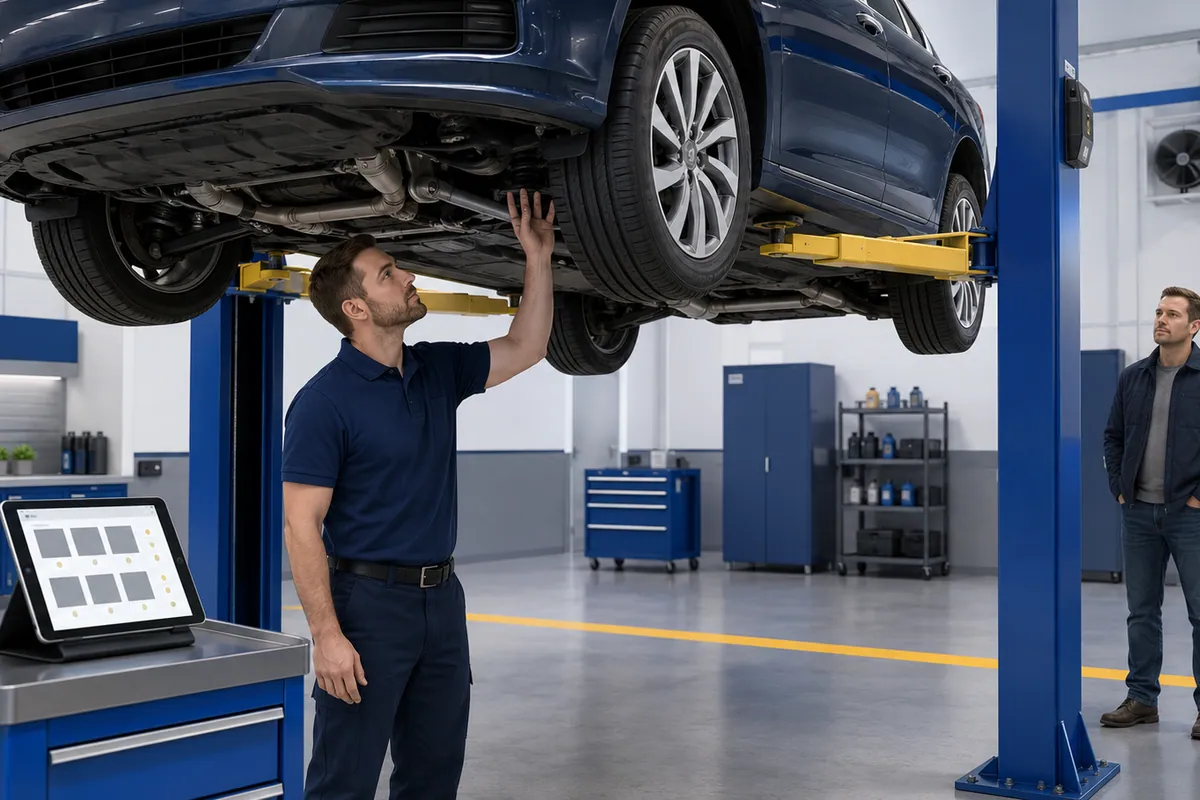

4:40 on a Friday. A guy stands in a stranger’s driveway, hand on the hood of a Highlander he does not own, the seller close enough to hear every word, and he is whispering into the phone: is this a good car? He wants a diagnosis conducted by description.
You cannot answer that. What he is asking for is a used vehicle pre-purchase inspection, and it takes a lift, a scan tool, a technician, and a block of time somebody has to protect. All four belong to you and none of them belong to him. That is why this is a service you can sell instead of a favor you keep doing.
So here are both halves of the answer. First, what a PPI covers and what it promises, in plain terms you can say on the phone. Then what to charge, what belongs on the checklist, and how a two-hour job most shops give away becomes the best new customer you get this month.
What a used vehicle pre-purchase inspection actually is, and what it is not
A used vehicle pre-purchase inspection is a paid, scoped, documented opinion about one specific used vehicle at one specific moment.
Every word in that sentence is load-bearing.
Paid, because it eats the same bay and the same technician a paying repair does. Scoped, because you inspect what you said you would and nothing else. Documented, because the report is the product. One specific vehicle at one specific moment, because a car that inspects clean Thursday can drop a transmission Saturday, and none of that becomes yours.
Now the part shops forget to say out loud. It is not a warranty, not a guarantee, and not a certification. It is also not the manufacturer “certified” program the buyer saw on a dealer’s window sticker, which has its own standards and nothing to do with you.
What the customer gets is narrower than he hopes and more useful than he expects. A written list of what is wrong with the car right now. An estimate of what those things cost. And a reason to walk away, or a number to negotiate with.
How long a pre-purchase inspection takes is the same question as what it costs
I am not giving you a national average duration. A PPI takes exactly as long as you decide it takes, and that decision is the most important one in this service line.
Set a deliberate time block. Shops that do this well tend to land near two hours and treat it as two hours: on the schedule, on a lift, with a technician nobody pulls off it to move a car. Whatever you choose, the block is what you price from, because the block is what you are selling.
Here is where it goes wrong. The PPI gets taken as a walk-in because the customer is “just down the road with the seller.” It gets done in forty minutes between a brake job and a no-start. Nobody writes anything down, and the shop bills eighty dollars if it bills anything.
That is not a pre-purchase inspection. That is a bay you gave to a stranger. And a PPI that takes two hours and bills for one lands in the same bucket as every other unbilled hour in the building, which is the number your effective labor rate reports back at month end.
One more reason to hold the block: a real inspection includes a road test, and the road test is where you learn that the noise the seller swore happens “only when it’s cold” happens at 94 degrees, in a left turn.
The reason you can charge for this is that the buyer does not own a lift
Your caller has a phone flashlight and, if he is thorough, a code reader he bought at the parts store on the way over.
He can see the top of the engine. He can see four tires from the outside. He can hear it start.
He cannot see a rear tire worn to the belts on the inboard edge, a seeping rear main, a crushed frame rail behind a repainted rocker, or a module that will not talk. He cannot tell whether the engine bay is clean because the owner is meticulous or because somebody degreased it Tuesday. (I washed a lot of cars in my dad’s shop. A spotless engine bay at a private sale is a decision, not a habit.)
You can see all of it in about the length of one coffee break, because you own the equipment that makes it visible.
That is also the honest answer when a customer asks why you cost more than the mobile service he found first. Lemon Squad, the national mobile inspection company that sits at the top of this search, publishes $219.99 for its standard used car inspection and lists “Over 25 Pictures” and a “Road Test” among what is included. That is a real service, and for a car three states away it may be the only practical option a buyer has.
It also arrives in a driveway. There is no lift in a driveway.
So tell buyers what to ask a shop, because the answers are what make you the right one. Do you see this make regularly? Is the report written before the phone call? Will you tell me what you did not look at?
What belongs on a pre-purchase inspection checklist
Treat the checklist as an internal document, not a marketing handout. It is what makes the inspection repeatable, makes two technicians produce the same report, and makes the document defensible six weeks later.
Build it in groups.
Identity and paperwork. VIN matched on the dash, the door jamb, and wherever else the make stamps it. Engine and transmission identification against what the car should have. Title in the seller’s name, mileage that agrees with the wear on the pedals. This group takes four minutes and has ended more deals than every mechanical finding combined.
Structure and body. Panel gaps, paint thickness variation, overspray in jambs and under seals, fastener marks, sealer that does not look factory, rail and floor pan from underneath, and the spare well. Photograph anything you flag.
Drivetrain and leaks. Leaks with a location and a rate, not just “leaks.” Coolant, belts and hoses, mounts, CV boots, axle seals, exhaust, cooler lines, and anything with a wet trail leading somewhere.
Brakes and tires, measured. Pad and rotor measurements, tread depth at three points across every tire, DOT date codes, and any mismatch across an axle. Numbers, not adjectives. “Brakes are okay” is not a finding. “Front pads 4mm, right rear tire 3/32 with inside edge wear” is a finding, and it is also an estimate waiting to happen.
Electrical and scan. Stored codes, pending codes, readiness monitor status, and any module that will not communicate. Monitors matter more than people expect: a car with freshly cleared memory and monitors that have not run again is a car whose check engine light has an appointment.
Road test. Cold start, idle quality, shift quality under load and on decel, braking straight and from speed, steering return, noises by condition, HVAC both directions, and the electronics the buyer uses daily.
What was not inspected, and why. This is the group every checklist skips and the one that protects you. No disassembly. No trim removed. No compression test unless authorized. No AC evaluation at 38 degrees ambient. No service history available. An inspection that states its own boundaries is worth more than one that implies there were none.
Deliver the report on the digital inspection tooling you already use, photos attached to the lines they belong to. The tooling is identical, so make the distinction out loud: a digital vehicle inspection is done on a car the customer already owns and aims to sell found work, while a PPI is done on a car he does not own yet and aims at a purchase decision. Same camera, different job.
Classic and collector car pre-purchase inspection is a different product
A classic car pre-purchase inspection is not the same service with older parts in it.
On a modern used car, the buyer wants to know whether it will still be running in two years. On a collector car, the buyer is usually making a five-figure decision about originality, and “will it start Tuesday” is somewhere down the list.
That changes the work. Numbers matching between the VIN and the engine and transmission stampings. Date codes on glass and castings. Whether the paint is original, and if not, what the repaint hid. Whether the drivetrain is correct or a period-plausible substitute. Evidence of past repair, past rust repair, and past optimism. Correctness versus condition, which are two opinions at two prices.
It takes longer, it needs marque-specific knowledge, and being wrong about originality is an expensive kind of wrong. Price it as its own longer block. And be honest about capability: if you do not know what correct looks like on a 1969 anything, scope the job to mechanical and safety condition, say so in writing, and send the buyer to a specialist for the rest.
How much to charge for a pre-purchase inspection
Price the job, not the market.
Your PPI price is two decisions you have already made: your posted labor rate times the time block you set. That is it. If the first one is unsettled, that is a bigger conversation, and it lives in what the right labor rate is for your shop.
You will notice I have not printed a national average, and that is deliberate. The pages most often quoted for PPI cost will not open for verification at all, and most of what is left is an estimator tool that manufactures a number rather than a source that reports one. I would rather give you arithmetic you can defend at your own counter.
So here is the arithmetic. All of it is illustrative. Run it on your own numbers.
Per accounting firm Paar Melis’s 2025 benchmark report, built from client shops’ actual 2024 financials, the average independent shop labor rate runs about $165 an hour and the average repair order runs about $702.
Take a two-hour block at $165. That is about $330 of labor value in that bay, and it is the real cost of the free PPI you did last week. Not zero. Three hundred and thirty dollars of capacity.
Do four of them in a month at that price and you have billed roughly $1,320 for work that used to be a favor.
Then the half that matters. Say two of those four walk away from the car. Good outcome, costs you nothing, and both now have your report in their email. One buys and does nothing. One buys and authorizes the brakes and the leaking rack you documented. At a $702 average repair order, that one conversion is worth more than half the month’s inspection revenue, and the estimate was already written.
I made up the four and I made up the split. I am not printing a conversion rate, because nobody has one worth quoting. Pull your last ten PPIs and count what happened. That is your rate.
Which brings me to the opinion I will defend.
The free pre-purchase inspection is the worst version of this service, and not mainly because of the money. The money is bad enough at $330 a pop. The real problem is that a favor never gets written down. Nobody builds a report for a job nobody is billing, so your whole position becomes what an advisor said in a parking lot. You gave away the bay and kept the exposure.
Charge for it, write it down, and hand the customer a real document with a real invoice attached.
The sentence that creates your exposure: “it’s a good car”
Your written report is your position. Everything said out loud in the parking lot is somebody else’s memory of your position.
Six weeks later, the call is never about your report. It is about a sentence. “Your guy told me it was a good car.” Whether anybody said that or not, the customer heard a verdict, because he called asking for one.
So make the document do the work.
- Scope it before you start. What you will inspect, what you will not, and what the report will contain. On the estimate, in writing, before the car goes up.
- List the exclusions in the report itself, in that last checklist group. No disassembly, no compression test, no history, no AC evaluation in February.
- Report condition, not verdicts. “Right rear tire 3/32 with inside edge wear” is a finding you can stand behind. “Solid car” is not a finding at all.
- Keep the photos and the report as long as you keep everything else. The frame rail photo from March is the whole conversation in May.
- Train the counter to answer with the document. The answer to the one question everybody asks is “here is what we found, here is what it needs, here is the cost, and the decision is yours.” Saying that without flinching takes practice, which is what service advisor training is for.
Requirements for estimates, authorization, and record retention vary by state, and some states are specific about all three. Confirm yours with an attorney who has read your paperwork. This is operator experience, not legal advice.
A pre-purchase inspection is a lead, not a transaction
Are pre-purchase inspections worth it? For the buyer, yes, and answer it honestly: he is buying a list and the standing to negotiate, not a promise.
For you it is better than that. A PPI has two outcomes and both of them end well.
He walks away from the car. You just saved a stranger several thousand dollars. He will tell people, and he will come back, because the next car he looks at needs the same inspection and you are the shop that told him the truth when it cost you the sale.
He buys the car. Now he owns a vehicle with a documented, priced list of everything wrong with it, from your shop, and no relationship with anybody else. There is no cold call as warm as a customer holding an estimate he asked for.
That is why a PPI stops being a couple-hundred-dollar job. You did not sell an inspection. You acquired a customer at the moment he had the strongest reason to trust you, and you got paid for it. Compare that with what a new customer costs through marketing, where this service is one of the ops worth naming in the words customers search.
One workflow note makes it work: the report ends with an estimate, not a summary. Every finding becomes a priced line, sent the same day, before he finishes negotiating with the seller. A priced list is a repair order waiting on a decision.
One checklist, or five different liability profiles
If you run more than one store, this service drifts within a month of you not looking at it.
Store one charges $330 and blocks two hours for it. Store two does it free for anybody who asks nicely. Store three does classic cars because a technician there likes old Mustangs, and nobody has discussed that exposure. Store four does not offer PPIs at all. Store five inspects and writes nothing down.
Then a customer complains about a car store three looked at, and you find out you do not have a policy. You have five.
Standardize five boring things:
- One checklist, the same groups in the same order, including the not-inspected group.
- One time block, identical across stores, protected in the schedule.
- One price, computed from each store’s posted rate where rates differ by market.
- One report template, delivered the same way, photos attached.
- One written refusal rule. No PPI on a vehicle you cannot get on a lift, on a marque that store does not service, or for a customer who will not accept a written report as the deliverable.
Then review one number per store per month: PPIs performed, and PPIs that billed the full block. The gap between those two columns is the whole story, and it will not read the same at all five stores.
Tell him to bring the car
The guy on the phone at 4:40 on a Friday is not being unreasonable. He is about to spend eleven thousand dollars on a machine he has known for nine minutes, and you are the only mechanic whose number he has.
He does not need your opinion. He needs your lift, your scan tool, a documented two hours, and an invoice for it.
So tell him what it costs, put him in the book, and tell him the truth about the rest: the car might sell before he gets it to you. If it sells that fast to somebody who never looked underneath it, well. That is information too.