
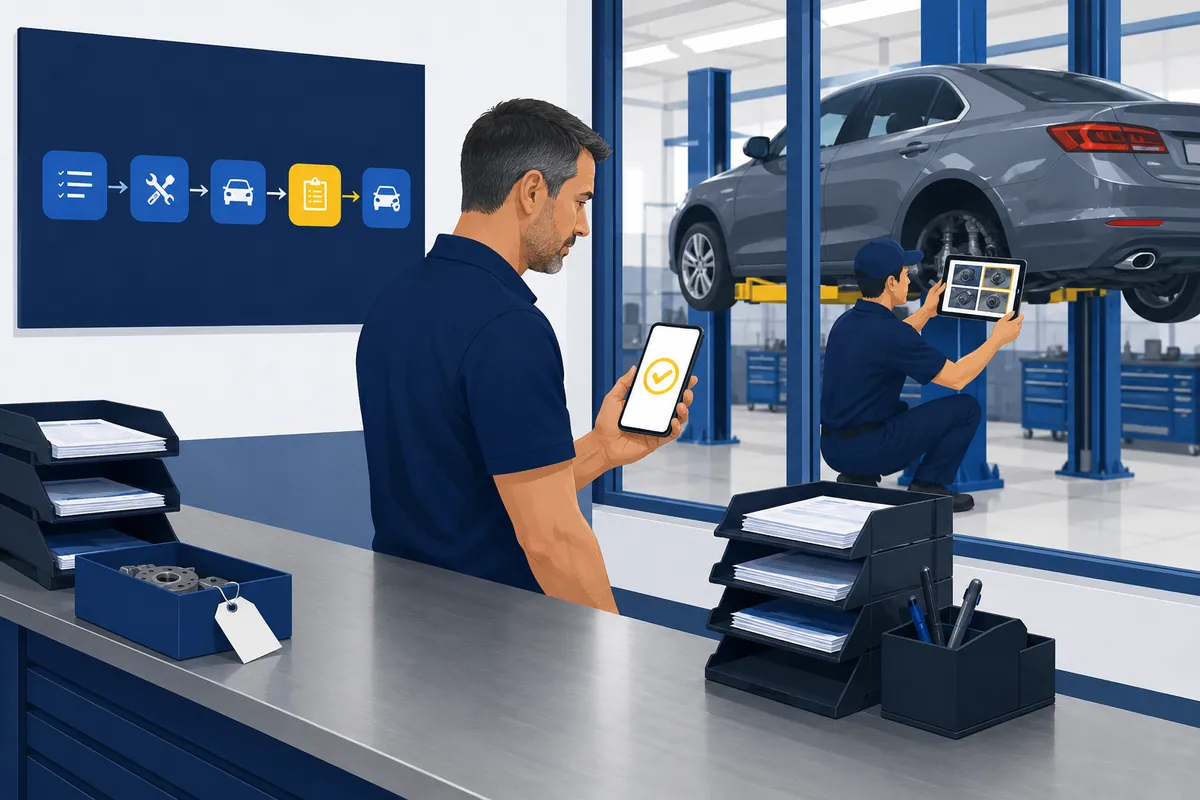

Almost every shop has one tech whose digital vehicle inspection covers fifty checkpoints and contains exactly one photo. A tire. Shot at an angle where it could just as easily be a Labrador.
That shop owns DVI software. It does not have a DVI program.
A digital vehicle inspection is a paper inspection sheet that finally learned how to take pictures. So does it pay? Yes. Shops that run one well sell more of the work their technicians were already finding.
That’s the easy half of this post.
The hard half is what nobody in the DVI business says out loud: a program that raises your average repair order raises your parts purchasing by roughly the same proportion. Every one of those extra parts can be bought and never sold, returned and never credited, or dropped in a core bin where it quietly expires.
This is written for the owner or the multi-location operator, not the customer in your waiting room. It covers what a digital vehicle inspection is, what the evidence says about ARO, how to run a program that lifts it, and the new leak that program creates on its way to making you money.
Read it in six minutes. Build the second half before you celebrate the first.
A Digital Vehicle Inspection Is a Trust Document, Not a Checklist
Digital vehicle inspections have been around long enough that most shops call them “the tablet thing.” Four operational things actually changed.
One distinction first, because the two get confused: a DVI documents a car the customer already owns, while a pre-purchase inspection evaluates one they are deciding whether to buy. Same camera, different job.
- Evidence replaced description. A photo or a 20-second video of the leaking axle seal goes with the finding.
- Approval moved off the phone. The customer gets a link, taps line by line, and approves or declines.
- The record became permanent. What was found, what was shown, what was approved, what was declined, and when. All attached to the repair order.
- Declined work became a list instead of a memory. Every “not today” is now a follow-up opportunity with a date on it.
That last one is where most of the unclaimed money sits, and it’s the one shops ignore.
The inspection itself hasn’t changed. Your techs were already finding the same brake wear, the same weeping shock, the same 9-year-old battery. DVI doesn’t find more work. It documents found work in a format a customer can actually believe.
Does It Pay? Start With Who’s Actually Running One
Adoption tells you something the case studies don’t. In the 2026 Ratchet+Wrench Industry Survey of more than 430 shop owners and managers, 52% reported using electronic inspection sheets. In accounting firm Paar Melis’s 2025 benchmark report, built from client shops’ actual 2024 financials, DVI adoption among their clients was 78%.
Two different populations, so don’t average them. The gap is the finding. Shops whose books are handled by a CPA firm specializing in auto repair run DVI at a materially higher rate than the industry at large. Correlation, not causation. Nobody adopted DVI because their accountant asked nicely. But it’s a signal: DVI travels with the other habits of a well-managed shop.
In the same survey, the most common sales closing ratio landed at 50–59%, against a most-common average vehicle opportunity of $1,200–$1,499 in found work. Half of what your techs find doesn’t get sold. That’s the pile DVI is aimed at.
The Vendor Numbers Are Real, But Read Them as a Ceiling
Most DVI statistics come from DVI vendors reporting on their own customers. That doesn’t make them fiction. It makes them fishing photos: technically accurate, taken at arm’s length, never featuring the day nobody caught anything.
AutoVitals, a DVI software vendor, publishes the most-cited set. From its own materials:
- Shops following its best practices increase ARO by 27% or more.
- Inspections with 40+ pictures show 45% higher ARO; edited or annotated photos show 19% higher ARO.
- Its case study on Victory Auto Service & Glass (28 locations across Minnesota, Wisconsin, and Florida) reports an average +$128 per repair order on tickets where a DVI was used versus tickets where one wasn’t, and more than $300 at their strongest locations.
All of that is vendor-reported customer data, not an independent benchmark. Nobody audited it, and the shops in it self-selected by buying the product and following the program. Read those numbers as what a well-run program can reach, not what showing up buys you.
Still, the 28-location figure is the only widely published DVI number measured across a real group instead of one hero shop. If you operate multiple stores, that’s your reference point.
Why It Works Has Nothing to Do With the Technology
I’ve watched shops spend six months choosing a platform and get almost nothing out of it, and I’ve watched a shop with a $12 phone tripod move its close rate in a month. The tool isn’t the variable.
Three things change when a customer sees a photo.
The trust question disappears. “You need brakes” is a claim. A photo of a 2mm pad next to a new one is a fact. A photo argues better than any service advisor I’ve ever met, and it never gets defensive.
The decision moves to where the customer’s life is. A phone call forces a yes or no in 30 seconds, usually while they’re at work. A texted inspection lets them look on the couch and show their spouse. People say no to pressure. They say yes to information.
Declined work leaves a paper trail. The customer taps “not now” on the rear shocks and it’s dated. Six months later that’s a call your advisor can make with specifics instead of “you were due for some stuff.” That trail is only worth something if the declined line carries a date and a dollar value in your customer record, which is the single most common blank field in a shop database: what an auto repair CRM stores has the audit.
How to Run a Digital Vehicle Inspection Program That Actually Lifts ARO
Buying DVI software and running a DVI program are different projects. Only one has a return. Here’s what separates them.
Inspect nearly everything. Every vehicle that comes in, not a subset somebody picks. If DVI only happens where the advisor already smells an upsell, you’ve built a sales tactic, not a process.
Set a photo minimum and enforce it. The only photo target with a published number behind it is AutoVitals’ own: 40 or more pictures per inspection, with a further lift when they’re edited or annotated. Vendor marketing, but at least it’s marketing that commits to a figure. Pick your own minimum and aim for one image per inspection item. Just have a number, because “some photos” reliably becomes three.
Budget the technician time and pay for it. Most shops I talk to land around 15 to 20 minutes for a full photo inspection. If that time is unpaid, a flat-rate tech does the fastest inspection that still technically counts. Not a character flaw. Arithmetic.
Make the advisor present, not pitch. The advisor’s job is to walk the customer through what the photos show and answer questions. The inspection already did the selling.
Work the deferred list. The biggest miss in the category. Most deferred-work lists have roughly the same read rate as a software license agreement. Somebody owns that list, calls it weekly, and books appointments off it. Otherwise it’s a museum of money you already earned.
Measure per person, not per shop. Averages hide your two problems and your two stars.
A workable weekly rhythm:
- Monday: pull last week’s inspection rate and photo counts by tech, and close rate on found work by advisor.
- Wednesday: call the deferred list from 30, 60, and 90 days ago.
- Friday: review one inspection per tech together, out loud, like a film session.
None of that requires new software. It requires somebody’s calendar.
What to Look For in Digital Vehicle Inspection Software
This isn’t a ranked list of digital vehicle inspection software. If you’re shopping, start with our breakdown of the best auto repair software tools and the framework for choosing shop software in 2026. Both cover the platforms where DVI lives.
What matters when you evaluate one:
- Native to your shop management system, or genuinely integrated. Inspection, approval, and the resulting parts order should land on one repair order. If anybody retypes anything, you’ve bought a second system.
- A fast technician app. Digital vehicle inspection app adoption dies on the shop floor, not in the office. If it takes four taps and a spinning wheel to attach a photo, your techs quietly stop.
- Photo and video handling with annotation. Circling the crack matters more than the megapixels.
- Texted approval with a timestamped record. Line-item approval, line-item decline, both preserved. That’s your documentation if the job gets argued about later.
- Deferred work that behaves like a worklist. Filterable by date and dollar value, not buried in ticket history.
- Reporting by technician and advisor. If you can’t see photo counts and close rates per person, you can’t coach anybody.
And skip any DVI “services” pitch that doesn’t put the record on the repair order. The record is the asset.
Every Digital Vehicle Inspection You Sell Buys More Parts
Here’s the part nobody tells you, and the reason this post exists. Selling more found work means buying more parts, and parts bought under time pressure go sideways more often. That isn’t a knock on DVI. It’s what success looks like from the back office.
Worked example, illustrative, using the AutoVitals-reported +$128 figure as the input:
A 400-RO-per-month shop adds a DVI program and lands the Victory Auto Service number. 400 × $128 = $51,200 per month in incremental sales. Good month. Great year.
Now follow the parts. If that lift takes monthly parts purchasing from $50,000 to $60,000, and just 1% of parts dollars never end up sold on a ticket, returned and credited, or put into stock, that’s $600 a month per shop. Call it $7,200 a year for one store, or roughly $36,000 a year across a five-store group.
New leakage, created by a program that’s otherwise working exactly as advertised.
One percent is conservative. The parts that go missing are the ones ordered fastest: the second caliper on a same-day approval, the wrong sensor swapped for the right one, the core left on a bench because the tech who pulled it went home. Our post on the most common parts ordering mistakes covers each one.
And a return isn’t finished when the part leaves the building. One transmission franchise started reconciling vendor statements and found an employee at one of their vendors had been withholding credits to flatter his own department’s numbers. Thousands of dollars the shop had earned, never applied. The owner had anti-theft signage all over his building. The money was leaking somewhere he’d never thought to look.
So, my one strong opinion on DVI: a DVI program without a parts-reconciliation step isn’t a growth plan, it’s a bigger funnel and a bigger hole. DVI does the front half of the job beautifully and the back half not at all.
For that back half, start with what parts reconciliation is and why it matters, then see how the return-and-forget loophole turns a returned part into a permanent expense. A pending credit is not a credit. It’s a promise with a tracking number.
Five Stores, Five Close Rates, and Nobody to Coach
At one location, DVI is a habit. At five, it’s a standard or it’s nothing.
Without one: store 1 inspects nearly every car with 30 photos, store 3 inspects half of them with six, and store 5 calculates “close rate” its own way. Five stores with five DVI standards isn’t a program. It’s a science fair.
Four things have to be identical across the group:
- Who inspects. Every vehicle, or a defined set of ROs. Written down.
- The photo minimum. One number, group-wide.
- What gets deferred and who calls it. With a follow-up interval.
- The definition of close rate. Same formula, same denominator, every store.
Standardize those four and store-to-store variance becomes coachable instead of mysterious. Our guide to parts and profitability KPIs for auto repair covers tracking ARO and close rate so the numbers compare.
Where WickedFile Fits, and Where It Doesn’t
Plainly: WickedFile is not a DVI tool. It doesn’t inspect vehicles, take photos, or talk to your customers. It has no opinion about your tablet.
It handles the back half: reconciling vendor invoices, credits, statements, card transactions, and repair orders against each other, so you can see whether the parts your DVI-approved work generated were sold on a ticket, returned and credited, or still unresolved. When DVI pushes parts spend up 20%, that’s the report that says whether the extra margin survived the trip.
If your parts volume is low enough that your bookkeeper already checks every invoice against every RO by hand, you don’t need us. Keep doing that. It works.
The Program Is Only Half Built
Digital vehicle inspections earn their reputation. Even discounted for who publishes the numbers, the evidence points one way: show the customer the problem and more of them say yes.
Just remember what you built. A DVI program turns found work into sold work, and sold work into purchased parts. The first two conversions get a dashboard. The third one gets a shoebox.
Build both halves. Otherwise you’ve spent a year raising your ARO for the privilege of donating the difference to a core bin. Cores, unlike your customers, never call back.