
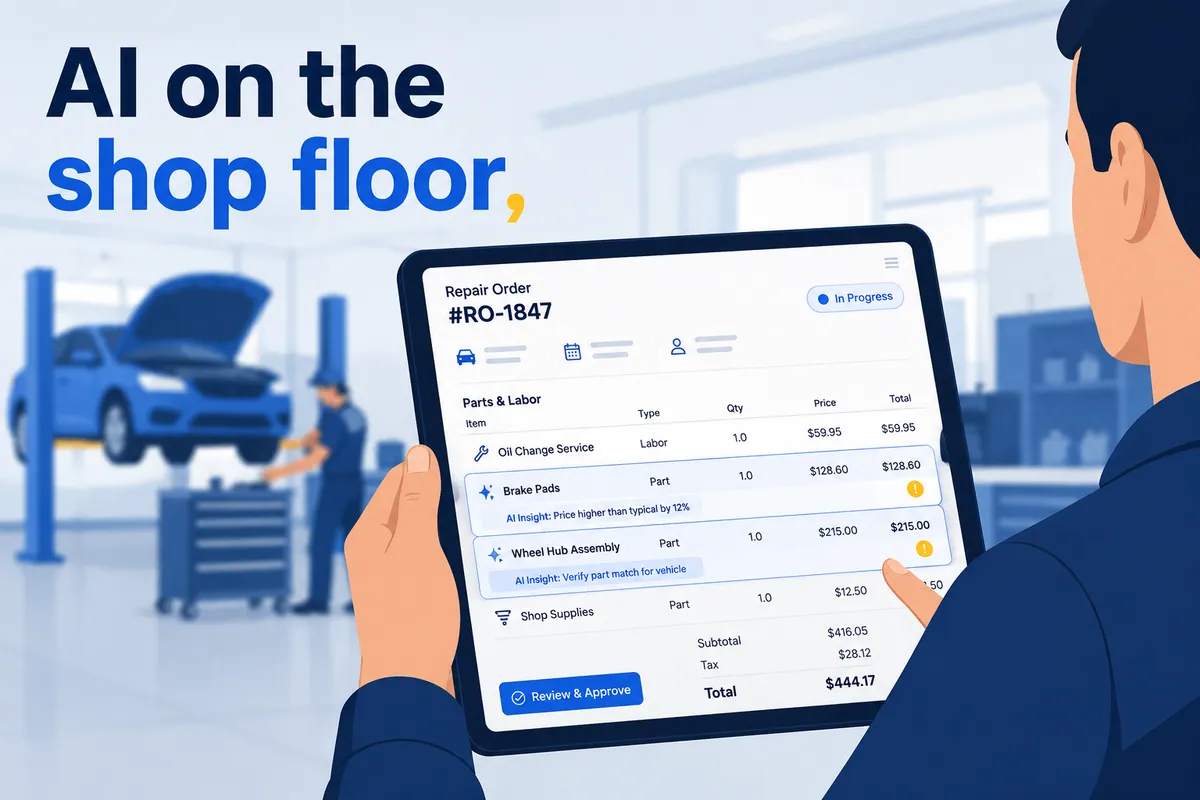

Read the automotive AI news cycle the way the vendors want you to, and 2026 looks like a wall of chatbots, copilots, and diagnostic assistants that are all, apparently, about to run your shop for you. (They are not. Your shop has trust issues with anything that can’t hold a wrench.) Strip the press releases away, and the automotive AI news that reaches your shop floor and your P&L comes down to six developments. Only one or two change how money actually moves through your shop.
This roundup is for the owner or multi-shop operator. Not the customer in your waiting room. They’re here for coffee and a ride home, not for parts-margin theory.
Here’s the answer up front. Most AI announcements are time-savers, and time-savers are good. But the one development with real dollars attached is the quiet one nobody puts on a billboard — AI reading your vendor invoices and flagging the parts errors that bleed margin one $40 line at a time. We’ll get there. First, the honest state of play.
Most automotive AI news is now a feature, not a product
The market is real and growing fast. Trade coverage from outlets like Ratchet & Wrench tracks AI showing up across diagnostics, the service drive, customer communication, and the back office. Adoption is climbing quickly. One widely reported figure puts AI use in shops above half by late 2026, up sharply from a year earlier.
Treat that number as illustrative. It depends entirely on how loosely “AI” gets defined. A spell-checker in a customer-message box counts in some surveys. So does autocomplete. By that bar, your phone has been doing automotive AI since 2014.
What’s not in doubt is the direction. AI is becoming a feature of the systems you already run, not a separate product you buy.
That changes how you evaluate it. You’re rarely choosing whether to adopt AI. You’re deciding which AI features inside your existing stack are worth turning on, and which one genuinely new capability is worth paying for. The rest of this roundup sorts the six developments by one test: does it save hours, recover dollars, or just add a button?
The service drive got a copilot. It’s useful, not magic.
The most visible automotive AI news this year lives inside the shop management systems — Tekmetric, Shop-Ware, Mitchell 1, NAPA TRACS, Protractor, RO Writer. They’ve all shipped some flavor of advisor copilot. AI that drafts an estimate from a few inputs, summarizes a digital inspection into plain language, and writes the first version of a customer text.
This is the augmentation story, and it’s genuinely useful. A service advisor who isn’t retyping “your brakes are at 3mm” forty times a day has more time to actually sell the job. The copilot drafts. The advisor edits and decides. That’s the right division of labor.
Two cautions for owners.
First, the value here is hours saved, not money recovered. Real, but harder to see on a P&L.
Second, every SMS will now market an “AI” tier, and not all of them earn the upcharge. For the tool-by-tool version of what’s worth turning on, see our guide to the best AI tools for auto repair. For putting it to work this year, see how shops can use AI in 2026.
In the bay, AI narrows the diagnostic tree. Your tech still closes it.
The bay is the other place AI showed up loudly. Diagnostic assistants draw on large databases of prior repairs — vendors describe the pools as running into the millions — to suggest likely fixes. Photo-based parts lookup lets a tech snap a picture and get candidate parts and labor lines back in seconds. For collision and mechanical work alike, this shaves real minutes off identification and second-guessing.
If you run a body shop, the diagnostic-and-estimating side is moving especially fast. We covered that in how AI is changing auto body repair.
The takeaway holds across the shop. AI is good at surfacing options and bad at making the final call. It narrows the diagnostic tree. Your tech still closes it. Buy it as a speed tool, not an oracle. An oracle that’s confidently wrong about a misfire is just a very expensive comeback.
The development with real dollars doesn’t photograph well.
Here’s the one that doesn’t make the highlight reel and should.
While the front of the shop got copilots, AI also got pointed at the boring, high-value job: reading the paper trail behind every repair order.
The mechanics are simple to describe and miserable to do by hand. AI and OCR read a vendor invoice, extract every line, and match each part against the repair order in your SMS and the entry in QuickBooks. Then it flags the gaps a human reviewer can’t catch across hundreds of invoices a month. A part billed above its matrix price. A core that never came back. A return that never got credited. A part bought but never sold.
This is the part the headlines skip, and it’s where I’ll plant my flag: most automotive AI news is a time-saver, and exactly one category recovers money. The copilots are fine. The diagnostic tools are fine. But “fine” doesn’t show up on a P&L. Caught margin does.
Run the arithmetic — and treat this as illustrative, not a quote. Say one location pushes 400 parts lines a month. Just 2% carry a billing error or a missed credit. That’s eight lines, at an average $35 each. Call it $280 a month. $3,360 a year, per store.
Now run six stores. That’s roughly $20,000 a year that no green QuickBooks checkmark will ever show you, because the totals reconcile even when the parts don’t. (Accounting software records what got entered. It doesn’t verify reality. Reconciliation does.)
This is the one narrow job WickedFile does. It reads invoices and flags leaks. For the engine, see how WickedFile uses AI behind the scenes.
Now the limits, because that’s the credibility test. WickedFile is not a shop management system — it doesn’t write estimates or run diagnostics. It’s not accounting software — it doesn’t replace QuickBooks. It’s not bill-pay — it doesn’t move money, issue cards, or touch accounts receivable. It’s the reconciliation layer between your SMS, your vendor invoices, and your books. It protects the profit those systems generate. It doesn’t compete with them.
What automotive AI news gets wrong for independent shops
Three things, consistently.
It sells replacement when the reality is augmentation. “AI will run your shop” makes a better headline than “AI drafts the estimate your advisor edits.” The second one is true. Anybody selling the first is selling you a demo, not your Tuesday.
It quotes adoption stats like your shop is behind. Most of those surveys count any AI feature, including ones you’d never notice. Don’t buy a tool out of FOMO. Buy it because it saves a measurable hour or recovers a measurable dollar.
It only looks at the front of the shop. Diagnostics and copilots photograph well. The back office does not. So the coverage skews toward the time-savers and almost completely ignores the one application — invoice auditing — that actually puts money back. If Shawshank taught us anything, it’s that the answer was hiding in the paperwork the whole time. For the wider software picture beyond AI, our 2026 auto repair software news roundup and the automotive software landscape cover what else is shifting; for the business side beyond software, the broader auto repair industry news roundup tracks margins, labor, and ownership.
How to evaluate any AI tool in one question
Of the six developments, the back-office auditing layer is the one that changes your numbers, and it’s the one most owners haven’t priced in. Independent shops run thin — net margins commonly land in the single digits — so margin that’s caught drops straight to the bottom line. For a multi-location group the case is stronger. No single store leaks enough for an owner to notice. The group leaks plenty, and it only surfaces when you can audit every location on one cadence.
So evaluate every AI tool — copilot, diagnostic assistant, or auditor — against one question: does this touch my P&L, or is it a button I’ll never click?
A copilot that saves your advisor an hour a day is worth turning on. A diagnostic assistant that shaves minutes per job earns its keep. And an auditor where one recovered core credit a week covers the subscription is the easiest math on the list. Spend your attention on the developments that move money. Let the rest stay headlines.
Want to see the auditing layer on your own invoices? Book a demo or compare your options. The free trial runs 500 scanned pages with no credit card — enough to find out whether the leaks the headlines ignore are already sitting in your parts invoices. The chatbots can wait. Your margin called dibs.