
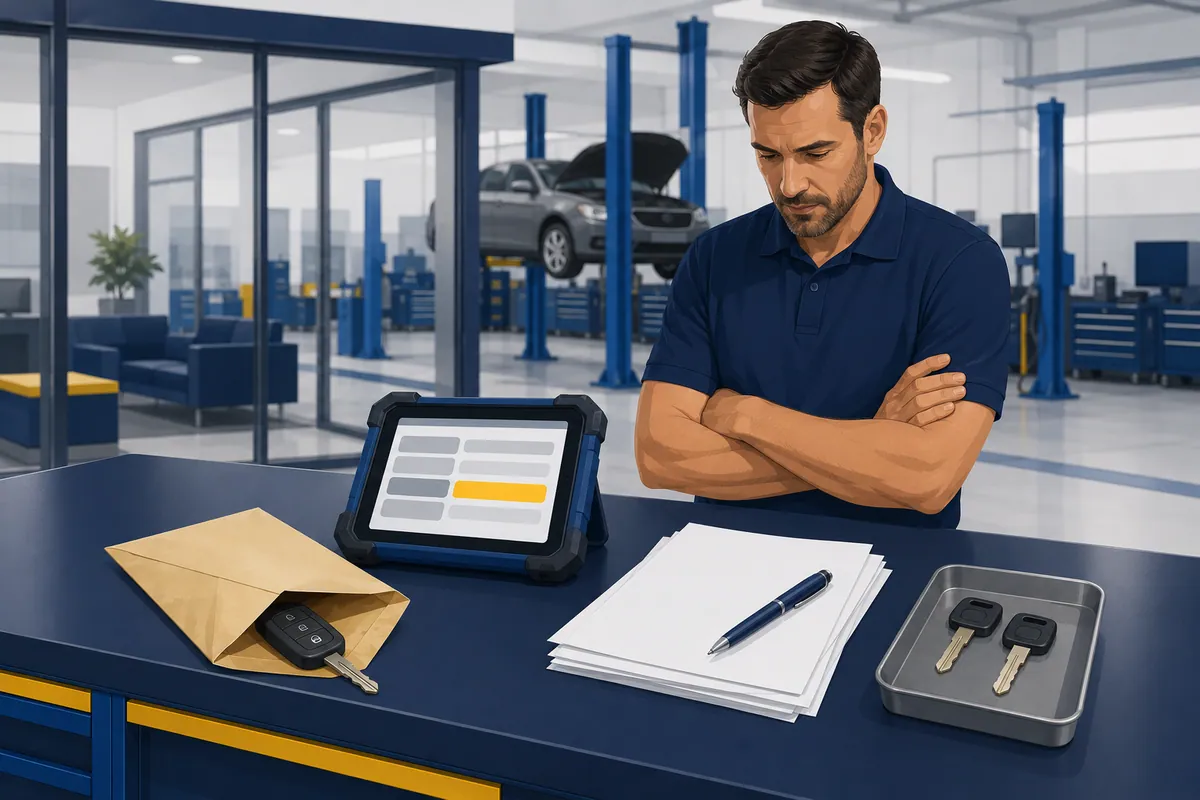

There is an envelope in a drawer at your front counter. A phone number on it, no last name, a broken key inside. Nobody knows which car it goes to, nobody will throw it away, and it has outlived two service advisors.
Automotive key fob programming is the service line that envelope has been asking for.
Here is the answer before the argument. The tool costs less than a decent tire changer. The credential behind it is $435 for two years. Neither number is why most shops turf this work. They turf it because nobody wrote down what the process is, who is allowed to run it, and how you prove the person asking for a key owns the car.
This is for the owner or the group operator, not the guy who dropped his keys in the lake. What the work is, what it costs, what to charge, how to verify ownership, and the jobs per month that justify it.
The locksmith in your parking lot is doing the job you turfed
A customer’s only key stops working. They are standing next to a car that will not start, and they call you first, because you are the shop they trust. Then you tell them to call a locksmith.
Here is the part that should sting. A mobile automotive locksmith often does that job in your lot, on a car parked on your property. You supplied the parking, the trust, and the referral. Somebody else wrote the invoice.
Consumer Reports, writing to car owners rather than to you, routes them elsewhere on recent vehicles for exactly one reason: “If you have a car that was built within the last five years, a new-car dealer will usually be your best bet when you need a replacement key fob, due to the expensive programming equipment that is required.”
That is a national publication routing your customers to a dealership over equipment cost. So let us price the equipment.
Three different jobs get called “key fob programming”
Three jobs share one name at the counter, and they carry three different risk profiles.
Tier one: adding a key when the customer already has a working one. The car can be told to accept another key because an accepted key is present. Short, low drama, and most shops could do it tomorrow.
Tier two: replacing a lost or broken fob or remote. Now you are sourcing the right fob for that VIN, cutting or coding a blade, and pairing it. Longer, and platform coverage starts to matter.
Tier three: all keys lost. Not a bigger tier two. A different business. With no working key to teach the car from, you are into manufacturer security functions, which means the credential, more bay time, and the only real liability in this topic. It also starts with diagnosis, and pricing and defending a diagnostic fee is its own argument that I am not re-running here.
You can offer tiers one and two and decline tier three. That is a service-mix decision, like deciding you do not do transmissions in house. The shops that get hurt are not the ones that refuse tier three. They are the ones that accept it without ever deciding to.
Three words come up inside these jobs. Car key transponder programming means a chip talking to the car from the ignition, usually the shortest ticket of the three. A proximity fob is the push-to-start setup: more antennas, more modules, more of your day. The immobilizer decides whether the engine may run at all, and it is the piece behind manufacturer security. You do not need the cryptography. You need to know which one you are quoting.
Can a customer program a key fob themselves? Sometimes, and your phone script should know which
Far more people search how to program a key fob than will ever read anything written for an owner, so here is the honest version.
Some platforms have an owner-side procedure, and it usually only works when the customer already has two functioning keys. Many newer platforms have none. Whether one exists is per platform, per year, sometimes per trim. So there is no procedure in this post, and “it depends on your exact vehicle” is a true answer at the phone rather than a dodge.
Now the useful part, because a consumer question is hiding a counter process. Whoever answers your phone asks two questions before quoting anything.
- Do you have a working key right now?
- What is the year and make?
Those two answers sort every caller into tier one, two, or three before anybody touches a car. Question one is the whole ballgame, and it is the one nobody asks. Tape it to the counter. It costs nothing and it is worth more than the tool until the tool arrives.
The key programming tool costs less than you think. The subscription behind it is the part nobody mentions
Autel’s own store lists the MaxiIM IM608 Pro II at a limited sale price of $3,695.00 against a regular price of $3,795.00. Manufacturer-direct, which is the best citation quality available on a tool price.
Now the sentence that matters more, printed by the company selling you the device. On that same page, Autel states that the KM100, MaxiIM IM508 series and MaxiIM IM608 series “require an active NASTF SDRM Subscription when used under a North American IP address,” and that “The NASTF subscription is NOT included with the device and must be purchased separately.”
The tool vendor is telling you, on the buy page, that the box alone does not do the job in this country.
Here is what I actually think, and it is about paperwork rather than money: the thing standing between most shops and this service line is an unpublished document checklist. They price the tool, learn a credential sits behind it, cannot find anyone who has written down what that involves, and put the decision back in the drawer next to the envelope. The $3,695 was never the obstacle.
So let us publish it. One budget note first. A key programming tool is software in a metal case, so price its update plan before you buy, the same way you price any scan tool and OEM subscription commitment.
The credential is the real gate, and it is not expensive. It is exacting
Immobilizer, key, and security module access sits behind vetted credentialing by design. The automotive right to repair post covers why that carve-out exists and tells you to get properly credentialed. This section is what that sentence costs.
The credential is a NASTF Vehicle Security Professional account, VSP for short. NASTF’s support site describes it as providing “full access to OEM security functions - such as programming keys, retrieving immobilizer codes, or ordering theft-related parts.”
The fees, from that same page. A VSP Primary Account is $435 for two years. A Subordinate Account is $250 for two years, and is “only available to U.S. W-2 employees and must be directly linked to an active primary VSP account.” An Administrative Account is free, for owners and office staff, and cannot reach vehicle security data. On the application page, that primary breaks out as an “Application Fee: $100 (2 year renewal)” plus a “Primary Account Fee: $335 (2 year license).”
Two years, not a monthly bleed. You will spend more than that on waiting-room coffee over the same stretch, and I have tasted the coffee.
What the application asks for, all of it from that page:
- A color copy of a valid U.S. or Canadian driver’s license.
- Proof of your place in the business: a “W2 (last 4 digits of SSN redacted), pay stub or business document listing applicant as owner.”
- Business standing: a Secretary of State certificate, business license, sales tax certificate, or annual tax return.
- A state locksmith license, “if required by your state.” That phrasing tells you the answer is local.
- A certificate of insurance showing “$1M aggregate / $500K per event Commercial General Liability” with “NASTF (Arvada, CO)” as certificate holder, and the business name and address matching the application.
- Two professional references, and NASTF is blunt: “no family members or generic 800 numbers.”
- The NASTF mobile app installed, with location services and notifications enabled, plus the line that becomes the whole multi-store problem later: “only one mobile device may be registered per account.”
Approval, per that page, “typically takes 2-3 weeks.”
That is the montage, and the montage is a certificate of insurance and two people willing to vouch for you.
Now the honest read. None of those requirements is a hurdle for a real business. You probably carry general liability at or above that limit already, so the certificate may be one call to your agent instead of a premium. You have a business license. You know two people in the trade you are not related to. The list is a filter rather than a wall, and it filters out exactly what you would want filtered out of a system that lets somebody make a working key for a car they are standing beside.
The two to three weeks is the part to plan around. You cannot decide on Tuesday that you are in the key business by Thursday.
What to charge for key fob programming, and why the spread is the product
I went looking for a national average and found the same figure on page after page. Then I checked who publishes those pages. They sell key replacement. A price quoted by the business you would be competing with is a rate card with a headline on it, and I am not laundering one into this post as an “industry average.”
What I can show you is dispersion, from a publication with no fobs to sell.
Consumer Reports, in its guide to replacing a car key fob, quotes specific vehicles. A 2019 Chevrolet Malibu with keyless entry, push-button start and remote start: “$147.98.” A 2017 Hyundai Ioniq fob at “$79.95” online against “the $236.45 the dealer would have charged.” A 2009 Honda Pilot, where a locksmith cut and programmed a key at CR’s own test center for “a total cost of $125,” saving them “$73 over what a local Honda dealer quoted us for the same process.” And a brand average rather than a quote: “The average price for an Audi key fob replacement, including programming, is $500.”
Individual quotes on named vehicles in a consumer article. Not a survey. Averaging them would invent a number that describes nothing. Read them for what they do prove: the same category of job gets quoted at $147.98 in one driveway and $500 in another. A market that disorganized has room in it.
We have also all quietly accepted that a fob can cost more than the brake job on the car it starts. The priciest component per ounce is now the thing customers leave in a swimsuit pocket at the lake.
So build your price from the inside. Your posted rate times the realistic time, using the rate you actually collect rather than the one on the wall, because your effective labor rate is the more uncomfortable number. The fob priced through your matrix like any other part, since a low-volume high-cost part is exactly the band where a lazily configured matrix gives margin away. Then a slice of the tool and the credential, which is the next section.
You are making a key to somebody’s car
Everything above treats this as a service line. It is also the one job in your building where the deliverable is permanent access to a two-ton object belonging to somebody else. A brake job ends. A key you originate exists forever.
Bob, who co-founded WickedFile after years of owning shops, learned the neighboring lesson expensively. Painters working on one of his stores saw where customer keys were kept and where deposits were kept. Days later the building was broken into overnight. Whoever came in went to the cash, then straight to the customer keys, and several vehicles left with them. One customer had a GPS tracker, which is the only reason any came back. Nothing was ever proven about the painters.
The lesson was not about painters. Access to a customer’s vehicle is a controlled thing, and control means a written process instead of a habit. Originating keys raises that stake, because now you are not storing access, you are creating it.
The process, in counter order.
Photo identification checked against the registration or the title. The names have to agree. If they do not, you are having a different conversation, not a faster one.
The VIN on the paperwork checked against the VIN on the car in your bay. Not the plate. The VIN. A plate moves between vehicles in four minutes and a screwdriver.
Write down what you saw and keep it with the repair order. Which identification, which registration or title, which VIN, who checked it, and when. NASTF wants a $1M/$500K liability certificate and two references before it lets anybody near this work. That tells you how the people who built the access system read the exposure, so read your own file the same way.
The refusal script, written before you need it. A car dropped in your lot overnight with a note, a phone number, and an envelope is not a job. It is an unverified person asking you to create access to a vehicle you cannot connect to them. The registered owner needs to be standing there with identification. Whoever opens at seven should be able to say that sentence without calling anyone.
And name who is allowed to run one. Not a department. A person. The credential belongs to a human being and registers one phone, so that list is short, knowable, and worth writing down.
One boundary on all of it. Those paragraphs describe operating practice, not a legal standard, and I am not the one to hand you a legal standard. The requirement here is local rather than federal: several states license automotive locksmith work, which is why NASTF asks for that license “if required by your state.” So make two calls before your first tier-three job. Ask your insurance carrier whether originating keys changes your coverage or premium. Ask your state licensing body whether the work needs a license you do not hold.
The break-even on key programming is a smaller number than you expect
All of this is illustrative. Use your own rate, your own fob cost, your own time.
- $3,695 for the tool over 36 months: about $102.64 a month.
- $435 for the VSP primary over its 24-month term: about $18.13 a month.
- Combined fixed cost: roughly $121 a month.
Now set your gross profit per job. Say a tier-two fob replacement leaves about $175 of gross profit after the technician’s time and the fob, which is conservative for an hour of labor plus a fob at matrix.
$121 divided by $175 is 0.69. One job a month pays for the tool and the credential. Not one a week. One a month.
At four a month, the same illustration throws off about $700 of gross profit against $121 of fixed cost, or roughly $6,900 a year that currently belongs to whoever your advisor recommends. Tier-three tickets run larger, since they carry a tow and a diagnosis.
Put that beside the other two capabilities arriving on owners’ desks uninvited. An ADAS calibration setup runs tens of thousands of dollars and needs twenty-plus a month before the payback works at all. A machine for the newer refrigerant is four figures before you buy a pound of anything. Key programming is the cheapest of the three by an order of magnitude, and it carries the highest gross profit per ticket.
The gate is not the $121. It is the two to three weeks, the certificate of insurance, and one person willing to own the process.
The tool travels between stores. The credential does not
A tool is property. It can live at your busiest building, ride across town in somebody’s truck on Thursday, and get scheduled like a scan tool. Groups already know how to do that part.
The credential is not property. Read the NASTF rules again with a group hat on.
- The primary account is issued to a person, who documents ownership or W-2 employment.
- “Only one mobile device may be registered per account.” One phone. Not one per store, and not a shared tablet in the manager’s office.
- Subordinate accounts are “only available to U.S. W-2 employees and must be directly linked to an active primary VSP account.”
Three consequences.
You cannot pass one credential around five buildings. The device registration settles that by itself, whatever workaround is about to get proposed in a management meeting.
You cannot credential a contractor. The W-2 language is explicit, so a plan built on a 1099 diagnostic specialist covering key work for the group needs rewriting.
And here is the one nobody sees coming: a subordinate account is not redundancy. It is linked to an active primary. It hangs off that account rather than standing beside it. If the person holding your primary resigns, the accounts underneath are dependents, not a backup. Real redundancy is a second primary, held by a second person, at $435 for two years.
So the group question was never where to keep the tool. It is who holds the account, what happens to the service line the week that person leaves, and whether $435 over two years is a fair price to remove a single point of failure. Asked that way, it is not close.
A test to run before your next management meeting. Name the person in your group who holds the VSP credential today. Write it down. Now write the name of the person who would hold it if that person resigned on Friday. If the second name does not exist, you did not find a staffing gap. You found out that a service line listed on your website is currently a favor from one employee.
What to do this week
None of this needs a purchase order.
- Add a decline reason to the repair order: key, fob, or immobilizer. Count it for 90 days and you will have a number where you currently have a feeling.
- Call two local automotive locksmiths and ask what they charge for all three tiers. They will tell you. That is your market, honestly gathered, in twenty minutes.
- Ask your insurance agent one question: what do my current general liability limits actually say, and does originating keys change anything.
- Tape the two counter questions to the phone, even if you never buy the tool. It stops advisors from quoting jobs nobody in the building can do.
Then decide with a number instead of a mood.
Where WickedFile fits, and where it does not
Limits first, because they are the bigger half here. WickedFile does not program keys. It holds no credential, has no opinion about your NASTF application, does not verify that anybody owns anything, and will not keep your identification records. It is not your shop management system and it is not your insurance agent.
What it does notice is that a fob is a part. Bought from a vendor for one specific job, real cost, and on an all-keys-lost ticket often the most expensive part on the invoice. A part bought for a repair order and never billed on it is a bought-not-sold exception, the same failure shape as an uncredited core. At $30 that leak hides easily. At fob money, one a month is a real hole, and it only surfaces when the vendor invoice and the repair order get compared line by line.
Otherwise this is a topic about process, a document checklist, and one named human. Which is usually how it goes.
So price the tool, read the application, and put a name on the credential. Then go open the drawer and deal with the envelope. Not because it is a lead. Because a broken key with no last name on it has been quietly filing a complaint about your process since before your current service advisor was hired.