
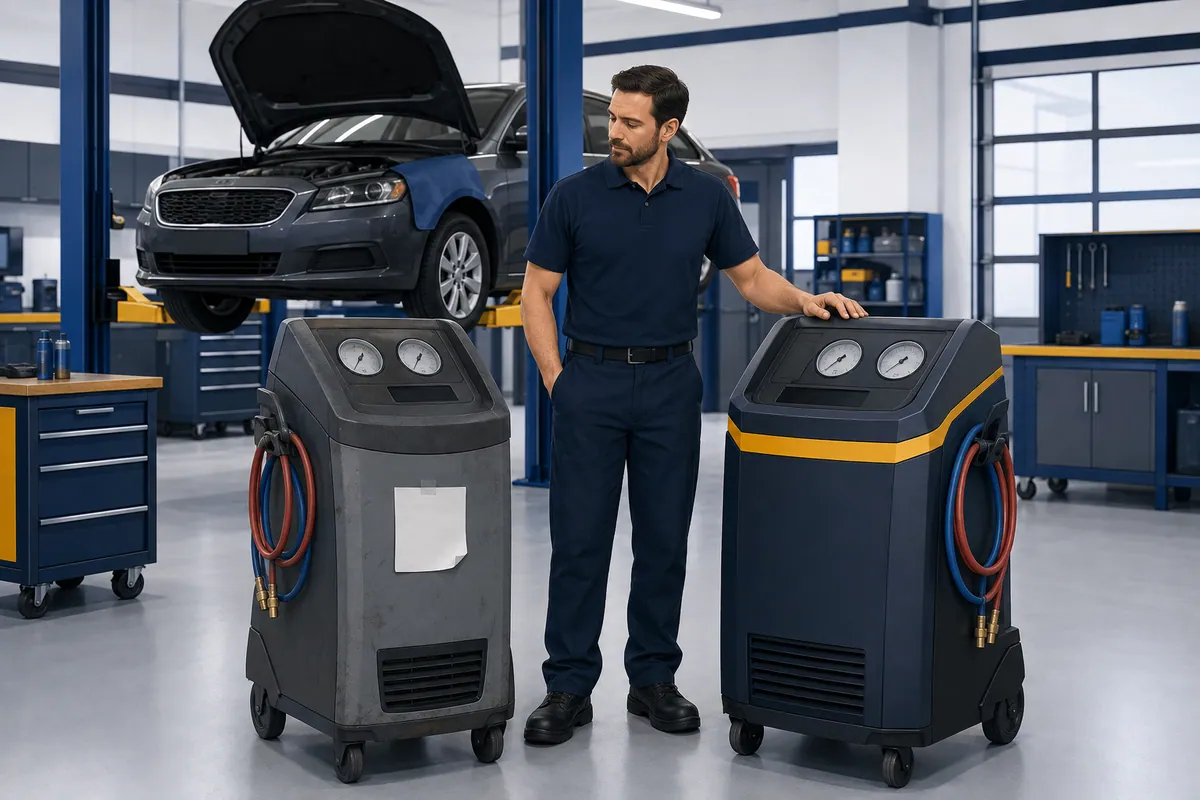

Walk into any shop that owns one A/C machine and you find a note taped to the front of it. Sharpie, all caps. R-134a ONLY. Some shops have that note twice, in two different hands, and one of them is underlined. The note exists because somebody already did.
A laminated warning is not an equipment strategy.
Here is the short answer, because you came for the money and not the chemistry. Most shops servicing recent model years should buy the R1234yf machine, and the machine is not the part you will get wrong. The refrigerant is. Equipment is a one-time number you can quote in an afternoon. Refrigerant walks out of your building in a customer’s condenser several times a week, at roughly three times the price you built your A/C pricing around.
This is for the owner or group operator, not the car owner. What the machine costs, what the refrigerant costs, what the EPA requires of your building, and the car count that makes it pay.
An R1234yf Machine Is a Second Machine, Not a Replacement
You already own an A/C machine. It works. It is paid for. Nobody is asking you to replace it.
That is what makes this different from every other equipment argument in the shop. You are not upgrading. You are being asked to run two fleets: one for the cars you have always serviced, and a second for a growing share of the cars now backing into your bays. Two other capabilities are arriving the same way and are worth reading beside this one: key and fob programming, where a cheap tool sits behind an expensive credential, and TPMS service, where a $279 tool gates work you touch weekly.
And notice what you cannot do about it. A car arrives Thursday in July with no cold air, and that work is on your lift today, with the customer in your waiting room reading a 2019 magazine. You cannot schedule it out. You cannot send it across town and get it back before close. The choice is a real service or a real apology.
So say it plainly: an R1234yf machine is not a sublet-or-buy question. It is a serve-it-or-turf-it question. Different question, different answer.
R-134a vs R-1234yf: Four Differences That Reach Your Invoice
Search R1234yf vs R134a and you get molecular diagrams. Here are the four differences that reach an invoice instead.
One. They are not interchangeable, and the fittings say so on purpose. EPA’s acceptable MVAC refrigerants page states that HFO-1234yf systems “must adhere to all of the safety requirements of SAE J639,” including “a flammable refrigerant warning label, high-pressure compressor cutoff switch and pressure relief devices, and unique fittings.” For professional servicing, EPA says container connections “must be consistent with SAE J2844.” The couplers were designed so a busy tech physically cannot cross-connect the two. Your Sharpie note was the backup plan.
Two. R-1234yf is mildly flammable, which is why the equipment standard is separate. EPA classifies it on that same page as “Mildly flammable (ASHRAE A2L) but can be used safely.” That is not a reason to avoid the work. It is the reason the machine is a separate product line rather than a firmware update to the one you own.
Three. The per-pound cost is a different order of magnitude, and it is the most under-appreciated line in this decision. Numbers and the vendor page below.
Four. Cross-contamination is a financial event, not a technical one. An unknown charge in your recovery tank has not damaged a car. It has damaged inventory, and possibly the next four cars. That is why machines at the top of the price range include an identifier that tests the charge before recovery, and the cheap ones often do not.
One thing people search for that I will not build: an R-1234yf pressure chart. Operating pressures are a vehicle-specific spec you read from the OEM information for that VIN, the same currency problem covered in keeping scan tools and OEM information current.
What an R1234yf Machine Costs Right Now
Three live listings, each linked to the page that carries its own number, all checked in August 2026.
- AIRTEK AC-1234plus: $4,280.00, on AirTek’s own product page. Read that one closely. It does not claim SAE J2843 for this model, and separately describes a different unit, the ACentre20, as “a newly launched SAE-certified 1234yf machine” with a built-in identifier. Ask about the model number, not the brand.
- Mahle ArcticPRO ACX2250: $6,259.00, at Garage Appeal, free shipping, “usually ships in 5-10 business days.”
- Robinair AC1234-4: $7,225.00, at Best Buy Auto Equipment. That page says it is “engineered to meet and exceed SAE J2927 and SAE J2843 standards” and carries an integrated identifier that “automatically samples the refrigerant in the vehicle’s A/C system prior to recovery.”
That spread tells you what the extra money buys at the top: certification to the recovery and recycling standards, plus an identifier that protects your tank from the one expensive mistake.
Budget two things nobody quotes. Your R-134a manifold set does not fit, so add a dedicated set of R1234yf gauges and couplers. And add a starting cylinder, because a machine with nothing in it is a very clean cart.
List prices on equipment ecommerce move, so treat the shape as four thousand and change up to a bit north of seven thousand, then get three local quotes. Ask each one which standards that exact model is certified to, in writing.
The Refrigerant Is the Line You Are Billing Wrong
I checked one supplier on August 13, 2026. A 10 lb cylinder of R-1234yf listed at $449.00, down from $469.00, with quantity breaks at $399, $379 and $349 for pallet quantities. On the same site the same day, a 30 lb cylinder of R-134a listed at $409.00, down from $439.00.
Read those two together, because that is the whole argument. Roughly $44.90 a pound against roughly $13.63, in a cylinder a third the size. You pay about the same money and get a third of the refrigerant. One vendor, one day, list price, not a market average. Price your own supplier. The ratio will not be kind there either.
(I grew up in my dad’s shop and I have carried a 30 lb cylinder of 134a up a ramp without thinking about it. A 10 lb yf cylinder is easier to carry and harder to look at.)
Here is the strong opinion, and it will annoy some very good service advisors: refrigerant belongs on the ticket by weight, every time. If your shop management system has no unit-of-measure field you can put ounces into, you are not pricing refrigerant. You are donating it in increments too small to notice.
Three ways it goes wrong.
1. Billing by the job instead of by the ounce
A flat “A/C recharge” price is a bet on the average car. The average car never comes in. Specific cars do, and their charge weights vary a lot across platforms. Read the weight off the OEM information or the underhood label for that VIN, put the ounces on the line, and let the number be the number.
At $44.90 a pound, an illustrative pound-and-a-half charge is $67.35 of raw material. If your flat price was built when a pound and a half cost twenty dollars, your flat price is now a coupon.
2. The cylinder nobody reconciles
You buy a cylinder. It becomes some number of jobs. Almost nobody can tell you what that number was, which means nobody can tell you whether the refrigerant got billed.
Illustrative math, every input yours to replace. One 10 lb cylinder at $449.00. At a pound and a half per full charge, that is about six charges before you account for anything left in the hoses or the machine.
Now assume two of those six went out on a flat price that did not cover the refrigerant. Three pounds, $134.70, about 30% of a $449 cylinder, gone with no theft, no bad vendor and nobody at fault. Twelve cylinders a year at that rate is roughly $1,616 a year, per store, on a leak with no symptom.
3. Recovered refrigerant, in both directions
Recovering and reusing is the entire point of the machine. But if your pricing assumes virgin refrigerant and your practice is recovery, you have a margin you are not measuring in either direction. Sometimes that is upside you never booked. Sometimes it is a tech topping off from a tank nobody weighed.
Two boundaries so you do not fight the wrong argument. This is refrigerant as a billed material with a measurable per-pound cost, which is not your fee block: whether hazmat and consumables belong in a shop supplies charge is a separate decision with separate state rules, and that post has it. Do not try to recover $67 of refrigerant through a percentage fee capped at fifty dollars. And if the job is finding the leak rather than filling the system, that is diagnostic work, priced off your own rate in the mechanic diagnostic fee post.
EPA 609, in Plain Terms
A framing note first, at the top rather than buried at the bottom. What follows is my read of EPA’s published pages as an operator, not a compliance opinion. Federal refrigerant rules are a floor, and plenty of states stack their own waste-handling and reporting requirements on top of it. Read EPA’s MVAC pages yourself, then call your state environmental agency, because the name on any penalty will be yours and not mine.
Three things, all from EPA’s regulatory requirements for MVAC system servicing.
Technicians. EPA states that technicians who repair or service MVAC systems “for consideration (e.g., payment or bartering) must be trained and certified” under Clean Air Act section 609. If you bill for it, this is you.
Equipment. Technicians must use “refrigerant handling equipment that has been certified by EPA or an independent standards testing organization approved by EPA.” Another reason to ask about the model number and not the brand.
Records, which is the part shops miss. EPA states that service shops must “maintain on-site records proving that each person using servicing equipment has been properly trained and certified,” must keep records of the facilities receiving recovered refrigerant, and that “records must be maintained for 3 years.” Three years. On site. Not in the tech’s glovebox.
Now the useful part, because it removes a barrier I hear about a lot. If your shop previously certified equipment ownership for CFC-12 or HFC-134a, EPA’s page says the shop “is not required to re-submit certification to EPA when they purchase new equipment,” and adds, in these words, that “this applies even if the shop purchases equipment for a different refrigerant, such as hydrofluoroolefin (HFO)-1234yf.”
You already did that paperwork. The second machine does not make you do it again.
The Break-Even Is Your Car Parc, Not the Weather
Now the money, and every input below is illustrative. Replace all of it with yours.
Take the mid-range verified machine at $6,259. Add roughly $700 for dedicated gauges, couplers and a starting cylinder. Call it $7,000 all in. Amortized over 36 months, that is about $195 a month.
Set your own gross profit per R-1234yf service after refrigerant cost and loaded tech time. Say $150.
$195 divided by $150 is 1.3. Two R-1234yf services a month cover the equipment.
If you came here for a payback table, that is the honest reason there isn’t one. When the fixed cost of a piece of tooling really does decide the answer, you get a real table, and the ADAS calibration payback math is where that argument lives. This is not that. Two jobs a month is not a hurdle, it is a Tuesday.
So the number that decides this is not the payback. It is what share of the vehicles on your lifts this month take R-1234yf. At zero, the machine is a very tidy cart. At fifteen percent, you are turfing work on cars that are already yours.
You do not need a national statistic for that. You need a clipboard and a week:
- For two weeks, have whoever writes the RO record the refrigerant type at check-in. It is on the label under the hood. Two seconds a car.
- Then pull 90 days of declined and referred-out work and count the A/C jobs you sent away, with a reason.
That describes your customers instead of the average of everyone else’s.
The macro only sets direction, and it points one way. Accounting firm Paar Melis’s 2025 benchmark report (built from client shops’ 2024 financials) puts average U.S. vehicle age at a record 12.6 years, projects the 6-to-14-year window independents live on to grow about 12% from 2020 to 2028, and puts independents at more than 70% of post-warranty repairs. Separately, EPA’s MVAC page shows the October 2023 Technology Transitions rule setting compliance for newly manufactured light-duty passenger vehicles at Model Year 2025, and medium and heavy duty at Model Year 2028. New cars are not going backwards, and the ones already carrying this refrigerant are aging straight into your window. That is every service line quietly becoming a capital decision, which is the automotive industry challenges pillar.
Five Stores Cannot Share One A/C Machine, and That Is the Whole Difference
We have argued the opposite on this site, and I would rather say so out loud than let two of our own posts quietly disagree.
In the ADAS calibration post, the group answer is hub and spoke. One store gets the level floor and the targets, the other four sublet to it, and the fixed cost spread five ways is the whole reason it works. That answer is right there and wrong here, for one reason: scheduling.
A calibration can wait until Thursday and can leave the property. An A/C service on a car already on your lift on a 96-degree afternoon can do neither. So the fixed cost does not spread. Every store that services R-1234yf needs its own machine, and any group plan starting with “we’ll run them all through the Westside store” ends with a customer at another counter being told to come back Friday.
Which makes the group question consistency, not capital allocation. Somebody in your market is going to be the car A/C repair shop that handles both refrigerants competently and bills them the same way at every door. That is a paperwork win, not an equipment win.
Two things standardize. How refrigerant is billed: one part number, one unit of measure, ounces, same matrix treatment at every store. If one location bills a flat recharge and another bills by weight, your consolidated parts margin is measuring two different businesses, which is the general fight in the multi-location back office post. And purchase to consumption: every cylinder is a vendor invoice, and every ounce should land on a repair order.
So put one line on the monthly report: pounds of R-1234yf purchased versus pounds of R-1234yf billed, by store. Not dollars. Pounds. Dollars drift with the market and hide the gap. Pounds do not, and a store where those two numbers sit half a cylinder apart every month is telling you something specific about how its tickets get written.
Audit This Before You Buy Anything
An afternoon, no purchase, no software. In this order:
- Count the turn-aways. Last 90 days, every A/C job you declined or sent out over the refrigerant. Add a decline reason to the RO going forward so next quarter this is a report, not an archaeology project.
- Total 12 months of refrigerant purchases. Every cylinder, every vendor, in dollars and in pounds.
- Total 12 months of billed refrigerant for the same period, from your SMS.
- Look at the gap.
Then read it honestly. If the two totals are close and the turn-away count is low, you do not need the machine yet, and I would rather say that than help you finance a cart. Revisit in two quarters.
If the totals are far apart, you found something better than a purchasing decision. You found a billing habit that will follow the new machine straight into a refrigerant costing three times as much per pound.
Nobody who buys a cylinder writes down where it went. That is the whole finding, and it costs nothing to fix.
Where WickedFile Fits, and Where It Does Not
Limits first, because they matter more here than the pitch. WickedFile does not service A/C, has no opinion on which machine to buy, cannot weigh a charge, is not your shop management system, and does not keep your EPA 609 records. What it does is treat a refrigerant cylinder as what it is: a vendor invoice that has to end up attached to jobs, exactly like a part. A cylinder bought with no repair order showing it sold is the same exception as a bought-not-sold alternator. One shop buying four cylinders a year? A notebook handles that, and you should close this tab. Five stores, three suppliers and a shared inbox is where it stops being a notebook job.
The Sharpie note on the front of your old machine has kept you out of one bad afternoon. It has never once billed a pound of refrigerant. That part is still on you.