

Ask three people at your front counter what the shop supplies fee covers and you’ll get three different answers. One of them will be “the computer adds it.”
That line is the most profitable one on your invoice and the one nobody has looked at since roughly 2014.
Here’s the number that should send you to last month’s P&L. According to accounting firm Paar Melis’s 2025 benchmark report, built from client shops’ actual 2024 financials, shop-supply sales average 3.3% of overall sales at 0.5% cost. Read that again. You are billing roughly six dollars for every one you spend.
This is for the owner or the group operator, not the customer: what to charge, whether it’s legal where you operate, and the half nobody audits (the supplies you’re buying). The example below puts $46,000 a year back on the table for one $2M shop.
Read it in six minutes. Fix it before the month closes.
What a Shop Supplies Charge Is Actually Paying For
A shop supplies charge recovers the consumables a job burns through that nobody can practically bill by the unit.
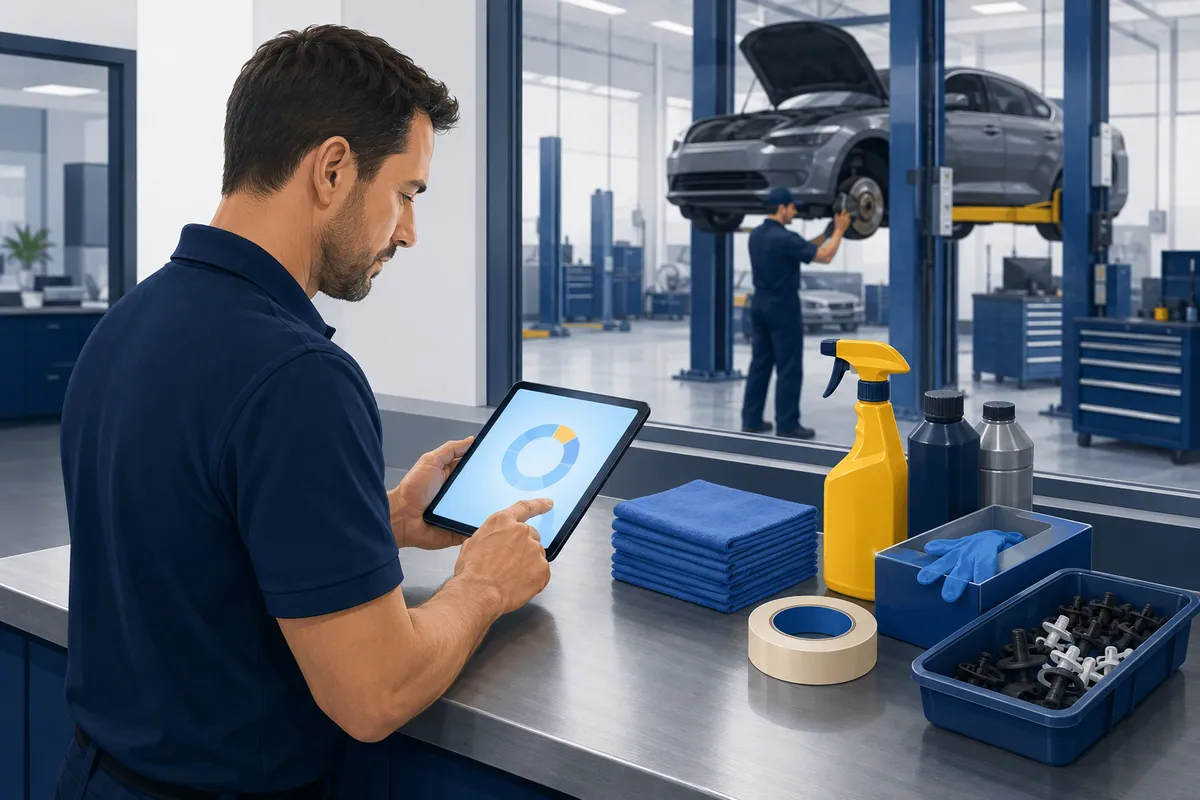
Brake clean. Shop rags. Nitrile gloves. Zip ties and trim clips. Thread locker, sandpaper, welding gas, floor dry, and the fifth O-ring after the first four went into the void under the lift. (I spent a summer of my teens in my dad’s shop functioning as a shop supply myself: rags, brake clean, and a broom.)
None of it is worth its own line. All of it costs real money.
What it is not: a slush fund. Not rent, not the electric bill, and not a way to recover a part you forgot to charge for. Put a $14 bottle of dye in a cooling system and that’s a part. Bill it as one. The same rule settles the tire counter: a TPMS service pack is a part and the relearn is labor, and neither one belongs inside this fee.
That distinction isn’t just tidy bookkeeping. In some states it’s the law.
On the ticket the fee sits near the bottom, next to hazmat and disposal. It’s one line among the blocks every auto repair shop invoice needs, and one field on the complete repair order spec.
Your Shop Supplies Charge Is Almost Pure Margin, Which Is Why Under-Billing Hurts
Here’s the math. Illustrative, built on the PMA benchmark and a $2M shop.
| Annual figures, $2M in sales | Recovering 3.3% (benchmark) | Recovering 1% |
|---|---|---|
| Shop supplies billed | $66,000 | $20,000 |
| Shop supplies cost (0.5% of sales) | $10,000 | $10,000 |
| Gross profit on supplies | $56,000 | $10,000 |
Notice what doesn’t move. The cost line is identical. You buy the same brake clean either way. The rags don’t know what you charged for them.
So the entire $46,000 gap falls straight to gross profit. No new customers, no labor-rate increase, no extra hours sold. That’s a hire.
Across a five-store group doing $10M, the same gap is roughly $230,000 a year.
And here’s the part that stings: most shops don’t have a shop supplies problem. They have a measurement problem. Ask an owner what they charge and you’ll get the percentage instantly. Ask what they recovered last year as a percent of sales and the room goes quiet. Only the second number is real. The cap, the advisor who deletes the fee to close a deal, the internal repair orders, the fleet accounts somebody exempted in 2019. All of it lives between the policy and the P&L.
How Much to Charge for Shop Supplies: Four Methods
Four common approaches. All four are industry practice, not a legal standard. Nobody hands out an approved number.
| Method | How it works | Where it breaks |
|---|---|---|
| Percentage of labor | 5–10% of the labor total, usually capped | The cap quietly eats big tickets |
| Percentage of the whole RO | Same percentage on parts + labor | Overcharges parts-heavy jobs, and customers notice |
| Flat fee per RO | A set $15–$35 on every ticket | Oil changes subsidize engine work, and vice versa |
| Itemized actuals | Bill what the job actually consumed | Most defensible, most work at the counter |
Percentage of labor is the most common, because labor hours are a decent proxy for how much brake clean and how many rags a job burns.
Now translate the benchmark into a number you can type into your shop management system. If labor runs about 55% of sales, 6% of labor lands almost exactly on 3.3% of total sales. Adjust for your own mix.
Then look hard at your cap. Paar Melis put the 2024 average repair order at about $702. Call it $385 in labor, so 6% is $23. Nobody blinks at $23. On a $4,000 job with $2,200 in labor, 6% is $132, and a $50 cap just ate $82 of it. Garden hose, house fire.
If your cap was set when your average ticket was half what it is today, it isn’t a consumer-protection gesture anymore. It’s a discount you forgot you were giving.
Are Shop Supply Fees Legal? That Depends Entirely on Your State
This is the part where I tell you to call someone licensed in your state, and I mean it.
California is the sharpest baseline. In its ARSC guidance on repair transaction fees, the California Bureau of Automotive Repair states that separate billing for items “generically noted as shop supplies, miscellaneous parts… and the like, is prohibited.” Supplies must be itemized and reflect what was actually used on that vehicle. Same guidance on hazmat: a shop may charge for handling and disposing of hazardous waste only where it’s directly related to servicing that customer’s vehicle, and a general hazardous-materials fee charged to every customer is not permitted.
That’s California. Requirements vary by state, and the range is wide: detailed itemization rules in some, general consumer-protection language in others, nothing specific at all in a few. Verify with your state’s repair board, consumer-affairs agency, or your attorney before copying anyone’s fee structure, including a benchmark from a national report.
Two habits travel well regardless:
- Disclose the fee on the estimate, before the work is authorized. Not as a discovery at pickup.
- Be able to explain the number. “It’s 6% of labor, capped at $75, and it covers consumables” is an answer. “The computer adds it” is not. Apply the same test to every discretionary line you sell, including the nitrogen upcharge, where the measured benefit is smaller than most owners assume.
Hazmat is a different fee with a different rule
Used oil, filters, coolant, refrigerant, batteries, tires. That’s waste handling, and it’s triggered by the job that generated the waste, not by every car that rolls in.
Keep it on its own line with its own rule. Two fees, two reasons, two things you can defend. Blending them into one mystery charge is how a fee line becomes a complaint.
Tires are a third category again, because in many states the amount is set by statute and the money is not yours to keep. See tire disposal fees and statutory pass-throughs.
The Half of the Fee Nobody Audits: What You’re Buying
Shop supplies is the rare line that’s simultaneously a customer-billing decision and a vendor-invoice decision. You buy the rags, the brake clean, and the clips from somebody, and recover them from somebody else. Most shops get exactly one of those halves right.
Three things go wrong on the buying side.
1. Supply purchases with no document. Somebody runs to the parts store, puts $140 of supplies on the shop card, and the receipt lives in a truck console until it doesn’t. Do that twice a week and a meaningful share of your supplies cost is an amount on a card statement with nothing behind it. That matters more here than almost anywhere else in your books, because this cost line isn’t just a cost line. It’s the input you use to set a revenue line. You can’t price a recovery off a number you’re estimating.
2. Supply invoices coded to the wrong account. You need two rows in the chart of accounts: income for supplies charged to customers, cost for supplies you consume. The QuickBooks setup for auto repair shops lays out both. With only one row, your recovery rate is unknowable. Dump supply purchases into parts COGS and your parts margin is wrong too, so you hunt the leak in the wrong place. P&Ls also vary. Some lump consumables into a broader garage-expense line, which is why you measure your own two accounts instead of borrowing anybody’s percentage (here’s how the expense lines stack up).
3. Things that aren’t supplies at all. A $200 socket set is a tool. A case of oil is inventory. Personal purchases land here too, because “shop supplies” is the softest place in any chart of accounts to hide something. It’s also where a $60 billing error sits forever, unquestioned. That’s the same dynamic behind most vendor overbilling in auto repair.
One more illustrative number. That $2M shop spends about $10,000 a year on supplies. If 15% of it hits a card with no invoice attached, $1,500 of your cost line is a guess. As a rounding error, fine. As the input for a $66,000 revenue line, not fine.
Five Stores, Five Percentages, One P&L That Lies to You
Store 1 charges 5% of labor capped at $40. Store 3 charges a flat $20. Store 4’s manager turned the fee off for fleet accounts three years ago and never mentioned it. Store 5 codes every supply purchase to parts.
Consolidate that and shop supplies income shows up at 1.8% of sales. Now tell me whether you have a pricing problem, a coding problem, or an advisor problem. You can’t. Neither can your controller.
Fix it in this order:
- One method and one number across stores. Exceptions get written down and approved.
- One chart of accounts, same numbers everywhere. That’s the point of a standardized COA across locations.
- One monthly report: shop supplies income divided by total sales, by store.
When store 2 sits at 3.1% and store 4 sits at 1.2%, you don’t need a consultant. You need a conversation.
How to Audit Your Shop Supplies Charge This Month
Six steps. No purchase required.
- Pull 12 months of shop supplies income and divide by total sales. That’s your real recovery rate.
- Pull 12 months of supply purchases and divide by total sales. That’s your real cost.
- Sample 20 closed repair orders. Count how many carry no supply fee at all, then find out why.
- Find your cap. Compare it to your ten largest tickets from last month.
- Pull every supply-vendor transaction off the credit cards and confirm each one has an invoice behind it.
- Open your estimate template. Confirm the fee is disclosed there, before authorization.
That’s two afternoons and a spreadsheet. If those six steps fix your number, you’re done. Go find the next leak in the profit-leak checklist instead. Process beats software, every time.
Where WickedFile Fits, and Where It Doesn’t
Limits first. WickedFile does not set your shop supplies charge. It doesn’t bill it, doesn’t decide whether 6% capped at $75 is right for your market, and has no opinion on your state’s rules. It’s also not your shop management system and not a replacement for QuickBooks.
What it does is treat supply purchases as what they are: vendor invoices that need a business reason, a document, and correct coding. A card purchase with no invoice behind it is an exception. A supply invoice on the statement that never reached the office is an exception. An invoice coded into parts COGS when it belongs in supplies cost becomes visible instead of buried.
That’s the buying half. You still own the billing half.
Set the number. Itemize it. Code it to its own account. Look at it twice a year instead of twice a decade.
Your rags are not going to invoice themselves.