
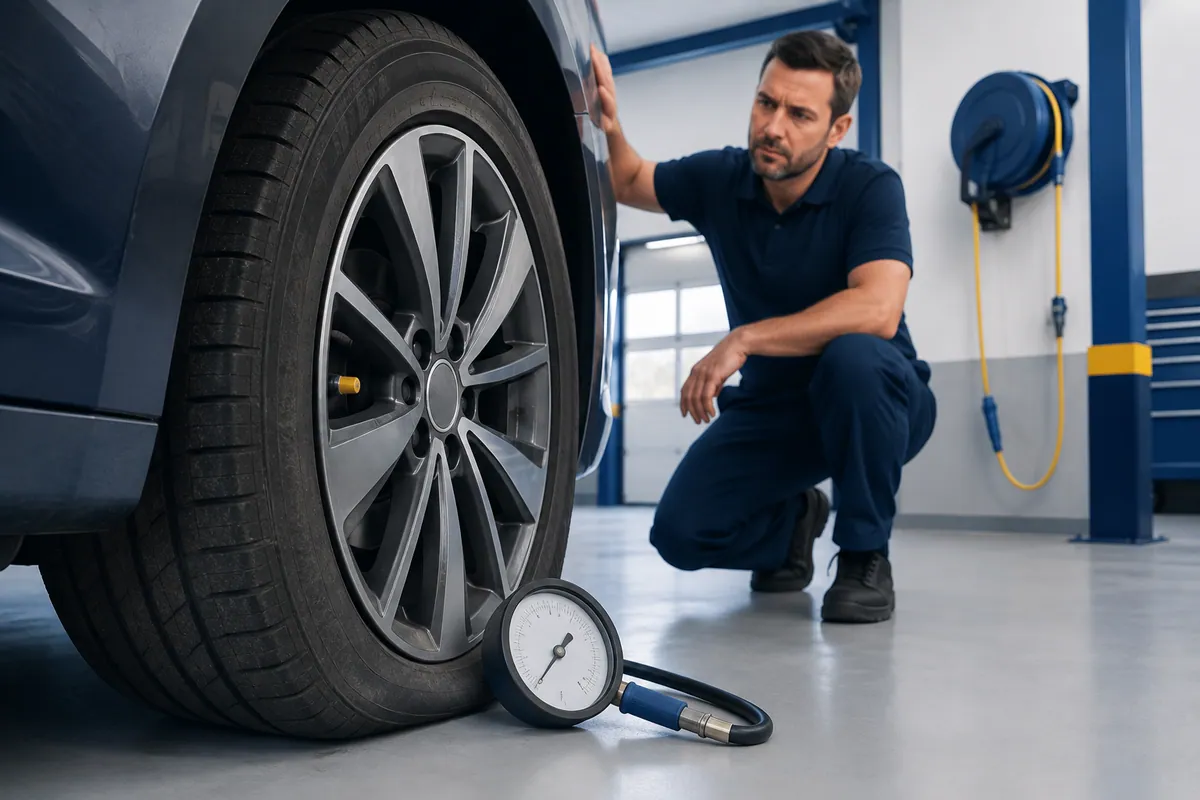

Green valve caps. Four of them, on a car in for a wheel bearing. Nobody at your counter knows which shop put them there. The customer does not remember paying for it. And two of the tires are eight psi low, green caps still on there doing their best.
Eight psi is roughly six times the entire measured benefit of the service those caps are advertising.
So here is the verdict up front. Nitrogen tire inflation works. The mechanism is real. The measured benefit, over a full year, is about 1.3 psi. I do not think it belongs on your menu, and the rest of this post is the work behind that.
This is not a debunking. Nitrogen isn’t a scam and the shops selling it aren’t running a con. The effect is real and it is too small to hang a line item on. Only that second part is my argument.
The Whole Argument Is 1.3 psi
Consumer Reports ran the test that settles it, and the results are published in full and not behind a paywall.
They took 31 models of all-season tires. One tire of each pair got air, the other nitrogen, both set to 30 psi at room temperature. Then they left them outdoors for twelve months.
“The average loss of air-filled tires was just 3.5 psi from the initial 30 psi setting.” The nitrogen-filled tires “lost an average of 2.2 psi.” CR’s own summary of it: “the reduction was only a 1.3-psi difference from air-filled tires over an entire year.”
Your customer’s tires drift further than that between a warm afternoon and a cold morning. They drift further than that on the drive home. The benefit is real, and it is smaller than the noise it is sold to protect against.
What Nitrogen Tire Inflation Is, and the Three Claims Made for It
Start with the part that surprises people at the counter. Air is already about 78% nitrogen. This was never a substitution. It is a purity question. You are selling the gap between about 78% and the mid-nineties, which is the smallest thing I have ever watched earn its own colored valve cap.
A nitrogen system pulls in ambient air and strips out most of the oxygen and the water vapor. Consumer Reports says it “ensured that we had 95 percent nitrogen purity in the tire,” which it calls the claimed limit of its own system. Nobody is selling 100%.
Three claims get made for it, and all three have a real mechanism behind them.
- Slower permeation. Nitrogen molecules are larger than oxygen molecules, so they work through rubber more slowly. True.
- Less moisture. Dry gas means less water vapor inside the tire, so less pressure swing with temperature and less corrosion inside the wheel. True.
- Less oxidation. Oxygen ages rubber from the inside and attacks aluminum. Less oxygen, less of both. True.
This is not an argument about physics. It is an argument about magnitude, and the magnitude, measured over twelve months, is 1.3 psi. Anyone who says nitrogen does nothing has not read the test either.
Yes, They Can Top It Off With Air
Customers ask this one, so answer it plainly. Can you put regular air in nitrogen inflated tires? Yes. Nothing bad happens. No reaction, no damage, no light on the dash. At 78% you have been mixing the two your whole life.
And that is the end of the service.
Because sooner or later your customer is miles from your bay with a low tire and a gas station air pump in front of them. They will use it. They should. Correct pressure with air beats low pressure with nitrogen, and it isn’t close.
The purity you sold is gone the moment that happens. Not degraded. Gone. The tire now holds a blend nobody measured and nobody at your counter can measure.
A service whose entire value is undone by a $1.50 air pump and a customer doing the right thing is not a service you can build a line item on. That is not a knock on the gas. It is arithmetic about human beings.
What It Would Cost You to Sell Nitrogen Tire Inflation Properly
Two costs. The second one is the one nobody prices.
The first is equipment. A nitrogen tire inflator runs from a small wheeled generator up to a plumbed system with a receiver tank, and a cheap nitrogen tire inflation kit is not what a tire store runs. I am not printing a price, because I could not open one current vendor page carrying a number for the machine a real shop would buy. Get two quotes locally. Equipment is not the reason to say no anyway.
The second cost is purge time, and that is where this quietly comes apart.
Here is how to inflate tires with nitrogen, described honestly. You cannot top off a tire that already contains air. Push nitrogen into a tire holding 78% nitrogen and you get a tire holding slightly more than 78% nitrogen. Reaching the purity that was actually tested means deflating and refilling repeatedly, one wheel at a time, until the original oxygen is diluted out.
Consumer Reports does not publish how many cycles that took, so I am not handing you a number for it. Here is what I have watched in a bay: most shops do one fill. That takes a couple of minutes and produces a tire that would not have generated CR’s result. Which means most of the nitrogen sold in this country is not what was measured.
Now the arithmetic, illustrative rather than surveyed. Say you charge $10 a tire, so $40 on the ticket. Say purging properly eats fifteen minutes of bay time. At the $165 average labor rate accounting firm Paar Melis’s 2025 benchmark report puts on the average shop, fifteen bay minutes is $41.25 of capacity. You sold $40 of service for $41 of bay, before the gas and before the generator note. And if the job took three minutes, you did not purge, and you charged for something you did not do.
The rate side of that is its own post: what you actually collect per billed hour is usually well below what you posted, which makes those minutes more expensive, not less.
The Trade Press Ran This Number Twelve Years Ago and Reached the Other Verdict
Tire Review published a piece on the benefits of nitrogen on May 31, 2014, written by Rich Ashley. It deserves credit for not hiding from the test.
It reports the finding accurately: “The nitrogen-inflated tires did have pressure loss over time, but the reduction was only a 1.3 psi compared to the tires filled with air.” And: “The nitrogen filled tires lost an average of 2.2 psi.”
Then it turns to price. “the nitrogen generator, filling system and technician time aren’t free.” And: “the dealer is entitled to some return for that.”
It goes further than that, and I should say so rather than let it look like it declined to take a position. It calls offering nitrogen “a legitimate value-added proposition,” and it names a real reason: drivers who never check their own pressure. It cites a 2009 NHTSA study finding only 57% of vehicles with TPMS were correctly inflated, and reasons that a slower leak helps the inattentive driver most.
That is the best argument for the service, and it is exactly where I part company with it. If the problem is a driver who never checks pressure, 1.3 psi a year does not fix that. A working TPMS and a documented pressure check at every visit do. And the article’s own remedy, encouraging the customer to come back for follow-up pressure adjustments, has you giving away bay time to protect a psi and a third.
So the article settles what to charge. It never settles whether a measured 1.3 psi is a big enough outcome to build a menu line on. That habit belongs to the industry rather than to one writer: we decide how to price a service before we decide whether it changes anything, and then nobody reopens the first question, because the second one is already producing revenue.
Sell the Thing That Actually Changes the Outcome
Everything nitrogen is sold to deliver, stable pressure, longer tire life, fewer failures, is delivered better by four things you already have.
- Correct pressure to the door placard. Not the sidewall maximum. The placard. Free, and on the average car in your lot it beats 1.3 psi several times over.
- A documented pressure check every visit, written on the repair order where the customer can see all four numbers. Also free. Also your best defense when somebody comes back angry about a tire.
- A TPMS system that actually works. Dead sensors are why a driver spends four months eight psi low without knowing it. That is a real service line, chronically underbilled at the tire counter, and it does the exact job nitrogen is marketed as doing.
- A real tire inspection with photos. Tread depth, tire age, uneven wear, and the cause of the uneven wear. A digital vehicle inspection turns that into something a customer can approve from their phone.
Two of those four cost you nothing. One is money most shops leave on the counter. None of them need a green cap.
If You Already Own a Generator, Don’t Just Eat the Loss
Plenty of you already bought the machine, and I am not telling you to roll it out back and let the weeds have it. Three adjustments.
Stop putting it on every retail ticket by default. An upcharge the customer did not ask for and the advisor cannot substantiate is the one that ends up in a review.
Stop pricing it as a benefit you cannot prove. If the counter is promising better fuel economy or noticeably longer tire life, they are overselling 1.3 psi. Disclose what it is. Do not upsell what it isn’t.
Use it where the mechanism earns its keep. Dry nitrogen helps in a system that stays sealed and never meets a gas station air hose: a race trailer, a fleet with controlled tire service, long-term storage. Narrower than the brochure. Still a real list.
Then run the general test, which isn’t mine to claim. It belongs to the shop supplies charge argument: if your advisor cannot explain a charge in one sentence to a skeptical customer, the charge comes off the ticket. An advisor who doesn’t believe in a line will discount it away anyway.
And a nitrogen upcharge is nothing like the statutory tire disposal fee two lines under it. That one is set by your state. This one is set by you, which makes it yours to defend and yours to remove.
For a group, the expensive version of this is inconsistency. One store sells it and the others don’t, so one brand delivers two different tire experiences and an upcharge line that means nothing on a consolidated report. Decide it at the group level and write the decision down with a date on it. A service line that exists at one store and not another is usually not a decision anybody made. It was inherited.
Put the air in. Set it to the placard. Check it every visit and write the numbers where the customer can see them. And if the green caps make somebody happy, leave them on. They are the only part of that service that ever worked as advertised.