
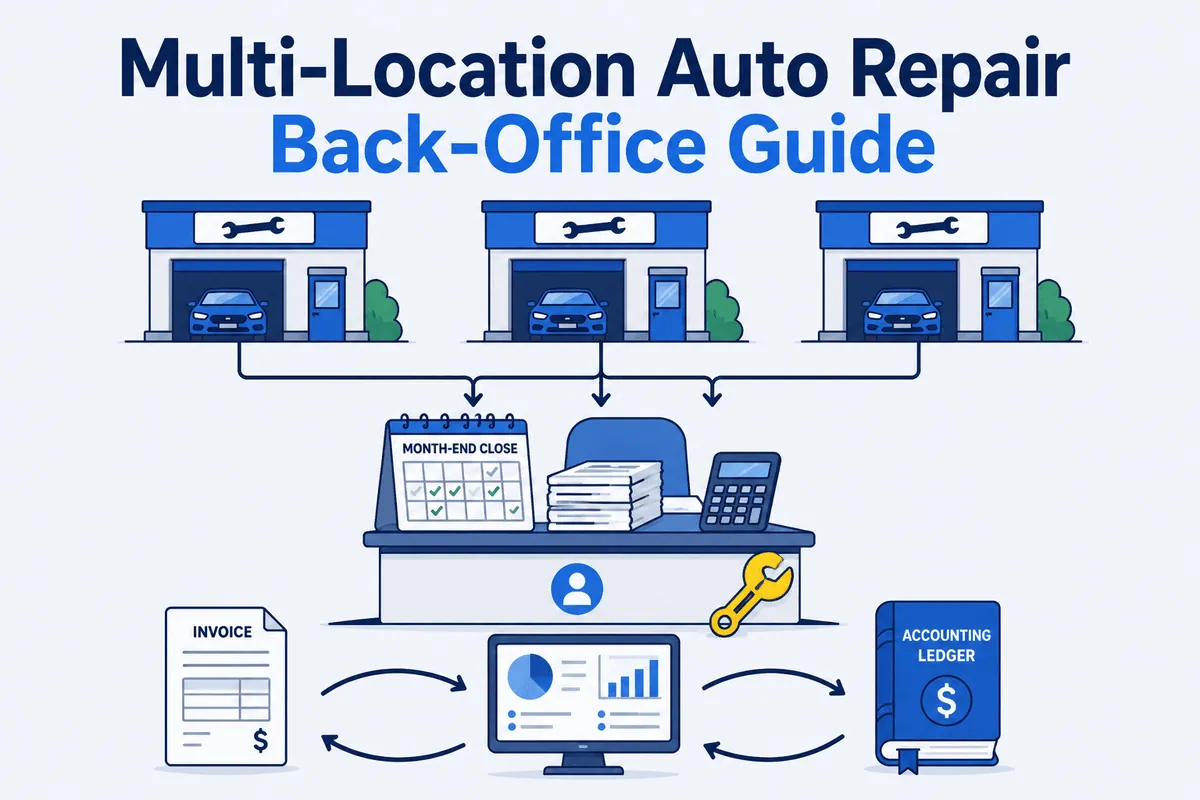

I have a recurring nightmare where I’m balancing eight stores’ parts statements at once, and I wake up before the cores come back. (My wife says I should reconcile my dreams. I told her that’s not a real process. She was unconvinced.) Here’s the thing about a multi-location auto repair back office: it’s where 3 to 8 margin points quietly go to die, and nothing ever looks broken on the way down.
If you run two stores, you already feel it. If you run eight, you’ve stopped pretending it’s under control. Your shop management systems are humming. The repair orders are closing. The books are getting done. But somewhere across those stores, a vendor billed you more than they quoted, a core’s been sitting in a bin past its return window, and no single store ever loses enough to notice. The group loses plenty.
This is a back-office playbook for the owner or MSO running the operation, not the consumer paying the bill. It covers who does what, the daily-weekly-monthly cadence that keeps a group’s books honest, and — more important — how to catch the money before it disappears into consolidated COGS.
Read it once. Build the cadence on one Saturday. Run it forever.
Why Back-Office Chaos Scales Faster Than Revenue
Add a store and your revenue goes up by one store. Your back-office complexity does not.
Each new location multiplies three things at once. Vendor statements (now four parts houses times five stores instead of one). Core bins (every counter with its own pile of unreturned starters). And advisor behavior (every service writer with their own habits around discounts and matrix overrides). The work isn’t additive. It compounds.
I grew up watching this happen. My dad owned shops, and I watched the back office go from a manageable shoebox to an unmanageable mess the moment a second location showed up. Not because anyone was incompetent. Because the informal checks that work for one shop — “the owner eyeballs the invoices” — have no version that scales. You cannot eyeball eight stores.
That’s the whole problem a multi-location auto repair back office has to solve. It has to make eight stores’ worth of transactions as legible as one used to be. Everything below is in service of that.
Who Owns What in a Centralized Back Office
Before the cadence, settle the org chart. Most groups land on a centralized or semi-centralized back office, and that’s the right instinct — one team running consistent process across stores beats five stores each improvising.
But “centralized” has to mean more than one room with the bills in it. Split the work into roles, even if one person wears several hats early on:
- Data entry and coding. Bills get entered the day they arrive and coded to the correct location. This is volume work, and it’s where consistency lives or dies.
- Reconciliation. Someone owns matching invoices to ROs and packing slips, chasing credits, and flagging exceptions. This is the role groups forget to name, which is exactly why it stops happening.
- Vendor management. Terms, statements, and disputes, negotiated at the group level instead of store by store.
- Approval and payment. The final sign-off before money leaves, ideally separated from the person who entered the bill.
Here’s the opinion I’ll defend with a number in a minute: most multi-location groups don’t have a parts-theft problem — they have a visibility problem. When eight stores’ worth of invoices land in one inbox and no role owns reconciliation, the leaks aren’t hidden by anyone. They’re just unwatched. Nobody decided to skip the line-level check. It simply has no owner, so it never runs.
The Daily Tasks That Keep the Group Clean
Daily work is small and boring, and that’s the point. Skip it and the weekly close becomes archaeology.
- Enter vendor bills the day they arrive, coded to the right location. A bill that sits in a pile for ten days is a bill you can no longer dispute cleanly. Date it, code it to the store, get it in. The goal is zero floating paper by end of day.
- Capture the quoted price at the point of order. When the advisor orders a part, the quoted unit price needs to land somewhere you can match against later. This is the single most valuable habit in the building. Without the quote, there’s nothing to catch the overbill against — the invoice becomes the only number, and the invoice is the one you’re trying to verify.
- Run core bin discipline at every counter. Every core comes off a job and goes in the return pile with the job number on it, and the parts driver takes them back on schedule. A core that misses its return window is a deposit you paid and will never get back. Per store, per day, it’s a five-minute habit. Across a group, it’s real money.
None of this is glamorous. All of it is what makes the weekly reconciliation possible instead of impossible. Process beats memory, especially when there are eight memories.
The Weekly Reconciliation Cadence for a Multi-Location Back Office
This is where the money actually gets caught, so this is the cadence you protect first.
Once a week, per store, you match three documents at the line level: the vendor invoice against the repair order against the packing slip. SKU, quantity, unit price, freight, core charge. Where they disagree, you flag it. This is a true three-way match, and almost no shop runs it on parts — which is exactly why two leaks thrive there.
Vendor overbilling. Parts houses update price files daily and fulfill from multiple distribution centers, so the price quoted Monday can ship Thursday at a different number. WORLDPAC quotes a control arm at $84, the truck delivers it, the invoice reads $97, and nobody re-checks the $13. Multiply that across every line, every parts house, every store. Our vendor overbilling guide breaks down the mechanisms in detail, and our vendor statement reconciliation guide covers the month-end safety net that backs it up.
Uncredited core charges. A core deposit you don’t get back is a parts cost you ate for nothing. The return-and-forget loophole is what kills it: the part comes back, the core goes in the bin, and the credit never gets chased. Weekly is the right cadence because the return windows are short. A return slip is not a credit — the part going back proves intent, not money. It’s not done until the credit shows up.
The weekly output is a flagged-discrepancy list per store, rolled up so you can see which location is leaking and where.
Worked dollar math (illustrative figures)
Take a single store buying $520,000 in parts a year. The commonly cited “acceptable” AP invoice error rate is 5% or less, so a conservative 1.5% silent overbill rate is defensible. That’s:
- $520,000 × 1.5% = $7,800 per store, per year, leaked before you’ve marked anything up.
- Across an 8-store group, that’s $7,800 × 8 = $62,400 a year — overbilling alone, before a dollar of uncredited cores.
- Add cores. Say each store does 50 core-eligible jobs a month and 15% walk away uncredited at an average $75 deposit: 50 × 15% × $75 ≈ $563/month × 12 ≈ $6,750/year per store, or $54,000 a year group-wide.
Combined, on illustrative-but-realistic numbers, an eight-store group is looking at north of $115,000 a year across just these two leaks. These figures are illustrative — your parts spend, return rate, and average core will move them — but the order of magnitude is the point. This is the money the weekly cadence exists to catch.
Why “I Trust My Guys” Isn’t the Same as Verifying
One transmission group I know of started reconciling vendor statements expecting to clean up some paperwork. Almost immediately they found something nobody expected: an employee at one of their vendors had been deliberately withholding credits to pad his own department’s numbers. Thousands of dollars that should have come back to the shops never did.
The owner was furious — partly because he had “stop the steal” signs hanging in his own bays. He was watching his people like a hawk. He never imagined the money was leaking on the vendor’s side, in a place no amount of trusting his crew would ever catch.
The lesson wasn’t that vendors are crooks. The vast majority aren’t. The lesson is that every dollar deserves an explanation, no matter which side of the counter it’s on. Trust your people. Verify your process. In a multi-location group, “verify” isn’t suspicion — it’s the only way anyone sees the whole picture, because no single person is sitting on all eight stores’ statements anymore.
The Month-End Close for a Multi-Location Group
Month-end is where you prove the daily and weekly work actually held. The close runs store by store, then rolls up:
- Reconcile every bank and card account, per location. No exceptions, no “close enough.”
- Confirm all vendor bills are entered and coded to the correct store. A bill coded to the wrong location corrupts two P&Ls at once.
- Reconcile parts COGS against parts revenue, per store. This is the tell. If a store’s parts COGS is climbing relative to its parts revenue, something upstream — overbilling, missed core credits, matrix drift — is bleeding in. The number moves a point or two and no one notices until it’s a trend.
- Chase open core credits and vendor credit memos so they post in the right period.
- Review the consolidated P&L with parts margin broken out by location. Comparable stores should have comparable margins. Where they don’t, you have a question to ask.
Standardize the chart of accounts and the location coding before any of this, or the consolidated P&L isn’t comparable and the whole exercise is theater. QuickBooks supports class and location tracking for exactly this. Our QuickBooks best practices for auto repair shops covers the setup that makes a multi-store close survivable, and the books-and-consolidation side lives in our multi-location auto repair accounting guide — that piece is the accounting; this one is the operation.
What Breaks When You Add the Next Store
The new location is where the cracks show, every time.
- Handoffs break. The “owner checks the invoices” habit has no version at store five. If you don’t assign reconciliation to a role, it defaults to nobody.
- Vendor terms go inconsistent. Each store negotiated its own pricing; without a master to reconcile against, you can’t even tell when a vendor is off-terms.
- Ownership of reconciliation goes fuzzy. The store assumes the back office has it. The back office assumes the store does. The line-level checking stops, and the leaks reopen.
The fix is organizational before it’s software: one chart of accounts, group-level vendor terms, and one named owner of reconciliation across all stores. Decide who owns it before you sign the lease on the next location, not after.
Two group-level files belong on that same pre-signing list. Insurance stops being five policies and becomes one loss history, where a claim at store three prices the renewal at all five and you inherit the seller’s claims when you buy (how group insurance actually behaves). And the plan for the next store is its own document, not a copy of the last one (building a mechanic shop business plan), or a development agreement with a brand attached if you are growing inside a franchise system, where the back office is the only place a multi-unit operator gets cheaper per store.
Where Software Earns Its Keep — And Where It Doesn’t
Here’s the honest part. If a process change fixes your problem, make the process change. Naming a reconciliation owner, capturing quotes at order time, and running core bins on a schedule will catch a real chunk of the leak with zero software spend. Do those first.
But running a true line-level three-way match every week across eight stores by hand is not realistic. That’s the job WickedFile does. It reconciles your parts invoices against the repair orders and packing slips across every location at once, flags the per-line overbills and the open core credits, and surfaces the exceptions so your back office reviews problems instead of re-keying paper. Our profit-leak overview covers the wider picture.
Be clear about what it does not do. WickedFile is the reconciliation layer inside the close — it sits between your SMS, your vendor invoices, QuickBooks, and your bank feeds and tells you whether the numbers agree. It does not replace QuickBooks or your shop management system. It does not process payments, issue cards, or do bill-pay. It finds the money; a human still calls the vendor, requests the credit, and moves the cash. It protects the margin your SMS generates — it doesn’t generate the revenue.
Standardize the cadence first. Automate the reconciliation so it actually runs every week across every store. That’s how a group keeps the 3 to 8 points it’s currently leaving on eight different counters — before your parts spend needs its own area code.