
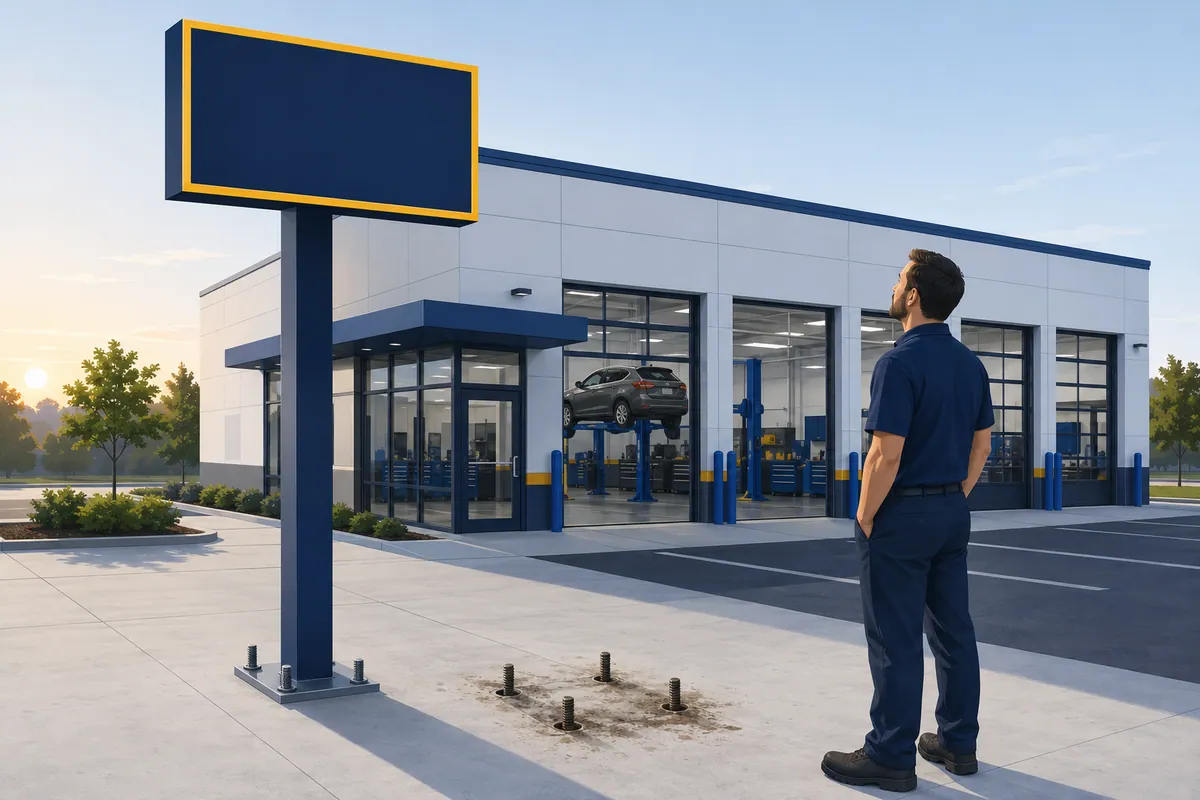

You can date a converted shop from the parking lot. The old sign base left a footprint in the concrete, and the new franchise sign is bolted six inches to the left, because the new footing had to miss the old one. Nobody moves concrete. They move the sign.
An auto repair shop franchise is the third door into this business, and it is the only one where you agree to pay somebody a percentage of your sales forever.
That last part is the entire article. The royalty is charged on sales, not profit. Which means “can I afford 6%” is the wrong question, and almost every page on this topic asks it anyway.
If you are still deciding between building a shop and buying one, that fork lives in the mechanic shop business plan, which owns startup budgeting, valuation, diligence and SBA 7(a) mechanics. I am not rebuilding it. This post owns one thing that post does not: what a franchise agreement costs you, what it buys you, and how to read the document that tells you.
For the owner or operator with real capital deciding where to put it. Not legal advice, and a franchise agreement is a document a franchise attorney should read before you do.
An auto repair shop franchise is the third path, not a better version of the first two
Start from scratch. Buy an independent. Buy a franchise. Three businesses, three risk shapes.
The pitch is that you are buying a shortcut. Sometimes you are. Here is what is in the box.
What you get:
- A name people already recognize, worth the most where nobody knows yours.
- A documented operating system: processes, checklists, training, reporting cadence. If you have never run a shop, this is the real product.
- A purchasing program with negotiated pricing at named vendors.
- Site selection help, because a bad address is the one mistake better management cannot fix.
- Fleet and national accounts you would spend five years building yourself.
- Lender familiarity. A loan officer who has financed forty of these asks fewer questions.
What you give up:
- Pricing autonomy, sometimes including your parts matrix.
- Vendor choice, in whole or in part.
- Marketing control, in exchange for a fund you pay into and do not run.
- Exit control. Most agreements carry approval rights and often a right of first refusal on your buyer.
- Territory boundaries, which cut both ways. They fence the system out, and they fence you out of the good strip mall two streets over.
- Term risk. Your agreement renews on their terms.
One clarification, because these get blended: buying a franchise is not selling to a consolidator. One is you joining a system. The other is private equity absorbing you.
For the baseline you are measuring against, what an independent auto repair shop actually makes is the revenue side. And per accounting firm Paar Melis’s 2025 benchmark report, independents perform more than 70% of post-warranty repairs in the U.S. The independent model is the market, not the consolation prize.
The auto repair shop franchise fee stack, and why every number you have read is different
Six lines in a typical auto-service fee stack. Most articles mention two.
- The initial franchise fee. One time, at signing. The number everyone quotes and the smallest one that matters.
- The royalty. A percentage of gross sales, paid monthly or weekly, for the life of the agreement.
- The national advertising fund. A separate percentage of gross sales, spent by the franchisor.
- A local advertising minimum. A required spend in your own market, on top of the national fund.
- A technology fee. Software, customer platform, reporting stack.
- A minimum royalty floor. The one that hurts. A floor means a slow quarter does not reduce what you owe, which turns a variable cost fixed exactly when you can least carry it.
Now the honest part about the research.
I went looking for brand-level royalty rates. For one national auto-service brand, three separate franchise portals published three different percentages. For another brand, three more. Not rounded differently. Different numbers, no methodology, no source.
That is not a range. That is three people remembering the same conversation differently.
So here is the shape, and only the shape: auto-service royalties commonly land in the mid single digits of gross sales, plus a separate advertising fund. The binding figure lives in Item 5 and Item 6 of that brand’s current Franchise Disclosure Document. Anything else is a rumor with a percent sign on it.
One note on the ad fund. A 2% national fund buys advertising in markets that are not necessarily yours, and it does not manage your Google Business Profile, your reviews, or your phone. Those stay yours, and the car count playbook is the work the fund does not do.
Franchise vs independent auto repair shop: run the incremental break-even
Here is the math that should decide this. All figures are illustrative, and the percentages are attributed to no brand.
Take a shop doing $2,000,000 a year. Apply an illustrative 6% royalty and 2% ad fund.
That is $160,000 a year.
Now put it next to profit. Per Paar Melis’s 2025 benchmark report, built from client shops’ actual 2024 financials, the average shop nets 9.6% of sales. On $2,000,000 that is about $192,000.
So the fee stack is roughly 83% of a benchmark shop’s entire net profit.
That stops people cold, and it should. But stopping there is the mistake the anti-franchise crowd makes, because the franchised shop is presumed to do more sales. That is the premise. So the real test is whether the brand generates more incremental gross profit than the fee stack costs.
Run it. Paar Melis puts the benchmark overall gross margin at 52.3%.
$160,000 ÷ 52.3% = $305,927 of incremental annual sales, just to break even on the fees.
That is about $25,500 a month. At Paar Melis’s average repair order of $702, it is roughly 436 additional repair orders a year, or about 36 extra repair orders a month.
Thirty-six. Every month. Forever. Before the brand has made you one dollar.
That is the question in front of you. Not “is 6% reasonable.” It is: does that sign put 36 more cars in my bays every month than my own name would, in this market, for the entire term.
Where nobody knows you and a fleet program comes attached, 36 is achievable. Where you have been the guy for eleven years and the whole town already calls you, 36 is hard, and you would be buying a system rather than a brand.
One strong opinion, since I have your attention
The fee stack is the only line on your P&L that rises when you get better at selling and never falls when you get better at buying.
Find five points of parts gross profit and you keep every dollar of it (the arithmetic on that is worked out here). The royalty does not move, because it is computed on sales and your parts cost is not a sale. Raise your labor rate 8% and the royalty rises with it. Cut $30,000 of fixed expense and the royalty never notices.
So inside a franchise, every operational improvement is worth more and every top-line improvement is worth slightly less. That asymmetry should decide which levers you pull the day after you sign, and I have never seen it in a brochure.
Read Item 20 before you read Item 19
This is the most useful section on this page, and the one no franchise portal writes.
Under the FTC Franchise Rule a franchisor must hand you a Franchise Disclosure Document with 23 numbered items. Per 16 CFR 436.2, you get it “at least 14 calendar-days before the prospective franchisee signs a binding agreement with, or makes any payment to, the franchisor or an affiliate.”
Use those 14 days. Almost nobody does. Discovery day is engineered to make day 15 feel inevitable.
Item 19 is optional, and that is the tell
Item 19 is the financial performance representation. It is where a franchisor tells you what its shops actually earn.
It is not required. 16 CFR 436.5 has the franchisor say so in the document itself: “The FTC’s Franchise Rule permits a franchisor to provide information about the actual or potential financial performance of its franchised and/or franchisor-owned outlets, if there is a reasonable basis for the information, and if the information is included in the disclosure document.”
Permits. And if the franchisor declines, the rule makes them write this, in the document you sign a receipt for: “We do not make any representations about a franchisee’s future financial performance or the past financial performance of company-owned or franchised outlets.”
Read that twice. A brand can ask you for six figures and legally decline to tell you what its shops make. (There is no Item 19.5 where they tell you anyway.)
That alone is not a reason to walk. Plenty of good systems keep Item 19 thin on advice of counsel. But an empty Item 19 is information, and anybody quoting you an average unit volume out loud is quoting a number they chose not to put in writing.
Item 20 is not optional, and it is where the truth lives
Item 20 covers outlets and franchisee information. The rule is blunt: “Disclose, in the following tabular form, the total number of franchised and company-owned outlets for each of the franchisor’s last three fiscal years.”
The table headings tell you what to look for:
- Systemwide outlet summary
- Transfers of outlets from franchisees to new owners
- Status of franchised outlets
- Status of company-owned outlets
- Projected openings
How an operator reads that, in four questions:
- Openings versus closures, by year. A system that opened 40 and closed 35 is not growing. It is treading water in a nice polo. The press release says “40 new locations.” Item 20 says what happened to the other 35.
- Transfers. A high count means franchisees are selling. Sometimes that is succession. Sometimes it is the exit door with a line at it. Three years of trend tells you which.
- Company-owned status. If the franchisor is reacquiring units, ask why. Buying back a strong market is strategy. Buying back failures to hold the count is not.
- Projected openings versus last year’s actual. Get last year’s FDD and compare the projection to what happened. Cheapest credibility test in the document.
Then read the rest with a purpose. Items 5 and 6 are your fees. Item 7 is the estimated initial investment, the only investment figure binding on anybody. Item 8 is restrictions on sources of products and services, which is the parts question in legal clothing. Item 11 is where the ad fund and technology fee get defined. Item 12 is your territory. Item 17 is your exit.
Fourteen days, seven items, one attorney. That is the assignment.
What the top auto repair franchises look like at scale
People searching for the top auto repair franchises want a ranked list of the best ones. I am not building that, because I cannot defend it and neither can anybody else on this topic.
What I can show you is the shape. Below are every Auto Repair and Oil Change brand in the automotive cut of the Franchise Times Top 400 for 2025. That page also lists detailing and car-parts brands, which are different businesses, so I left them out. Two disclaimers, both load-bearing: the page publishes no methodology, which puts it in excellent company here, and “large” is not “best” or even “profitable for the franchisee.” Global sales are the system’s, not yours.
| Brand | Franchise Times segment | 2025 rank | 2024 global sales ($M) | 2024 units |
|---|---|---|---|---|
| Valvoline Instant Oil Change | Oil change | 37 | 3,100 | 1,908 |
| Midas | Auto repair | 46 | 2,269 | 2,026 |
| Jiffy Lube | Oil change | 48 | 2,200 | 2,221 |
| CARSTAR | Auto repair | 53 | 1,700 | 789 |
| Take 5 Oil Change | Oil change | 62 | 1,390 | 1,180 |
| Big O Tires | Auto repair | 64 | 1,300 | 463 |
| Christian Brothers Automotive | Auto repair | 92 | 825 | 302 |
| Meineke Car Care Centers | Auto repair | 113 | 674 | 785 |
| Maaco | Auto repair | 130 | 611 | 379 |
| Grease Monkey | Oil change | 177 | 346 | 513 |
| Precision Tune Auto Care | Auto repair | 239 | 200 | 292 |
| Strickland Brothers Oil Change | Oil change | 257 | 167 | 249 |
| SpeeDee Oil Change & Auto Service | Oil change | 300 | 118 | 173 |
| Mr. Transmission | Auto repair | 386 | 65 | 113 |
Segment labels are Franchise Times’ own, which is why CARSTAR and Maaco, both collision brands, sit in the auto repair bucket.
One thing about this table nobody flags: a “2025” ranking is built on 2024 sales. Valvoline’s own fiscal 2025 release puts system-wide store sales at $3.45 billion, about 11% above the 3,100 below, and its store count at 2,180 rather than 1,908. So the table is a year behind by design. That is fine as long as you do not read it as current, and it is worth remembering the next time a portal quotes you a systemwide number with no date on it.
Three things worth noticing.
Oil change out-scales general repair. If you picture an auto repair franchise as a full-service mechanical shop, you are shopping in the smaller half of the category.
The relationship between the last two columns swings enormously. Christian Brothers reports more global sales than Meineke on well under half the outlets. That could be facility size, service mix, market selection, agreement vintage, or how the numbers were collected. You cannot tell from a rank table. That gap is exactly what Item 19 exists to explain, and exactly why you read Item 20 when Item 19 is empty.
Almost none of these brands publish investment figures on their own site. That vacuum is why the portals exist and why their numbers disagree.
Three brands do publish, from their own pages:
- Midas puts the total initial investment “between $209,150 and $884,890,” with an initial franchise fee of “$35,000,” on its own investment breakdown published February 7, 2025.
- Meineke states on its franchise FAQ that “the total estimated initial investment for a leased Meineke location ranges from $123,121 to $572,411.94,” and points you to Item 19 for store sales.
- Christian Brothers Automotive says on its franchise investment page that “this allows franchisees to start the business with the initial liquid capital of just $85,000,” that “on average, 82-83% of the investment can be financed over a 10-year period using an SBA loan,” and that “our owners and operators are part of the business payroll, earning a base salary of $60,000/year.”
I am not printing Christian Brothers’ total investment, franchise fee or net worth requirement, because those three tiles render as placeholders rather than figures. If a number does not load, it does not get published. Get those from Item 7.
The SBA Franchise Directory is the franchise-specific financing layer
The 7(a) mechanics belong to the business plan post. One thing here is franchise-only, and worth knowing before your first lender call.
Franchise brands can be listed in the SBA Franchise Directory. Per the SBA’s own document page, the list “is made available for use by Lenders/CDCs in evaluating the eligibility of a small business that operates under an agreement.”
It launched in 2018, was discontinued in 2023, and came back. Per law firm Foley & Lardner, “effective June 1, 2025, the U.S. Small Business Administration (SBA) will reinstate its Franchise Directory,” and under the reinstated process “the SBA Addendum (Form 2462 or negotiated addendum) is not required.” Franchisors certify in writing instead.
Practically: your lender uses the listing as an eligibility screen instead of analyzing the agreement’s control provisions from scratch. A listed brand is a shorter conversation. An unlisted one is a longer week for somebody.
Now the sentence every franchise portal leaves out. The SBA writes, on the Directory itself: “Placement of a franchise brand in the Directory is not an endorsement or approval of the brand and does not ensure the success of the business.”
That is the federal government disclaiming the exact endorsement half the internet implies it is giving, presumably after getting tired of being cited as a co-signer.
Two brand-published claims, labeled as the brands’ own and not as rules: Meineke says “typically, Small Business Administration (SBA) loans require a 30% cash injection,” and Christian Brothers publishes that 82-83% figure. Your actual equity injection comes from your lender applying program rules to your deal. Get it in writing before you write an offer.
What changes when you own six of them
The month a converted shop files its first royalty report, somebody in that office discovers the sales number and the bank deposits have never once agreed. Which was fine for eleven years. It is not fine now, because a percentage of that number is going somewhere.
Multi-unit development agreements are the standard growth path: commit to opening a set number of units on a schedule, get area rights and usually a fee break on units two through N. Miss the schedule and you can lose the territory, which makes a development agreement a construction deadline wearing a franchise agreement.
Why franchisees consolidate is arithmetic. The royalty is a fixed percentage of sales and does not scale down with unit count. Your general and administrative expense does. So the only place a multi-unit franchisee gets cheaper per store is the back office, which is precisely where most groups duplicate instead of centralize. How a multi-location back office should be structured is a decision for before store three.
Three back-office consequences that are genuinely different inside a system.
One. Your royalty is computed off reported sales, so the sales number has to be right. Not approximately right. Most agreements carry audit rights plus the cost of the audit if they find a variance.
Two. Franchisor purchasing programs route parts through named vendors, which concentrates your spend. Concentration is good for pricing, and it also concentrates exactly where credits and cores go missing, because more of your money runs through fewer statements. One vendor’s process problem is now most of your parts spend. How vendor statement reconciliation works is the manual version, and at one location a highlighter and a Saturday does the job.
Three. A franchisor-set matrix turns off-matrix discounting into a compliance question, not just a margin question. When you set the matrix, an advisor giving away 8% is a margin conversation. When the franchisor sets it, the same discount can be a breach. Holding a parts pricing standard across locations covers the measurement side.
That is where WickedFile fits, and it is a narrow fit. We reconcile parts invoices, credits, statements and repair orders across locations so the numbers you report are numbers you can defend. What we do not do: WickedFile does not read a franchise agreement, does not compute your royalty, and is not an FDD reviewer.
One lever you keep: a franchisor generally does not dictate your technician pay plan. How flat rate and other pay plans behave stays worth reading, because it stays yours after you sign.
Converting an independent shop into a franchise is a different trade
You keep your entity, building and crew. You sign, re-sign the building, adopt the system, retrain the counter, convert the software, and start reporting sales. Most large brands run some version of a conversion program, often with a reduced initial fee, because you arrive with the two most expensive things already paid for: the real estate and the car count.
Here is the trade conversion pitches skate past. You start paying a percentage on the sales you already had.
A new franchisee’s baseline is zero, so every car the brand brings is incremental. Yours is not zero. At $2,000,000, that illustrative $160,000 has to be earned by growth on top of $2,000,000, and the 36 extra repair orders have to be 36 you were not already getting. Conversions fail right here. The brand adds 15 a month in a town that already knew you, and the other 21 come out of your own profit.
Sometimes it still works: when you are buying a system you genuinely lack, a fleet program you cannot get alone, or a succession path that makes your shop financeable for a buyer.
What I will not do is print a conversion fee. A specific reduced-conversion-fee figure circulates for one large brand, and I could not find it on that franchisor’s own page or in a filed FDD, so it is not going on this page. Ask for Item 5, in writing, with a current issue date.
The sign is six inches to the left for a reason
Whoever bolted that sign up made a decision. They looked at eleven years of their own name over the door, decided the brand would bring more cars than the name did, and signed a document that made the bet permanent.
Sometimes that is right, and more often than the independent crowd admits, especially for a first-time owner who needs a system more than freedom.
Just make the call with the arithmetic in front of you instead of at discovery day. The royalty is on sales, so the test is 36 more cars a month, forever. Item 19 is optional, so silence there is data. Item 20 is not, so the openings-versus-closures column is the closest thing to an honest answer anybody hands you for free.
And you get 14 calendar days. Spend them on the boring tables, not the brochure. The brochure has never once mentioned the bolt holes.