
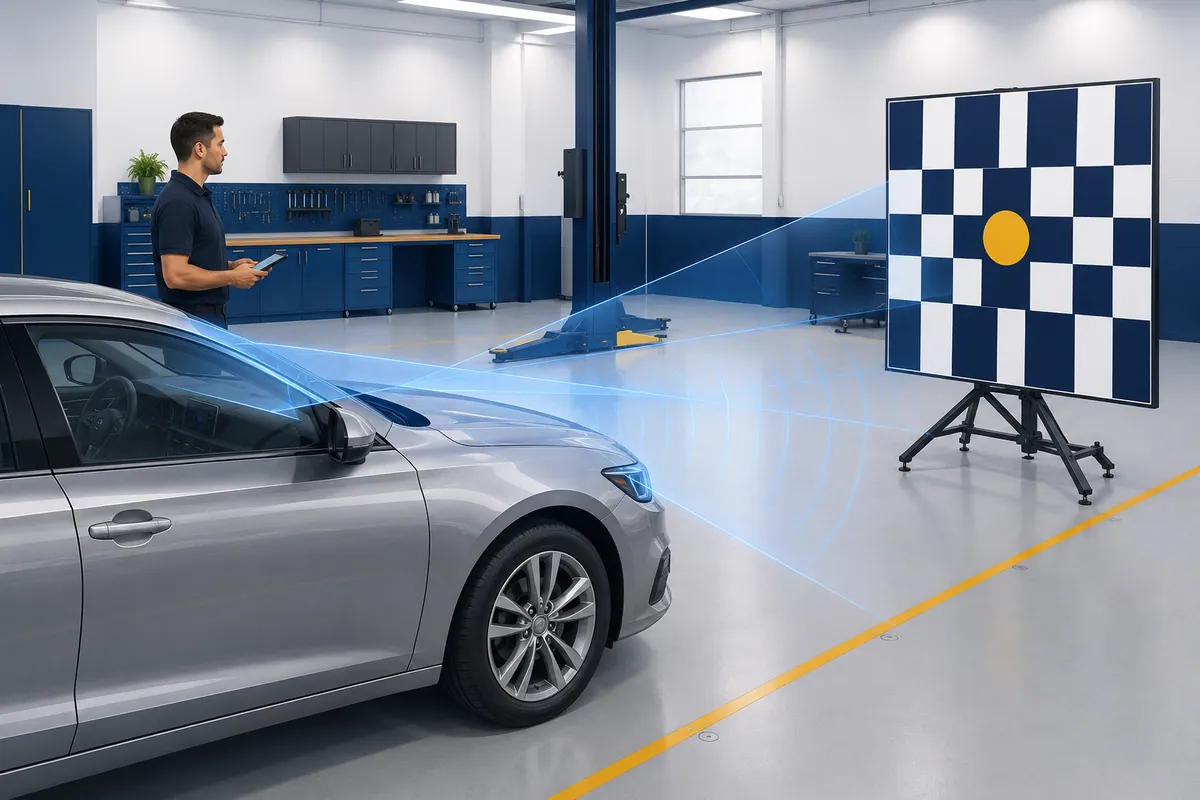

The most expensive piece of ADAS calibration equipment in most shops is the target board behind the parts shelf, currently holding up a box of wiper blades. Nobody has touched it since the training class. ADAS calibration is the first genuinely new profit center to land in general repair in about a decade, and most shops are handling it the most expensive way possible.
Here’s the short answer, because you’re probably here for the money and not the physics. Most general repair shops should sublet ADAS calibration right now, bill it properly, and revisit the equipment question at 20 or more calibrations a month. Before you spend $60,000 on targets and a level floor, find out whether you’re even billing the calibrations you’re already sending out.
This is written for the owner or multi-shop operator, not the car owner. What a calibration is, what you pay versus what you can bill, the break-even math on going in-house, and what changes across five stores.
What ADAS Calibration Actually Is
ADAS stands for advanced driver assistance systems. Lane keep, adaptive cruise, automatic emergency braking, blind spot monitoring, surround view. All of it depends on cameras, radar units, and ultrasonic sensors aimed at the factory relative to the vehicle’s centerline and thrust line. An ADAS calibration re-aims them, or teaches the module where they’re now pointing.
Here’s what makes this different from every other repair you do: a sensor that’s off does not turn on a light. A camera a degree or two off center just decides the lane is slightly to the left of where it is. No code, no symptom in the bay, no way for the customer to know. You either did the procedure or you didn’t.
Static vs Dynamic, and Why Your Floor Matters
Static calibration happens with the vehicle stationary. You place physical targets at OEM-specified distances and heights, measured off the vehicle’s thrust line, and the module reads them. That requires a level floor, controlled lighting, a plain background, and enough clear space in front of and behind the car that nothing else lands in frame.
Dynamic calibration happens on the road. A scan tool runs the learn procedure while a tech drives at a specified speed on clearly marked roads, in acceptable weather, for however long the OEM says. Which means a technician and a laptop in a customer’s car for twenty minutes. That’s billable time, and nine times out of ten nobody bills it.
Lots of platforms require both, in a specific order, and some require the alignment done first. A windshield camera calibration is also not the same procedure as a rear radar calibration, which is why “ADAS camera calibration” and “ADAS sensor calibration” aren’t interchangeable line items.
The Jobs That Trigger One
You are almost certainly already doing calibration-triggering work and calling it something else:
- Windshield replacement (the forward camera lives behind the glass)
- Wheel alignment, or any suspension or steering work that changes the thrust line
- Front or rear bumper, grille, or fascia removal (that’s where the radar hides)
- Mirror replacement on blind-spot and surround-view platforms
- Ride-height changes, including a lift kit or a load-leveling repair
- Module replacement, and on some platforms a battery disconnect
- Any collision damage in the neighborhood of a sensor
That list is platform-specific, and the only correct source is the OEM information for that VIN. Which is why staying current on diagnostic tools and OEM updates is its own discipline.
The ADAS Calibration Process, and the Two Steps Shops Skip
The calibration process end to end looks like this:
- Identify what systems the vehicle actually has and what the OEM requires after your specific repair. VIN-level, not guessing.
- Pre-scan and document the codes that were there before you touched it.
- Prep the vehicle: correct tire pressures, fuel level where the OEM specifies it, cargo out, alignment done first if you touched suspension.
- Perform the static procedure, the dynamic procedure, or both, in the order the OEM specifies.
- Post-scan, clear, verify.
- Print the calibration report: pass or fail, VIN, date, tech, procedure performed.
- Attach it to the repair order and bill it as its own line.
Steps 1, 6, and 7 are the ones that get skipped. Step 1 goes because a scan tool tells you what’s throwing codes, not what the OEM requires after a bumper R&I.
Steps 6 and 7 are cheaper to fix and matter more. The calibration report is your liability defense. If that car is in a lane-departure incident eight months from now, the only thing between you and a very expensive conversation is a document with a VIN and a date on it.
Someone stopped by our booth a couple of years back, heard what we do, and said cheerfully, “Why would anyone keep invoice history? I just throw all that away.” Another owner standing three feet away nearly fell over. On a car with eleven cameras, throwing away the paperwork isn’t a filing preference. It’s an uninsured position.
What ADAS Calibration Costs, and What You Can Bill
Sublet calibrations commonly run $200 to $400 per event depending on the platform and how many systems are in play. Shops typically bill somewhere in the $300 to $500 range. Revv publishes an average of $350 to $500 and reports even smaller shops seeing 20 to 40 calibration opportunities a month, in a piece written by its own director of partnerships. Vendor-reported, from a company that sells calibration programs. Useful for orientation, not a benchmark.
The one clean third-party number available: in the 2026 Ratchet+Wrench Industry Survey of more than 430 independent shop owners and managers, ADAS is a profit center for 38% of shops, with EV at 30%. Read that the other way and it’s the more interesting stat. For the other 62%, ADAS work is happening and not making money.
Two ways that happens. Either you’re absorbing the sublet cost instead of passing it through, or you’re passing it through at cost because it feels like a pass-through rather than work you performed. It isn’t a pass-through. You identified the requirement, you coordinated the vendor, you gave up the bay time, you took on the liability, and you’re the one the customer calls. That deserves a margin, and the shops treating calibration as billable labor rather than a courtesy see it show up in their effective labor rate.
The In-House Decision: Run the Payback Before You Run the Credit Card
Here’s the strong opinion, and it’s going to cost me some equipment-vendor friendships: most shops don’t have an ADAS equipment problem. They have a billing problem.
Revv’s 2025 ADAS calibration industry benchmark report (300 collision, mechanical, and auto glass facilities across North America, published by a company that sells ADAS software) found 86% of shops already perform some calibrations in-house, while only 21% report a fully optimized process. Vendor-published, so read it directionally. But if 86% already own some version of the equipment and only one in five has the process working, the constraint was never the box.
Now the math, both ways. All of it illustrative. Plug in your own sublet rate and loaded tech cost.
Assume a $60,000 all-in setup: targets and fixtures, an OEM-capable scan tool, and the facility work. That tracks the median initial equipment investment of $55,494 in Revv’s 2025 benchmark report, plus the $5,000 to $15,000 in facility modifications its director of partnerships cites in the Aftermarket Matters piece above. That’s the same piece that specs the bay at a minimum 30×50 feet, 800–1,000 lux at 5000–6500K, 60–80°F and 30–60% humidity. For ongoing cost, use the $18,773 a year in tooling and software from that same Revv report. That’s roughly $1,564 a month, and it’s fixed whether you do 8 calibrations or 80. Then 0.75 loaded tech hours per calibration at $75 fully loaded.
| 25 calibrations/mo | 8 calibrations/mo | |
|---|---|---|
| Billed at $400 | $10,000/mo | $3,200/mo |
| Tech time (0.75 hr at $75) | −$1,406 | −$450 |
| Tooling + software ($18,773/yr) | −$1,564 | −$1,564 |
| In-house net | $7,030/mo | $1,186/mo |
| Sublet instead: keep $150 each | $3,750/mo | $1,200/mo |
| Incremental gain from in-house | +$3,280/mo | −$14/mo |
| Payback on $60,000 | ~18 months | never |
At 25 a month, the setup pays for itself in about a year and a half, then contributes roughly $39,000 a year in additional gross. That’s a real decision worth having.
At 8 a month, read the bottom two rows again. The fixed $1,564 of tooling and software eats the entire spread. Going in-house at 8 calibrations a month doesn’t pay back slowly. It doesn’t pay back at all. You’d be about $14 a month worse off than subletting, and that’s before you’ve spent a dollar of the $60,000. So don’t. Sublet it, bill it at a proper margin, and put the capital somewhere it earns. I’d rather tell you that than sell you a level floor.
Notice what kills that row. It isn’t the equipment. It’s the subscription you’ll still be paying in year four whether the bay is busy or not.
Two things the table misses. In-house wins cycle time and stops you turfing the windshield job. Against that: the technician who’d run the bay is usually the real constraint, not the capital.
One more line item that never makes the spreadsheet: if you buy the gear, tell your agent. A $55,494 target system sitting on an equipment schedule that still describes the alignment rack it replaced is insured for the wrong number, and auto repair shop insurance coverage covers scheduling it properly, plus the certificate of insurance to collect if you sublet instead.
One caution on the vendor headline you’ll see quoted everywhere. Revv reports its in-house shops averaging $21,509 a month in ADAS revenue, and on the same page, a 9% net profit margin. Do the second piece of arithmetic nobody does: $21,509 a month is about $258,000 a year of ADAS revenue, and 9% of that is roughly $23,000 a year of actual profit, against a $55,494 median equipment spend. Revenue is not profit, and here the gap is a factor of eleven. To Revv’s credit, both numbers sit on their own page. They just never get quoted together.
For the macro version of this argument (ADAS as one of six forces turning every repair into a capital-expense decision), see the automotive industry challenges pillar, which puts a fully tooled setup at $26,000 to $75,000 and up.
Training and Certification: What Exists, and What It’s Worth
There is no single national ADAS calibration certification, and any vendor implying otherwise is selling something.
The closest thing to a neutral credential is ASE’s L4 ADAS Specialist certification: 50 questions, two hours, $134 in fees, no prerequisite test since ASE dropped that requirement, though the actual certificate requires three years of relevant hands-on experience. It covers diagnosis, service, and calibration of radar, camera, and ultrasonic systems. Credentials run five years.
Beyond that, ADAS calibration training courses come from the equipment makers, third-party training networks, and the OEMs. All three are worth money. None replaces reading the OEM procedure for the car in front of you, because that procedure changes by platform and model year. That’s a currency problem, not a training problem, and the diagnostics and OEM updates post covers it.
Certification helps you sell the service and defend the work. It won’t tell you whether this Subaru needs the static procedure before or after the road test.
Where ADAS Calibration Is Heading (as of mid-2026)
Three things worth watching, and then I’ll stop pretending to be a futurist.
Volume only goes one direction. As ADAS-equipped cars roll out of warranty into independent bays, calibration-triggering work becomes ordinary rather than exotic. The 6-to-14-year-old vehicle is your bread and butter, and those cars have cameras now. Two more capabilities are arriving on the same schedule and by the same route: a second A/C machine for the new refrigerant, where the group answer is the opposite of the one above because a hot car cannot be sublet, and key and fob programming, where the tool is cheap and the credential is not.
Verification is the next argument. The industry has largely solved “did we identify the calibration.” It hasn’t solved “was it performed correctly,” and there’s no warning light for a sensor two degrees off. Expect pressure from insurers, OEMs, and eventually courts for a documented record rather than a line on an invoice.
Federal attention is increasing. Legislation touching calibration requirements has started moving. For the week-to-week, the auto repair industry news roundup is a better home than this page, which I’d rather keep about the money.
One Calibration Bay, Five Stores
This is where the math flips, and it’s the section most ADAS content never writes because most ADAS content is aimed at a single shop.
Take five stores each doing 8 calibrations a month. Individually, every one of them fails outright: at 8 a month, in-house loses to subletting. Together they’re 40 calibrations through one bay: $16,000 billed, minus 30 hours of tech time and the same fixed $1,564 of tooling and software, nets about $12,186 a month against $6,000 if all five stores just sublet. Incremental $6,186 a month. The $60,000 pays back in about 10 months.
That’s the entire argument for a group, and it’s worth sitting with. The fixed cost that makes in-house impossible at one store is the same fixed cost, spread five ways.
So the hub-and-spoke model is the right answer for most groups. One store gets the level floor, the targets, the lighting, and the trained tech. The other four sublet to it exactly as they’d sublet to a third party.
Two rules make it work:
Charge internal transfer pricing at market. If the hub bills the spoke stores $0, the spoke store’s P&L looks artificially strong and the hub’s looks terrible, and within a quarter someone in a meeting will suggest shutting down “the calibration bay that loses money.” Bill the market sublet rate. Let the hub earn the margin it actually earns.
Standardize the sublet paperwork before you standardize anything else. Five stores inventing five ways to record a sublet calibration is exactly how a group ends up with an intercompany balance nobody can explain. The multi-location back office post covers the general version of this; calibration is just a particularly expensive instance of it.
The Sublet Calibration Invoice That Never Made It Onto the RO
Now the part that pays for itself before any of the above.
A sublet calibration is a vendor invoice. The calibration shop bills you $250. That charge has to land on a specific customer’s repair order as a sublet line, get marked up, and get billed. When it doesn’t, you paid $250 for a calibration you gave away. And unlike a missing part, nobody notices, because the car left, the customer’s happy, and the system is calibrated. The money is just gone.
If that failure shape sounds familiar, it’s because it’s the same one as an uncredited core. Money leaves, no document ties it to an ending, nobody’s fault, nobody’s job.
Illustrative math on a five-store group subletting 40 calibrations a month at $250, to outside vendors or to its own hub: that’s $10,000 a month in sublet invoices. Miss 6% of them (about two and a half a month across five stores, which is a slow Tuesday’s worth of paperwork) and you’ve given away $600 a month. $7,200 a year, on a leak that requires no theft, no bad vendor, and no incompetence. Just a busy advisor and a sublet invoice that arrived four days after the car left.
The fix is boring and free:
- Use the RO number as the PO number on every sublet calibration you order. The invoice then arrives already pointing at the job it belongs to.
- Add a required sublet line to the RO at the moment you order, not when the invoice shows up.
- Run one report a month: every sublet calibration invoice paid, matched to a sublet line on a repair order. Unmatched rows are calibrations you bought and gave away.
If you’re one shop doing four sublets a month, a spreadsheet handles this and you do not need software. Genuinely. Go set up the PO convention and close the tab.
If you’re a group with five locations, four calibration vendors, and 40 sublets a month landing in a shared inbox, that reconciliation stops being a spreadsheet job. That’s the kind of exception WickedFile is built to surface: a paid vendor invoice with no matching business outcome on a repair order, sitting next to the missing credits and the bought-not-sold parts. To be clear about what it is not: WickedFile is not a calibration tool, it does not perform or verify calibrations, it has no idea whether your targets are level, and it will never tell you which scan tool to buy. It checks whether the money you spent has an ending.
Audit This in One Afternoon
Two hours, no purchase required. Total 90 days of sublet calibration invoices. Total 90 days of sublet lines on your repair orders. The gap is what you absorbed. Then check the margin on the ones that did get billed, because sublet lines going out at cost is the second leak, and it’s usually the bigger one.
Then, and only then, go price targets.
Because a calibration bay you can’t fill is just a very expensive, extremely level floor.