
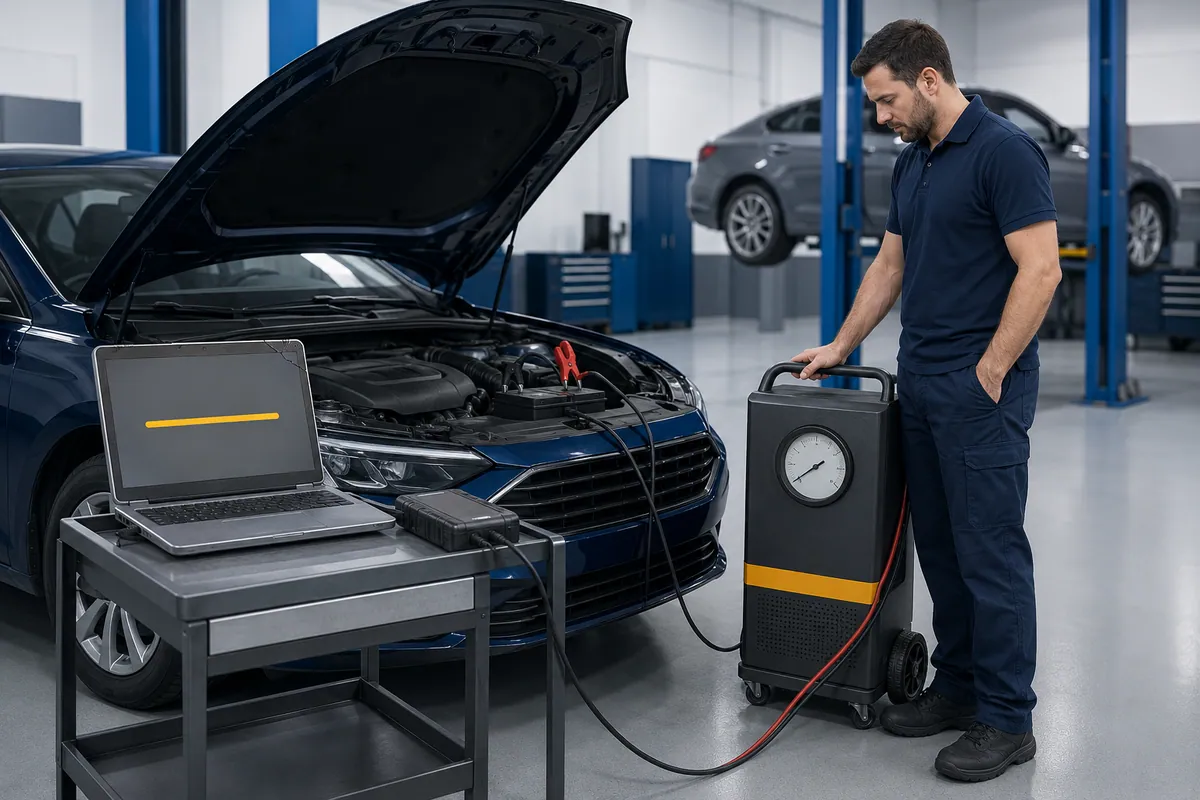

Somewhere in your shop there is a laptop with a cracked corner, eleven saved OEM logins, and four percent battery. It is the most expensive software license you own. At this exact moment it is being used to check fantasy football.
ECU programming is the job that laptop exists for, and the one your shop is almost certainly doing without billing for it properly.
Here is the stake before the argument. Say a flash and its follow-up procedures eat an honest hour and a half of a technician’s day. At the roughly $165 labor rate that accounting firm Paar Melis reported across its client shops’ 2024 books, that is $247.50. Write “software update, no charge” on four of those a month and you handed away about $990 a month, or near $11,880 a year, on work you already performed. Illustrative, and use your own rate.
This is for the owner deciding whether to buy in, and for the owner who already bought in and cannot tell whether it is paying. What the work is, what the tools and subscriptions cost, why modules die mid-flash, what to bill, and what to do about it this week.
You are already in the programming business. Nobody wrote it down
In the 2026 Ratchet+Wrench Industry Survey of more than 430 shops, OEM repair-information access came in as the third biggest industry challenge at 16%, behind the technician shortage at 29% and rising costs at 19%. Owners already name this problem out loud.
What they rarely do is notice it arriving through the back door.
You did not decide to get into programming. A battery replacement needed a registration. A throttle body needed a relearn. A transmission came back and the car would not shift right until somebody wrote the calibration. None of those started life as a programming job. They started as ordinary tickets that quietly grew a software step.
That is the whole reason this gets billed badly. Nobody prices a job they did not know they accepted.
And the car parc is pushing the same direction. Paar Melis puts the average U.S. vehicle age at a record 12.6 years, with the 6-to-14-year band that independents live on projected to grow about 12% between 2020 and 2028. Those are the cars now old enough to need software attention and new enough to have software worth attending to.
J2534 is a federal floor, not a coverage list
Three words get used interchangeably at the counter, so let us separate them. Flashing or reflashing means writing new software onto a module already on the car. Module programming usually means configuring a replacement module so the vehicle accepts it. PCM programming is the same activity, named after the box.
The standard behind most of it is SAE J2534. Bosch Diagnostics, on its own J2534 FAQ, describes it as “an interface standard designed by SAE (Society of Automotive Engineers) and mandated by the US EPA for vehicle ECU reprogramming.”
Now the two sentences on that page that should change how you buy.
Bosch states that “The US EPA regulation mandates that automotive OEMs must comply with SAE J2534 pass-through reprogramming from model year 2004 and forward for their Powertrain ECU’s.” And then the scope: “J2534 pass-thru reprogramming is only required for emissions based ECUs (eg. Powertrain, Engine, Transmission, Throttle Controller).”
Read that twice, because it is the answer to a question shops ask after they spend the money.
The mandate is emissions. Powertrain, engine, transmission, throttle. That is the floor a manufacturer has to meet. Body modules, restraint systems, and comfort electronics are not in it. Immobilizer and security functions are not in it either, and that carve-out is deliberate. The right to repair post covers the legal access framework and its own list of what access actually means in a bay. Its second layer says module programming is where most shops hit the wall. This post is that wall, and I am not re-litigating the statutes here.
So “we have a J2534 tool” and “we can program anything” are two different sentences. Anything past the emissions floor is whatever each manufacturer decided to offer, priced however they liked.
The flash is not the end of the job, which is why these tickets run long
This is the most useful line I found anywhere, and it is printed by a tool manufacturer rather than a magazine.
On that same Bosch page: “J2534 reprogramming application software typically does not incorporate diagnostic Scan Tool functions that must be utilized to perform post-reprogramming tasks.”
Unpack that. The software that writes the calibration is frequently not the software that finishes the job. The relearns, the resets, the idle relearn, the steering angle, the setup routines that make the car behave like a car again often come from a different tool than the one that just spent eleven minutes with a progress bar.
Which explains the thing every service advisor has felt and nobody has named. The download took twelve minutes and the ticket took two hours. The flash was never the work. The flash was the part with a progress bar, and a progress bar is the only part of this job a customer can imagine.
Quote the procedure. Not the download.
What the setup actually costs, and which half is recurring
The interface is the boring number.
Autel’s store lists the MaxiFlash VCI J2534 at a “Limited Sale price $1,300.00”, manufacturer-direct, and states the device works with OEM software such as Toyota Techstream, Volvo VIDA, Honda HDS, JLR IDS, BMW 3G, and Ford Motorcraft. That is less than a mid-grade tire changer for the ability to write software to a car.
The recurring half is the OEM subscription, and this is the part that behaves unlike anything else you buy. It is per manufacturer, and it is usually sold by the day.
DG Technologies, which builds J2534 hardware, publishes sample rates: GM at “$55 for 2 days,” Ford at “$26.95 for 3 days,” Chrysler at “$35 for 3 days,” and notes that “The average charge per flash over time is $25.” The same page lists the requirement in three items: a J2534 pass-thru device, a PC with internet access, and OEM data subscriptions.
Two honest caveats on those numbers. DG builds hardware, so it is a vendor reporting OEM rates rather than the manufacturer’s own page. And no OEM portal published its pricing where I could read it. So treat $25 to $55 as the shape of the cost, and price your own portals for the four or five brands you actually see, because these move.
Keeping current on scan tools and OEM subscriptions is its own spending discipline, and that post owns it. What I want here is narrower and stranger: a two-day subscription is not really a subscription. It is a job cost. Bought for one car, on one afternoon, for one repair order. Hold that thought for the billing section, because it is where the money goes.
Buy the power supply before you buy the interface
Here is the one strong claim in this post, and it will annoy a tool rep or two.
The interface is not the first purchase. The power supply is.
This is the only job in your building whose failure mode is destroying a working computer on a customer’s car. A brake job that goes badly gives you a comeback. A flash that goes badly can leave you holding a module that will never boot again, in a car that will not start, that a customer is expecting at five.
The cause is almost never exotic. It is voltage.
Clore Automotive, which builds this equipment, collected the OEM requirements in one place and quotes a Porsche technical service bulletin on the consequence directly: “If a low voltage condition occurs while being programmed, …the module may be rendered permanently inoperable.”
Permanently inoperable. That is the manufacturer’s own word for it.
The specs on that page are worth knowing before somebody hooks up the shop charger and hopes:
- Porsche asks for “a minimum continuous output capability of 40 Amps at 13.8 VDC under load,” and says the voltage “must never exceed 14.5 VDC for more than a few moments.”
- Across manufacturers, published minimum current requirements run from 55A to 100A, with plenty in between.
- BMW wants 50% to 70% more available current than other manufacturers.
- Honda wants a jump starter connected to augment the battery.
- Subaru delays the diagnostic tool connection until the system stabilizes at 13.5V.
A proper flashing supply holds a target voltage instead of charging toward one. Clore’s own specification for its PRO-LOGIX flashing supplies is an output range of 13.1 to 14.9V, adjustable in 0.1V increments, with stable current on demand up to 100 amps.
I am not going to print a price for one. I looked, and the manufacturer pages that carry the specification do not carry a number, so anything I typed here would be me repeating a reseller. What I can tell you is the comparison that matters: price one against a single replacement module, plus the tow, plus the bay day, plus the phone call where you explain to a customer that their car is worse than when they dropped it off. That comparison is not close, and you can run it with one browser tab and your parts vendor on the phone.
This is the part of the job where you want deliberately boring equipment. Nobody has ever bragged about their power supply. That is the point of it.
What to charge for module programming
Build the price from the inside, the same way you would build any other.
Your posted rate times the realistic time, and realistic means including the post-flash procedures Bosch just told us come from a different tool. If your labor guide says 0.4 and the job honestly takes 1.5, you have a documentation problem, not a pricing problem.
Use the rate you actually collect. Your effective labor rate is the more uncomfortable number, and this kind of work is exactly where posted and collected drift apart, because “it was just a software update” is the easiest discount in the building to give away.
Then recover the subscription on that repair order. Not monthly. Not in overhead. On the ticket that consumed it.
And keep programming time separate from diagnostic time. They are different activities with different justifications, and pricing and defending a diagnostic fee is an argument that post already makes properly. Diagnosis found the module. Programming is what you did about it. Charging once for both is how shops end up performing two jobs and billing one.
In-house, sublet, or the mobile programmer in your parking lot
Volume and platform mix decide this. Not pride.
Sublet honestly when programming shows up a few times a year, or lands on brands your interface covers poorly. There is no shame in it. There is real damage in subletting and then failing to bill the sublet through, which is the same leak that shows up on ADAS calibration invoices, and that post owns the sublet-invoice problem.
Bring it in-house when it shows up weekly on the makes you actually service. At $1,300 for the interface, the arithmetic is not the hard part.
And notice the third option, because it is already happening. A mobile programming specialist who drives to your shop, plugs into a car in your lot, and writes an invoice. Sometimes that is a smart trade. Sometimes it is the same story as the locksmith doing key work in your parking lot: you supplied the bay, the diagnosis, the customer relationship, and the trust, and somebody else supplied twenty minutes and a laptop.
The trap is not any of those three. It is the shop that does the work in-house, with its own tech, on its own laptop, and bills none of it. That shop bought the tool, pays the subscriptions, absorbs the labor, carries the bricking risk, and books the revenue nowhere. It is the only option on the list with no upside.
For groups: the laptop is the asset and the saved logins are the exposure
Multi-store operators have a different problem, and it is not where to keep the interface. Hardware is easy. It rides across town in somebody’s truck on Thursday, same as a scan tool.
The exposure is the laptop and what is saved on it.
Think about what actually lives on that machine. OEM portal credentials for five or six manufacturers, bought on a company card. A browser full of saved logins. Subscription renewals pointed at one email address, which is frequently a person’s address rather than the company’s. A specific Windows build that somebody got working once and nobody dares update.
Three consequences worth a management meeting.
The subscriptions renew whether or not anybody flashes anything. Per-day passes expire cleanly, which is fine. Annual portal access does not, and an annual subscription to a brand that store three stopped seeing two years ago is a quiet standing order nobody reads.
The renewals are pointed at a human. When that human leaves, the receipts stop arriving somewhere you can find them, and access to a paid portal walks out with them.
The machine itself is a single point of failure with no spare. One dying laptop can suspend a service line across every store you own, and the recovery time is however long it takes somebody to rebuild an environment nobody documented.
A test to run before your next meeting. Name the email address that receives your OEM subscription receipts. If it belongs to a person rather than the business, you did not find an IT preference. You found out that a service line you sell is currently registered to somebody’s inbox.
What to do this week
None of this needs a purchase order.
- Pull ninety days of repair orders and search for the words “software,” “update,” “flash,” “reprogram,” and “relearn.” Count how many carried labor. That gap is your number, and right now it is a feeling.
- Add a line to the RO for programming subscription cost. Even at $25, a cost with a home gets billed and a cost without one gets absorbed.
- Check what your labor guide says about the flashes you do most, against what they actually take. Bring the post-flash procedures into the estimate.
- Ask your lead technician what he hooks up to the car during a flash. If the answer is the shop charger, you have found the cheapest risk reduction available to you this quarter.
- Find out whose email the OEM subscription receipts go to.
Then decide with numbers instead of a hunch.
Where WickedFile fits, and where it does not
Limits first, because they are the larger half.
WickedFile does not program modules. It has no opinion about your J2534 interface, holds no OEM subscription, will not tell you which platform needs which procedure, and cannot stop a module from bricking. It is not a scan tool and it is not your shop management system.
What it notices is narrower, and it is the leak this whole topic creates.
A short-term OEM subscription is a job cost with no part number. It is bought on a card, in the middle of an afternoon, for one specific repair order. There is no vendor invoice with a line item on it. There is an email receipt, and email receipts do not reconcile against anything.
Years ago at a conference, somebody stopped by our booth, heard what the software did, and said: “Why would anyone keep invoice history? I just throw all that away.” Another owner standing there could not believe what he was hearing, and the two of them ended up arguing about whether keeping auditable records was necessary at all. I think about that conversation whenever a shop tells me their programming costs are “in overhead somewhere.” Overhead somewhere is the same filing system, with better branding.
The fix is mostly not software. It is deciding that the subscription belongs to a repair order and writing it there. Do that with a sticky note on the laptop and you have solved it. Do it consistently and you will find out whether this service line makes money, which is a question most shops selling it genuinely cannot answer.
So go find the laptop. Charge it, then start charging for it. And plug the car into something that holds 13.8 volts like it means it, because the most expensive brick in your building should be the one holding the door open.