
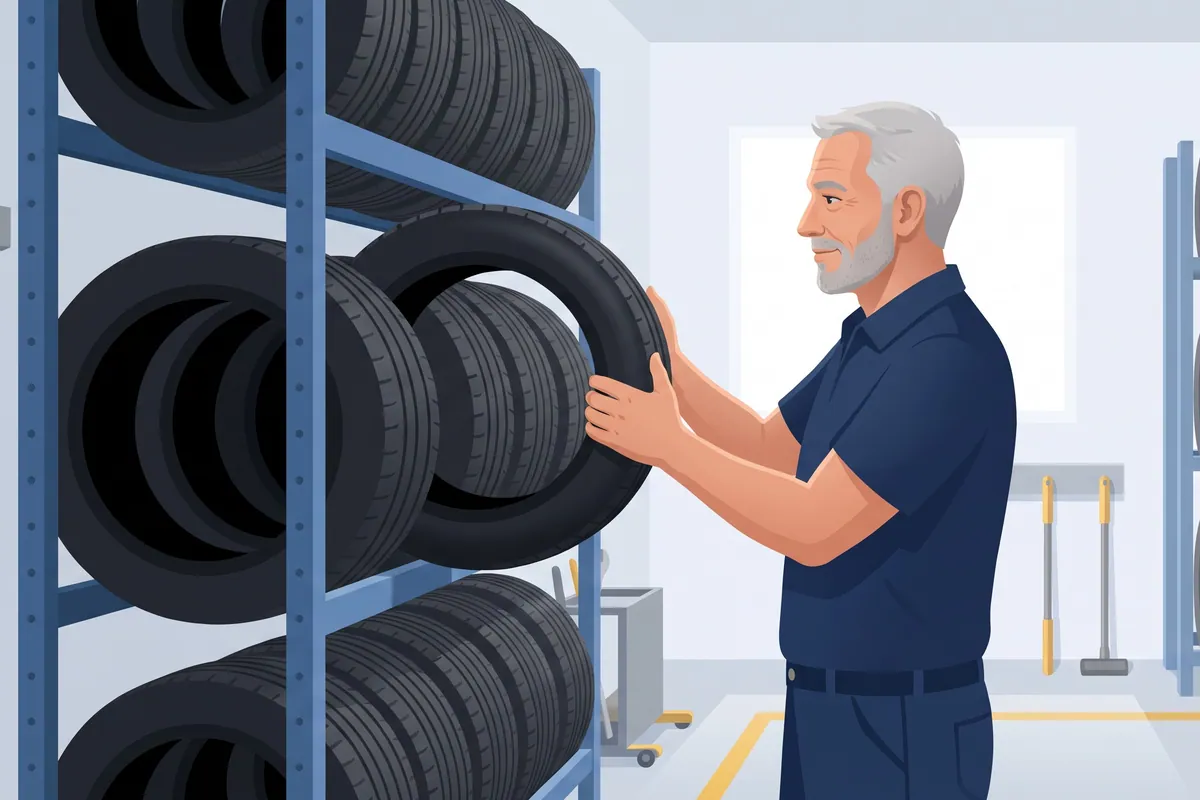

Tire racks are steel shelving built to hold tires standing on their tread, so a shop can store tire inventory and customer tires up off the floor where everyone can see them. The right tire storage rack turns a pile into rows.
Every shop also has the one set of four tires in the corner that nobody has claimed since April. Nobody throws them out, because everyone knows the customer will call the day after you do. (At some point those tires stop being storage and start being furniture.)
Full disclosure: I run WickedFile, which reads tire invoices, credit memos and statements and flags the duplicate bills and missing credits. That’s the paperwork side of tire storage. The rack advice comes first, and it works with or without us.
Which tire racks fit a repair or tire shop?
Commercial tire storage comes in four basic shapes. Pick by how many tires you hold and how often they move.
Beam racks that hold tires on their tread. This is the workhorse. Two upright frames, pairs of beams, and tires standing side by side on each level. Lyon’s heavy-duty wheel and tire storage rack is a good example of the spec to look for. In November 2026, Lyon listed the starter section at $736.36. It’s 60 inches wide, 18 inches deep and 84 inches high, with three adjustable levels and 2,600 lb of capacity per level.
Lighter tire shelving. Same idea, lighter steel, lower price. Store More Store’s tire racks listed a 60 by 15 by 84 inch rack without casters at $275.88 on sale, and a 120 inch tall version at $382.36, also on sale. Fine for passenger tires. Read the capacity before you load it with light truck tires.
Mobile racks on casters. Good for seasonal changeovers, where a customer’s set rolls from storage to the bay and back. The same Store More Store page listed a 67 inch rack with casters at $539.38 on sale.
Stack racks and high-density systems. Truck tires get stacked in portable frames. Big tire operations use multi-level or carousel systems. Those are usually quoted per project, so I won’t print a number.
For a single tire rack for shop use, start with one beam section, load it, and confirm your math before you buy the rest of the wall.
Size a tire storage rack by counting tires, not floor space
Here’s where most rack plans go wrong. The owner measures the wall, buys racks to fill it, and then discovers the rack holds fewer tires than the pile did.
Do it in this order instead:
- Count your peak. Inventory plus customer seasonal sets, on your busiest week of the year.
- Measure a real row. Stand five of your most common tires on the floor, side by side, and measure the row. Divide 60 inches (or your beam length) by the width of one tire. That’s tires per level.
- Multiply by levels. Tires per level times levels per section gives tires per section.
- Check the weight. Multiply tires per level by the weight of your heaviest common tire, and compare it to the rated capacity per level.
- Add growth room. Then add one more section for the oversized tires that never fit the plan.
An illustrative example: if 7 tires fit on a 60 inch beam and the rack has 3 levels, that’s 21 tires per section. A shop holding 200 tires at peak needs about 10 sections. At Lyon’s listed starter price, that’s $7,364 for 10 sections. Ask your dealer about add-on sections and freight before you treat that as the budget.
Where the rack goes matters too. Continental Tire’s storage tips say to keep tires cool, dry and out of direct sunlight, and “away from things like electric motors, furnaces, switches, and sump pumps because they are sources of ozone.” It also says to store tires vertically rather than stacked where possible, and off the bare ground.
Which means the corner behind the air compressor, the one spot in every shop with free wall space, is exactly where the tires shouldn’t go. There’s a reason it’s free.
Your tire rack holds two kinds of tires, and only one is yours
This is the part rack catalogs skip. A shop’s tire racks usually hold two very different things:
- Your inventory. Tires you bought from a vendor, on an invoice, that you’ll sell on a repair order.
- Customer property. Seasonal sets and take-offs you’re holding for someone else.
They look identical. They are not the same on your books. One is an asset you paid for. The other belongs to your customer, and you’re just holding it.
Keep them physically separate. Give customer tires their own section, tag every tire with the customer name and the repair order number, and keep a simple log that ties each rack spot to a customer. When the customer comes back in October, nobody should be reading sidewalls to find their set.
If you charge for seasonal storage, it’s a real revenue line. Say you store 100 sets and charge $80 a season (illustrative, set your own price). That’s $8,000 a season. Lose one set, and replacing it costs most of what ten customers paid you. The log is cheaper.
Tire invoices are where the money on the rack goes missing
The rack is the easy part. Every tire on it came with an invoice, and tire invoices carry more lines than most parts invoices.
Federal excise tax. Under 26 U.S.C. 4071, the manufacturer, producer or importer owes 9.45 cents for each 10 pounds of a tire’s maximum rated load capacity “as exceeds 3,500 pounds.” Biasply and super single tires run at 4.725 cents. If FET gets passed through on your invoice, you can check it.
Here’s illustrative math for a truck tire rated at 6,000 lb:
- Correct: (6,000 minus 3,500) divided by 10 is 250. 250 times $0.0945 is $23.63 per tire.
- Wrong, calculated on the full 6,000 lb: 600 times $0.0945 is $56.70 per tire.
On a 20 tire order, that’s $472.50 versus $1,134. A $661.50 difference, on one line, on one invoice. And a tire rated at 3,500 lb or less owes nothing under the formula, so FET on a tire like that deserves a phone call.
Disposal and casing charges. Your vendor’s disposal charge is a cost, separate from the state tire fee your customer pays. If you want the full breakdown, here’s what a tire disposal fee is and who keeps it.
Duplicates and partial deliveries. A pallet of 40 tires that arrives in two drops can produce two invoices for the same 40 tires. At an illustrative $110 a tire, that’s a $4,400 mistake that looks perfectly normal on a statement.
Returns and warranty credits. A tire that goes back for the wrong load range is a credit you’re owed. Until the credit memo shows up on the statement, it’s still your money sitting at the vendor.
Vendor mistakes on tire invoices are more common than you’d think
Good tire vendors still make mistakes. Credits don’t get applied. Statements carry the same invoice twice. A load range gets billed wrong. A split delivery gets billed whole, twice.
Reviewing them isn’t about distrusting your vendor. Your rep is probably great. It’s about the fact that a busy distributor processes thousands of lines a week, and some of them are going to be yours.
Here’s the weekly check I’d run by hand:
- Pull every tire invoice from the week. Paper, email and portal.
- Match each one to what arrived. Count against the packing slip, not the invoice.
- Match each one to a repair order or to stock. If a tire was ordered for an RO, the RO number should be the PO number on the invoice.
- Check the extra lines. FET against the formula, disposal against your agreement, freight against your terms.
- Log every return until the credit memo arrives.
- At month end, tie the statement to your log before you pay.
That’s maybe an hour a week for a busy tire shop. If you want the bigger picture, how vendors overbill on invoices covers the patterns that show up across every parts category.
Counting the rack only works if someone also checks the bills that filled it
You can count every tire on your racks and still lose money, because the count tells you what’s there. It doesn’t tell you what you paid for. That’s the gap WickedFile was built for.
Here’s what it does for a tire business:
- Reads the documents. Tire vendor invoices, credit memos and statements, scanned or uploaded.
- Matches them to repair orders. It pulls ROs from your shop management system and ties each invoice to a job, so a tire bought for an RO but never sold shows up.
- Matches them to money. It connects to QuickBooks Online and to bank and card feeds through Plaid, so a payment with no invoice, or an invoice with no accounting entry, gets flagged.
- Flags what’s off. Duplicate invoices, statement lines with no supporting document, returns still waiting on credit, and fees and charges that eat margin.
The best way to spend the free trial (500 scanned pages, no credit card) here: take last month’s statement from your biggest tire vendor and every invoice and credit memo behind it. Upload them and see what doesn’t tie. For most shops that’s a few hundred pages.
What it doesn’t do: it won’t count your rack, label customer tires or run your seasonal storage log. It isn’t a tire shop management system, so your counter stays in your tire shop management software. It isn’t a payment processor, and it doesn’t replace QuickBooks or your bookkeeper. After the trial, the Grow plan is $299 a month, flat.
Run your tire vendor’s statement through the free trial →
A tire rack plan you can start this week
- Count your tires at peak, inventory and customer sets separately.
- Measure a real row of your most common size and do the math.
- Pick the spot away from the compressor, the furnace and the sunny window.
- Buy one section, load it, and confirm the math before you buy ten.
- Tag every customer tire with a name and RO number.
- Start the weekly invoice check the same week the racks go up.
If you want to go further on counts, cycle counting versus a full physical inventory explains how to keep stock numbers honest without shutting the shop for a day.
And that set of four in the corner? Call the customer one more time, then tag it and give it a proper spot on the rack. It’s been there long enough to have earned one.