
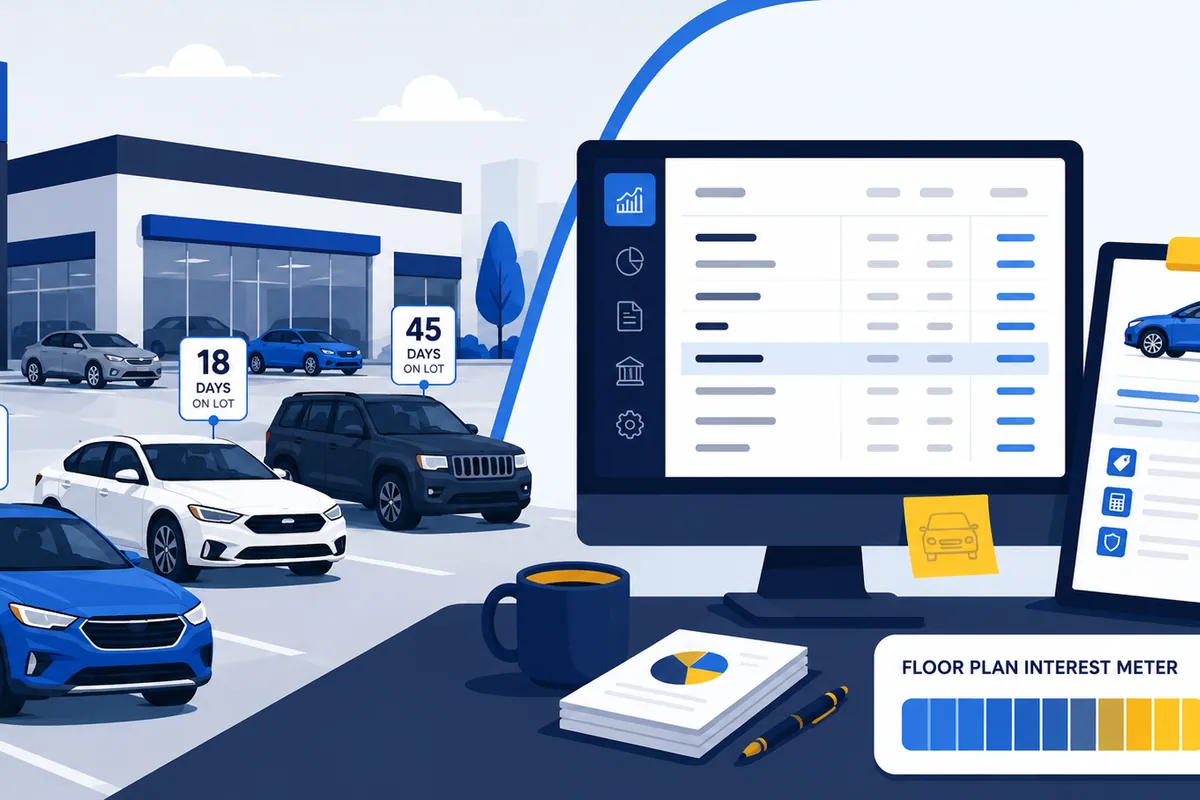

A car dealership runs on one ironclad financial law: the lot is never wrong, the spreadsheet is never right, and the floor-plan interest never sleeps. (My accountant told me that last part. I told him it was poetry. He told me to pay the interest.) If you sell vehicles for a living, your accounting software is doing more heavy lifting than any other tool you own, and most dealers never stress-test the choice until month-end goes sideways.
This guide to accounting software for car dealerships is for car dealers and dealership bookkeepers, the people who buy and sell vehicles, floor inventory, and run F&I. It is not for independent repair shops. If that is you, the financial model is genuinely different, and you want our auto repair accounting software guide instead. Go on. We will hold the door.
Still here? Good. Let’s talk about the actual options for accounting software for car dealerships, what each one is genuinely good at, and the quiet place your margin tends to leak.
What dealership accounting software actually has to do
A dealership is not a normal business with a chart of accounts bolted on. It is an inventory business where the inventory costs tens of thousands of dollars per unit, sits on borrowed money, and changes value while it waits.
So dealership accounting has a heavier job than ordinary small-business books. It has to handle:
- Vehicle cost accounting. Acquisition price, recon, transport, and reconditioning, all attached to a specific VIN until that unit sells.
- Floor-plan interest. Borrowed money against floored inventory, accruing daily, eating margin on every car that ages on the lot.
- F&I accounting. Finance reserve, warranty, GAP, and product income, each posting to the right account on the right deal.
- Deal-level profitability. Front gross, back gross, and total gross per unit, not just a monthly P&L that says “we did fine.”
- OEM financial statements. Franchise stores owe their manufacturer a statement in the manufacturer’s exact format, every month, no exceptions.
That last one is the great divide. A franchise Ford or Toyota store has to produce an OEM-formatted financial statement. An independent used-car lot does not. That single requirement pushes most franchise dealers toward a DMS with native accounting and lets a lot of independents live comfortably on QuickBooks. Keep it in mind as we go. If you want the practice itself rather than the tools — how car dealership accounting actually works, from vehicle cost to the OEM statement — that is its own guide.
Two models of accounting software for car dealerships: native DMS vs QuickBooks-connected
Before the list, understand the fork in the road, because every option below is on one side of it.
Model one: native DMS accounting. The books live inside the same system that runs sales, service, parts, and F&I. One system, one data core, no exporting. This is Dealertrack, CDK Drive, Reynolds, PBS Systems, Autosoft, Tekion, Frazer, and DealerCenter. The upside is that vehicle cost and the deal never separate. The downside is you are married to the DMS for your accounting too.
Model two: standalone accounting (QuickBooks or Xero). The books live in general accounting software, and the DMS or your team feeds the financial data in. The upside is your accountant lives in software they already know, and it is cheaper to start. The downside is you are trusting an integration — or manual entry — to keep two systems honest.
Neither is wrong. I have seen sharp dealers thrive on both. The mistake is picking blind.
The 10 real options for accounting software for car dealerships
I researched these live rather than from memory, because a stale software list helps nobody. Each entry gets one thing that genuinely sets it apart, because “it has accounting” describes all of them and tells you nothing.
Quick comparison
| Software | Maker | Best for | Accounting model | Standout differentiator |
|---|---|---|---|---|
| QuickBooks | Intuit | Small lots, the books layer | General ledger (not dealer-specific) | The universal standard your CPA already speaks |
| Xero | Xero | Small lots wanting simple, affordable books | General ledger (not dealer-specific) | Unlimited users on every plan, no per-seat fee |
| Dealertrack DMS | Cox Automotive | Franchise & multi-rooftop | Native, real-time | Intercompany accounting + vAuto/VinSolutions cross-platform reporting |
| CDK Drive | CDK Global | Large franchise stores | Native GL/AP/AR | Deep, entrenched franchise ecosystem + ADP payroll GLI |
| Reynolds (ERA-IGNITE) | Reynolds and Reynolds | Large franchise stores | Native GL/AP/AR | One of the “big two,” built as a single Retail Management System |
| PBS Systems (v10) | PBS Systems | Franchise & independent groups | Native, real-time | North American DMS with its own in-house support |
| Tekion ARC | Tekion | Dealers wanting one cloud platform | Native, live GL posting | Single cloud data core, built AI-native from day one |
| Autosoft DMS | Autosoft | Mid-size franchise | Native, real-time | Single-click month-end close + built-in PO tool for vendor spend |
| DealerCenter | Nowcom | Independent & BHPH | BHPH portfolio + QuickBooks add-on | Native buy-here-pay-here collections module |
| Frazer | Frazer | Independent used-car | Native full GL | 19,000+ dealers since 1985 at a low flat price |
Prices are deliberately absent from most rows. Enterprise DMS vendors quote rather than publish, and I would rather tell you nothing than tell you a number I can’t stand behind.
1. QuickBooks (Intuit) — the books layer, not the dealership
QuickBooks is the most common accounting software on earth, and plenty of small lots run on it. Your CPA already knows it, every bank feed connects to it, and it produces a clean P&L and balance sheet.
The catch is dealership-specific. QuickBooks does not treat a vehicle as an asset moving through acquisition, recon, transport, floor-plan interest, and sale. Those costs get tracked separately and entered later, which is why deal-level profit on a QuickBooks-only lot usually gets rebuilt in a spreadsheet. Floor-plan interest works, but only with a manual setup: a liability account for the principal, an expense account for the interest, posted by hand.
Differentiator: it is the universal accounting language. Whatever DMS you pick, your accountant probably wants the numbers to land here eventually. Online versus Desktop matters less than it used to; Intuit is steering everyone to Online, and the dealership gap is identical on both.
2. Xero (Xero) — the simple, affordable books layer
Xero is cloud accounting software for small businesses, and it sits in the same lane as QuickBooks Online: a clean general ledger, AP, AR, bank reconciliation, and financial statements. It is not dealer-specific. A small lot can run its books here the same way it would on QuickBooks, with the same caveat about deal-level cost living in a spreadsheet.
The reason a small dealer calls it out is the user model. Every Xero plan includes unlimited users at no extra cost. QuickBooks Online charges by seat. If you want the owner, the bookkeeper, and the CPA all in the books without paying per head, that math gets friendly fast.
Differentiator: unlimited users on every plan, plus a large app marketplace. The interface is cleaner than a lot of dealers expect, and Xero is the other standalone option when you are not committed to QuickBooks. For a small lot that wants simple, affordable books and more than one person in them, it is a real alternative.
3. Dealertrack DMS (Cox Automotive) — built for the multi-rooftop group
Dealertrack DMS is the dealer management system inside Cox Automotive, the same family as vAuto, VinSolutions, and Manheim. Its accounting is real-time, with general ledger, AP, AR, and OEM financial statement support baked in.
Differentiator: intercompany accounting and cross-platform reporting. If you run multiple rooftops, Dealertrack handles the intercompany side and ties accounting back into vAuto and VinSolutions so you can see the picture from lead to close to service across stores. That Cox ecosystem connection is the whole pitch, and for a group it is a real one.
4. CDK Drive (CDK Global) — the entrenched franchise standard
CDK Drive is one of the most established franchise DMS platforms in the country, with a full accounting system: chart of accounts, AP/AR, and financial reporting that meets OEM requirements. Payroll journal entries flow in from ADP’s General Ledger Interface, and AP invoice handling can be extended with Yooz.
Differentiator: the depth and gravity of the franchise ecosystem. CDK has been the default at large franchise stores for years, with integrations and OEM relationships that run deep. That entrenchment is exactly why some dealers love it and some feel locked in. Both reactions are fair.
5. Reynolds and Reynolds (ERA-IGNITE) — the other half of the big two
If CDK is one of the two enterprise franchise standards, Reynolds and Reynolds is the other. The company has sold to dealers since 1866, back when it printed business forms. Today its DMS is ERA-IGNITE, with native accounting: general ledger, AP, AR, parts, service, F&I, and OEM-format financial statements all in one system.
Reynolds frames the whole thing as a Retail Management System, not a stack of modules. The pitch is that sales, service, parts, F&I, and accounting were built to run as one platform from one company, with posting errors caught and corrected inside the same workflow that created them.
Differentiator: it is one of the big two, and it is deliberately a single-company, single-platform system. Some dealers value that everything comes from and is supported by one vendor. Others find that same single-vendor model rigid. Like CDK, it is enterprise, it is quoted not published, and the reaction depends on how much you want one company holding the whole store.
6. Tekion ARC (Tekion) — the single-platform cloud bet
Tekion’s Automotive Retail Cloud unites the DMS, CRM, service, payments, payroll, and accounting on one cloud platform. Accounting features live GL posting and automated reconciliation, and the whole thing was built cloud-native from day one rather than ported from older software.
Differentiator: one data core, one login, no integrations between modules. Sales, service, parts, F&I, and accounting share the same underlying data, so a transaction does not get copied between systems. It is the cleanest version of “everything in one place,” for dealers willing to commit to the platform.
7. Autosoft DMS (Autosoft) — month-end without the marathon
Autosoft DMS runs the full store with built-in accounting: financial statements, journal entries, reconciliation, and cash-flow monitoring, with real-time posting.
Differentiator: the single-click month-end close and a built-in purchase-order tool for overseeing third-party vendor spend. Custom dashboards let the accounting office browse pending and posted transactions, and the close process is designed to be one process rather than a week of reconciling. For a mid-size franchise store, that close-day sanity is worth a lot.
8. PBS Systems (v10) — the North American DMS with its own support
PBS Systems is a dealer management system out of Calgary that has worked only on automotive dealerships since 1988. Its v10 platform brings accounting, sales, service, parts, and CRM into one system, with department-level real-time financials and native AP, AR, and general ledger. It serves both franchise and independent stores, with more than 3,500 rooftops across North America, and runs cloud or on-premise.
Differentiator: the in-house, single-company model. PBS builds, runs, and supports its own platform with its own North American support team rather than handing you off to a third party. For a franchise or independent group that wants integrated accounting and a vendor that picks up the phone, that owned-support reputation is the draw. It is the same single-platform tradeoff as the big two, at a different scale.
9. DealerCenter (Nowcom) — built for buy-here-pay-here
DealerCenter is a cloud all-in-one aimed squarely at independent and BHPH dealers, with inventory, CRM, desking, and a native buy-here-pay-here portfolio module covering collections, side notes, and loan modifications. Accounting runs through a QuickBooks integration rather than a full native ledger.
Differentiator: the native BHPH collections and portfolio engine. If you carry your own paper, DealerCenter manages the receivable side as a first-class feature, not a bolt-on. The core BHPH module is listed around $50 a month, with the QuickBooks integration a paid add-on — the rare DMS that shows you a price up front.
10. Frazer (Frazer) — the independent used-car workhorse
Frazer has served independent used-car dealers since 1985 and counts more than 19,000 dealers across the U.S. It includes a full accounting suite with a detailed, customizable general-ledger chart of accounts, plus inventory, VIN decoding, and a deep library of forms.
Differentiator: longevity and price. Frazer is famous for a low flat monthly cost and free unlimited support, which is why so many small independents have run on it for decades. It is not flashy. It is the truck that always starts.
My one strong opinion: pick by deal volume, not by feature list
Here is where I will get a little opinionated, because somebody should.
Dealers shop accounting software the way they shop trucks: by the spec sheet. They compare feature checklists, watch nine demos, and pick the one with the longest list of modules. That is backwards.
The feature lists all rhyme. Every option above does general ledger, AP, AR, and financial statements. The thing that actually decides whether you are happy in eighteen months is not features. It is deal and unit volume, and whether your software keeps deal-level cost attached to the ledger.
A 15-car-a-month independent lot does not need an enterprise DMS. It needs QuickBooks, or Frazer, or DealerCenter, and a disciplined process. Buying a heavyweight franchise DMS for that store is paying for a feature list you will never touch.
A 200-unit franchise store running on QuickBooks alone is the opposite mistake. At that volume, vehicle cost, floor-plan interest, and F&I income drift away from the ledger and get rebuilt in spreadsheets that nobody fully trusts. That store has outgrown the books and is paying for it in close-day chaos.
Match the software to the volume. Process beats feature list, every time.
The leak nobody puts on the demo: floor-plan interest on aged units
Let me show you the quiet one with real numbers. Call it illustrative, because your floor-plan rate and aging will differ.
Say you floor a $30,000 used unit. Your floor-plan line charges roughly 8% annual interest, which is about $6.58 a day on that car. (Thirty grand times eight percent, divided by 365. The lot may be wrong sometimes, but the math never is.)
A unit that sells in 30 days costs you about $197 in floor-plan interest. Annoying, but priced in.
A unit that ages to 120 days costs you about $789 in interest before it ever sells. That is real front gross, gone, on one car, because it sat.
Now run it across the lot. If five units a month drift from a 45-day target to 110 days, that is roughly an extra $428 of interest each, about $2,140 a month, north of $25,000 a year in floor-plan interest you did not have to pay — purely from aging, not from anything on a demo screen.
Here is the part that matters for software. Native-accounting DMS platforms track floor-plan interest by design. QuickBooks-only lots post it by hand. In either case, the number is only as honest as your willingness to reconcile interest against actual days on lot. The software can hold the data. It cannot make you look at it.
Where parts and vendor invoices fit — one honest aside
One last thing, and then I will stop selling you software you may not need.
Your dealership has a service department and a parts counter. That side of your building has the exact same vendor-invoice headaches an independent repair shop has: parts billed but never sold, returns that were never credited, cores that never came back, vendor statements nobody fully reconciles before paying. Your dealership accounting software records what gets entered. It does not audit whether the vendor invoice behind the entry was correct.
That is a real and separate problem from picking a DMS, and it is the one corner of this where invoice reconciliation software is worth a look — not for the vehicle side, for the parts-and-service side. That is honestly the only place our world touches yours. No pitch beyond that. If your service department’s vendor credits all reconcile cleanly, you do not need it.
The short version
Accounting software for car dealerships comes down to a fork: native DMS accounting that keeps deal cost attached to the ledger, or a DMS that pushes clean data into QuickBooks or Xero. Match the choice to your deal volume, not to whoever has the longest feature list. Then actually watch floor-plan interest on aged units, because that is the bill that grows while you stare at demos.
For the broader landscape, see our overview of automotive software and the deeper dive on automotive ERP software if you are weighing an all-in-one platform. To untangle dealership F&I versus shop accounting, automotive finance software draws that line. And if a QuickBooks-connected DMS is your path, the same QuickBooks best practices apply on the books side.
Pick the right system, reconcile the interest, and the only thing aging on your lot will be the coffee in the break room.