
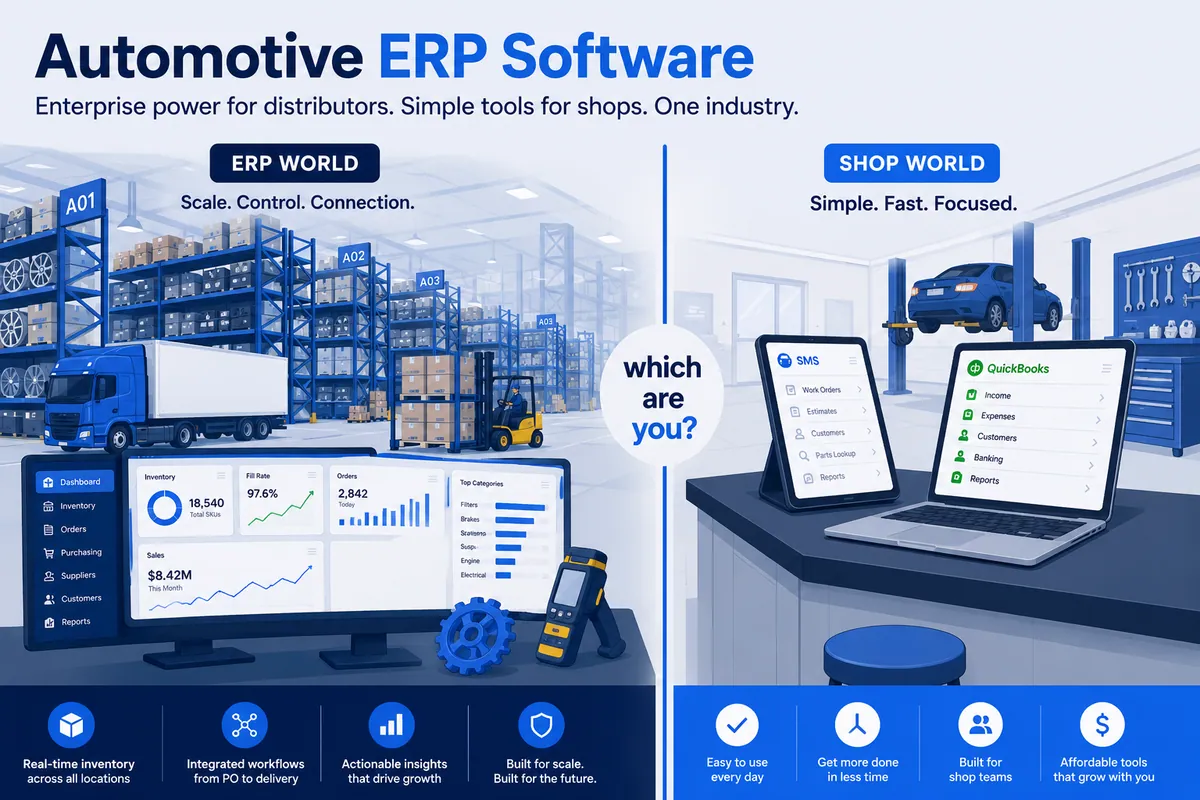

If you’ve been searching for automotive ERP software, here’s the most useful thing I can tell you before you spend a dime: you probably don’t need one. (I know, terrible sales pitch. Stick with me.) Automotive ERP software is a heavier, broader category built for parts manufacturers, large distributors, and big dealer groups — not the shop fixing cars in three bays down the street.
I grew up in my dad’s repair shops. I’ve swept the floors, ordered the parts, and done the bookkeeping. So when an owner tells me they’re looking at a six-figure ERP because money feels like it’s slipping away, I get a little protective of their wallet. This guide explains what automotive ERP actually is, who genuinely needs it, the real platforms in 2026, and the much cheaper path that fits almost every repair operation instead.
This is written for the owner and the multi-shop operator. Not the customer in your waiting room. The goal is to save you from buying a $100,000 system to fix a $300-a-month problem. Read it in six minutes. Decide in one.
ERP means “enterprise,” and your shop probably isn’t one
ERP stands for Enterprise Resource Planning. An ERP system is one integrated platform that runs the core functions of a business — accounting, inventory, purchasing, production, supply chain, sometimes CRM and HR — off a single shared database. Every department reads from and writes to the same numbers in real time.
“Automotive ERP software” is that idea pointed at the car business. It’s what a company buys when it has to coordinate a factory floor, multiple warehouses, thousands of SKUs, procurement, and a general ledger in one connected system. When the marketing says “single source of truth,” this is what it means. Finance, the warehouse, and the production line all looking at the same data instead of emailing spreadsheets at midnight.
That’s genuinely powerful — for the businesses that need it. The key word is enterprise. ERP is built to wire together many departments and often many legal entities. A repair shop has a counter, a few bays, and a back office. The match usually isn’t there.
Three kinds of business actually need automotive ERP
Automotive ERP earns its cost in three kinds of operation, and you can usually self-identify in one sentence.
- Parts and component manufacturers. If you make automotive parts — stamping, machining, injection molding, assembly — you’ve got production scheduling, bills of materials, and shop-floor data that all have to tie back to finance. Textbook ERP job.
- Wholesale parts distributors. If you stock and ship parts at scale across multiple warehouses, you’re juggling complex inventory, demand forecasting, procurement, and order fulfillment. Distribution-grade ERP is where large auto parts distributors pull it all together.
- Large dealer groups and big multi-entity operators. When you’re running many rooftops as separate legal entities and need consolidated financials, intercompany accounting, and group-wide reporting, ERP starts to make sense.
Notice what’s not on that list. The independent repair shop. The multi-location repair group. Even a sharp operator running ten or eleven stores is closer to “several shops that share an owner” than “an enterprise that manufactures and distributes.” That distinction is the whole decision.
The real automotive ERP software platforms in 2026
If you genuinely are a manufacturer, distributor, or large group, these are the platforms you’ll actually see on a shortlist. I’m naming them accurately and staying in my lane on what each one is for. Don’t read capabilities into this table that a vendor demo hasn’t shown you.
| Platform | Best for | What it actually is |
|---|---|---|
| NetSuite | Multi-entity groups, finance-led | Cloud ERP suite; strong financials and consolidation across entities |
| Acumatica | Growing mid-market | Cloud ERP with distribution and manufacturing editions; consumption-based licensing |
| Epicor Prophet 21 | Wholesale parts distribution | The established distribution ERP; widely used by large distributors |
| Epicor Vision | Automotive aftermarket distribution | Aftermarket-specific distribution management, separate from Prophet 21 |
| SYSPRO | Manufacturers and distributors | Mid-market ERP with deep manufacturing and inventory roots |
| Plex | High-volume manufacturers | Cloud manufacturing ERP/MES (a Rockwell Automation company) |
| QAD | Automotive supply-chain manufacturers | ERP with strong automotive supplier and supply-chain focus |
| DELMIAworks | Discrete/repetitive manufacturers | Formerly IQMS; manufacturing ERP/MES suite, now part of Dassault Systèmes |
A few honest notes, because the naming trips people up. Epicor sells two different things that both touch automotive: Prophet 21 for wholesale distribution and Vision for aftermarket distribution. They are not interchangeable. DELMIAworks was IQMS before Dassault acquired and rebranded it. Plex is owned by Rockwell Automation. None of these is a repair-shop product. None of them is what you bolt onto a Tekmetric or Shop-Ware operation.
ERP, shop management software, and accounting software are three different animals
This is where most of the confusion lives. Let’s separate the three cleanly.
Shop management software (SMS) — Tekmetric, Shop-Ware, Mitchell 1, NAPA TRACS, Protractor, Fullbay, RO Writer — runs the front of the shop. Repair orders, scheduling, the parts matrix, technician dispatch, customer texts, parts ordering. It’s the operating system of the bay.
Accounting software — almost always QuickBooks, sometimes Sage or Xero — runs the books. General ledger, P&L, balance sheet, payroll, sales tax, payables and receivables. It’s the system of record for your money. We get into where it falls short in our guide to auto repair accounting software.
Automotive ERP tries to be the back end of an enterprise — production, multi-warehouse inventory, procurement, supply chain, and finance — in one platform. For a manufacturer or distributor, that consolidation is the point. For a repair shop, the SMS already covers the front and QuickBooks already covers the books, so ERP mostly buys you a second copy of what you have at roughly ten times the price.
Put simply: an SMS is built for the bay, accounting software is built for the books, and ERP is built for the factory and the warehouse. If your business is fixing cars, the first two are your stack. Not the third.
Run the math before you sign anything
Almost every shop tells me the same thing. Money is leaking, the numbers feel fuzzy, and somewhere a sales rep convinced them a bigger system is the cure. So let’s run the dollar math. Illustrative numbers, but the shape is real.
Say you’re a strong eight-shop group looking at a mid-market automotive ERP. Licensing alone might run $4,000–$8,000 a month. Implementation — data migration, configuration, integrations, training — commonly costs as much as the first year of licensing. Call it another $60,000–$100,000 up front. You’re well into six figures in year one, plus months of disruption while everyone learns a system that wasn’t built for repair.
Now the alternative for that same eight-shop group. A shop management system at roughly $200–$400 a month per location is $1,600–$3,200. QuickBooks at around $90–$200 a month for the group. And a parts-invoice reconciliation layer at $299 a month flat. Even at the high end, that’s under $4,000 a month total. No six-figure implementation. Every tool purpose-built for repair instead of retrofitted from a factory.
The ERP buys you consolidation you mostly don’t need. The leaner stack buys you the thing you actually do need — eyes on where parts margin is going. (This is the “we’re gonna need a bigger boat” moment of your P&L, except the boat is fine. You just stopped looking in the water.)
The honest exception: if your group has genuinely grown into manufacturing, large-scale distribution, or a real multi-entity finance structure, revisit ERP seriously. For everyone else fixing cars, keep reading.
The stack that actually fits a repair shop
For nearly every repair operation, the right setup is three pieces, not one monolith. We lay it out in full in our guide to the right software stack for a shop, but here’s the short version.
- A shop management system to run the front. Pick the one that fits how your techs and advisors actually work.
- QuickBooks to run the books. It’s the standard for a reason, and your accountant already speaks it. For groups, here’s how we’d handle multi-location back-office accounting.
- A reconciliation layer between the two — because this is the piece both the SMS and the books are blind to.
That third piece is the one most shops are missing. And it’s the real reason owners go looking at ERP in the first place. They feel money slipping, so they assume they need a bigger system. They don’t. They need someone watching the parts invoices.
Here’s the opinion I’ll defend with a number: most shops don’t have a theft problem, they have a visibility problem. Your SMS knows what you intended to sell. QuickBooks knows what you recorded. Neither one checks whether a vendor invoice line actually matches the repair order it was bought for. So a missing credit slides through. An uncredited core never comes back (cores aren’t homing pigeons). A part gets bought, never sold, and never credited. None of it is dramatic enough to notice on its own. Stack a few dozen $40 and $200 misses across eight locations and twelve months, and you’ve quietly funded a very nice boat you’ll never get to drive.
An ERP, for all its scope, doesn’t natively audit a vendor invoice line against the RO it was bought for. A reconciliation layer does exactly that, and only that. If you want the category in depth, start with invoice reconciliation software, and for the wider map of tools see our overview of automotive software categories.
Where WickedFile fits, and why it is not an ERP
Let me be flat about this. WickedFile is not an ERP. It does not run your general ledger, manage production, plan your supply chain, or replace your shop management system or your accounting software. It doesn’t process payments, issue cards, or handle AR and invoicing either. If you came here looking for the system that runs your whole company off one database, that’s not us, and I’d rather tell you now than waste your demo.
WickedFile is the reconciliation layer — the third piece above. It sits between your SMS, your vendor invoices, your QuickBooks, and your bank feeds, and it surfaces what each of those alone can’t see: parts priced off-matrix, advisor discounting, uncredited cores and returns, and parts bought but never sold or credited. It’s narrow on purpose. It does one job an ERP doesn’t do at all, and that your existing stack doesn’t do well.
That focus is also why it’s $299 a month flat instead of six figures, and why a multi-location group can stand it up in days instead of the months an ERP rollout eats. You keep the SMS your techs like and the QuickBooks your accountant trusts, and you add the one missing layer that protects the margin those systems generate. You can start a free trial (500 scanned pages, no credit card) or compare your options first.
So here’s the takeaway. If you manufacture or distribute parts, go evaluate a real ERP from the list above — and good luck, those rollouts are a journey. If you fix cars, skip the ERP, keep your stack lean, and put the reconciliation layer where the money’s actually leaking. Trust your people. Verify your parts invoices. And keep the six figures for something that’ll actually move a car.